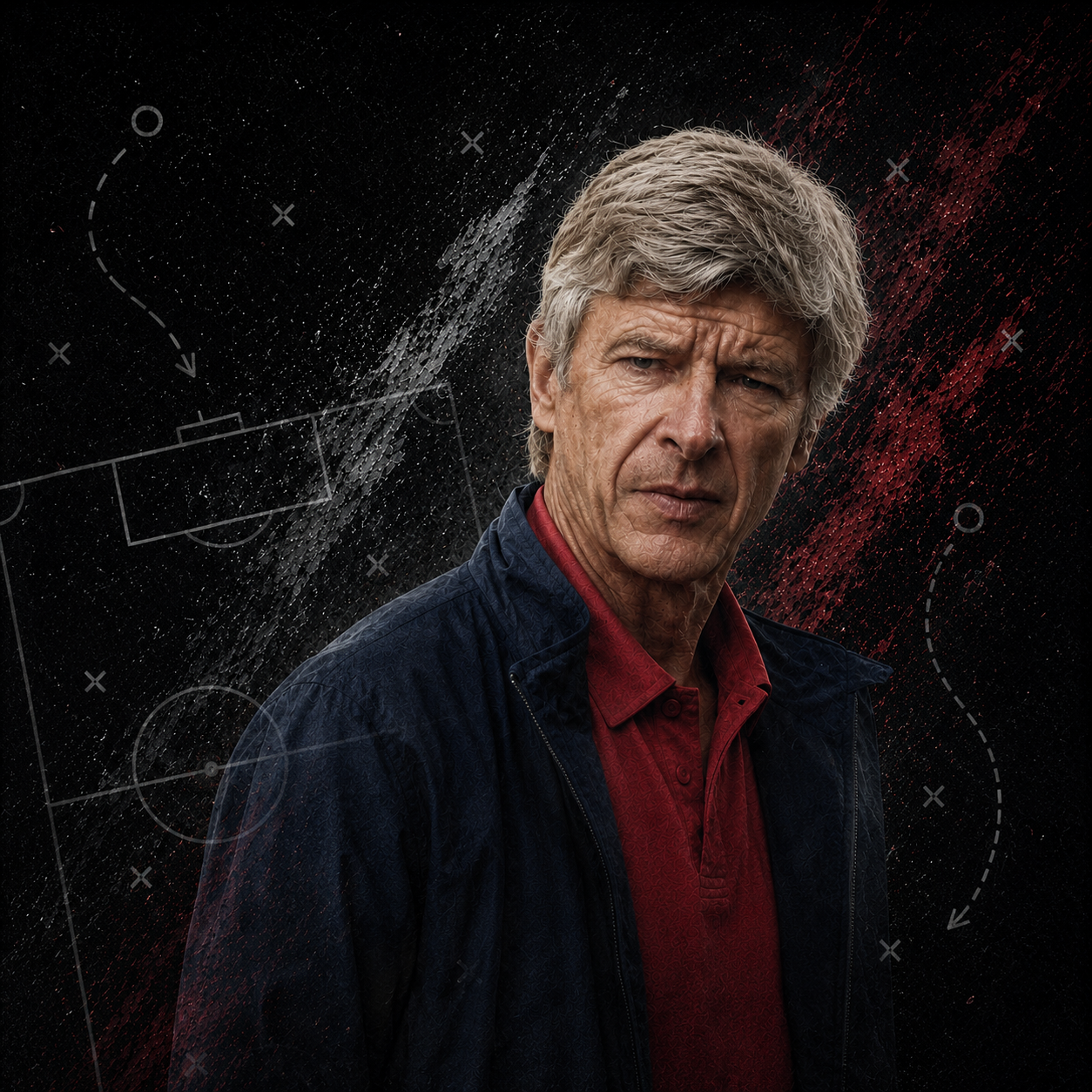
The Wenger Years Part 1: Arsène Who?
When Arsenal F.C. announced Arsène Wenger as their new manager in September 1996, the reaction across English football was one of bewilderment. Management within the English game had long been dominated by British figures whose reputations had often been forged through distinguished playing careers. This archetype was embodied by Wenger's predecessor, Bruce Rioch, who made over 500 English League appearances as a player and earned 24 caps for Scotland before embarking on his successful managerial career. In contrast, Wenger's playing career consisted of modest spells with clubs such as Mulhouse and RC Strasbourg, leaving him without the profile or prestige that was typically a prerequisite when managing one of England's biggest clubs.
Although he had guided AS Monaco to the 1988 French League title and enjoyed further success in Japan with Nagoya Grampus Eight, winning both the 1995 Emperor's Cup and the 1996 Japanese Super Cup, Wenger's previous achievements carried little weight amongst many English supporters, whose knowledge of European and Asian football remained limited. Consequently, Wenger arrived at Highbury as an unfamiliar figure, an unknown quantity viewed with scepticism by supporters, the media, and even members of his own dressing room, with Arsenal captain Tony Adams later admitting that his first impression was that Wenger looked more like a schoolteacher than the successor to the club's legendary former manager George Graham.
The uncertainty surrounding Wenger’s appointment was reflective of a wider identity crisis that had engulfed Arsenal since the departure of legendary manager George Graham. The dismissal of Graham, who managed Arsenal for nine years between 1986 and 1995, following a scandal surrounding agent payments had brought to an end one of Arsenal’s most successful periods. Having guided the Gunners to a multitude of trophies, including two First Division titles and the 1994 European Cup Winner’s Cup, Graham’s philosophy of defensive excellence had come to define Arsenal’s identity as a club; an identity embodied by players such as Nigel Winterburn, Tony Adams, Lee Dixon, and Steve Bould. Whilst the appointment of Bruce Rioch, a manager who much like Graham had played professionally for both Aston Villa and Scotland, signalled that Arsenal would seek to adhere to Graham’s successful formula, continuity soon became understood as stagnation. Rioch was dismissed from his managerial duties following just a single season at the club, leaving Arsenal in need of a new direction.
Whilst Rioch’s unsuccessful spell highlighted how difficult George Graham’s tenure would be to replicate, it was not the only factor driving the Arsenal hierarchy's desire to modernise. The creation of the Premier League in 1992 had accelerated the commercialisation and internationalisation of the English game, with increased television revenues, growing foreign investment and the arrival of overseas players reshaping the landscape within which clubs operated. At the same time, Manchester United had emerged as the dominant force in English football under Sir Alex Ferguson, combining sustained success on the pitch with an increasingly modern approach to player development and club management. Arsenal, by contrast, still remained closely associated with the disciplined, defensively resilient football that had characterised the Graham era. Whilst this identity had delivered considerable success, there was an increasing recognition within the club that maintaining Arsenal's position among England's elite required more than continuity. The appointment of a new manager therefore represented an opportunity not simply to replace Bruce Rioch, but to redefine Arsenal's footballing philosophy and adapt the club to the demands of a rapidly changing football landscape.
At the heart of Arsenal's desire for transformation was vice-chairman David Dein. A successful businessman with a keen interest in the structure and commercial success of American professional sport, Dein purchased a substantial shareholding in Arsenal in 1983, a time when investment in English football was widely regarded as a poor financial decision. Whilst he oversaw one of the most successful periods in the club's history under George Graham, Dein was far more than a passive director, as he emerged as one of the most influential administrators in English football, playing a central role in the negotiations that led to the formation of the Premier League in 1992. Dein recognised earlier than many of his contemporaries that English football was entering a period of unprecedented commercial and sporting change, believing that clubs would need to modernise both on and off the pitch if they were to remain competitive in an increasingly globalised footballing culture.
This vision shaped Dein's approach to Arsenal's future. Unlike many directors of the period, whose responsibilities rarely extended beyond financial oversight, Dein took an active interest in the club's footballing direction, recruitment strategy and long-term planning. The dismissal of Bruce Rioch therefore presented Dein with the chance to redefine Arsenal's identity for a new era. Rather than seeking another manager in the mould of George Graham or Bruce Rioch, Dein became convinced that the club required a progressive thinker capable of challenging established conventions. In Arsène Wenger, Dein believed that he had found precisely that figure.
Despite being a relatively unfamiliar figure to English football fans, Wenger's achievements in France and Japan had earned him widespread admiration amongst football executives, who regarded him as one of Europe's most progressive managerial minds. Across his spells at Nancy, Monaco, and Nagoya Grampus Eight, the Frenchman became notorious for his scientific approach to management; an approach that built on the ideas of Paul Frantz, who managed Wenger at Mulhouse, and emphasised healthy diets, physical conditioning, and effective training. Alongside his distinctive scientific philosophy, Wenger also earned a reputation as a manager capable of combining attractive, technically proficient football with tactical discipline, resulting in both his Monaco and Nagoya Grampus Eight sides scoring freely without sacrificing defensive organisation.
Whilst Wenger's tactical innovations attracted considerable attention, his greatest strength was arguably his ability to manage players. At Monaco, he developed the careers of emerging talents such as George Weah, Emmanuel Petit, and Lilian Thuram despite operating within a demanding, success-orientated club culture. Similarly, at Nagoya Grampus Eight, Wenger quickly earned the respect of a squad operating within an unfamiliar cultural setting, demonstrating an ability to communicate his ideas and foster collective discipline regardless of language or footballing tradition. Rather than relying upon authority alone, Wenger cultivated relationships built upon mutual respect, intellectual curiosity, and a shared commitment to continual improvement.
It was this combination of tactical intelligence, progressive thinking and effective man management that distinguished Wenger from many of his contemporaries. His willingness to involve himself in every aspect of a player's development, from nutrition and physical conditioning to psychological preparation, reflected a holistic philosophy that extended far beyond the touchline. Consequently, many within football viewed Wenger as a figure whose future could ultimately lie in technical leadership or football administration rather than management alone. David Dein, however, recognised that these qualities made him the ideal candidate to lead Arsenal’s transformation, appointing the Frenchman before his talents could be taken elsewhere.