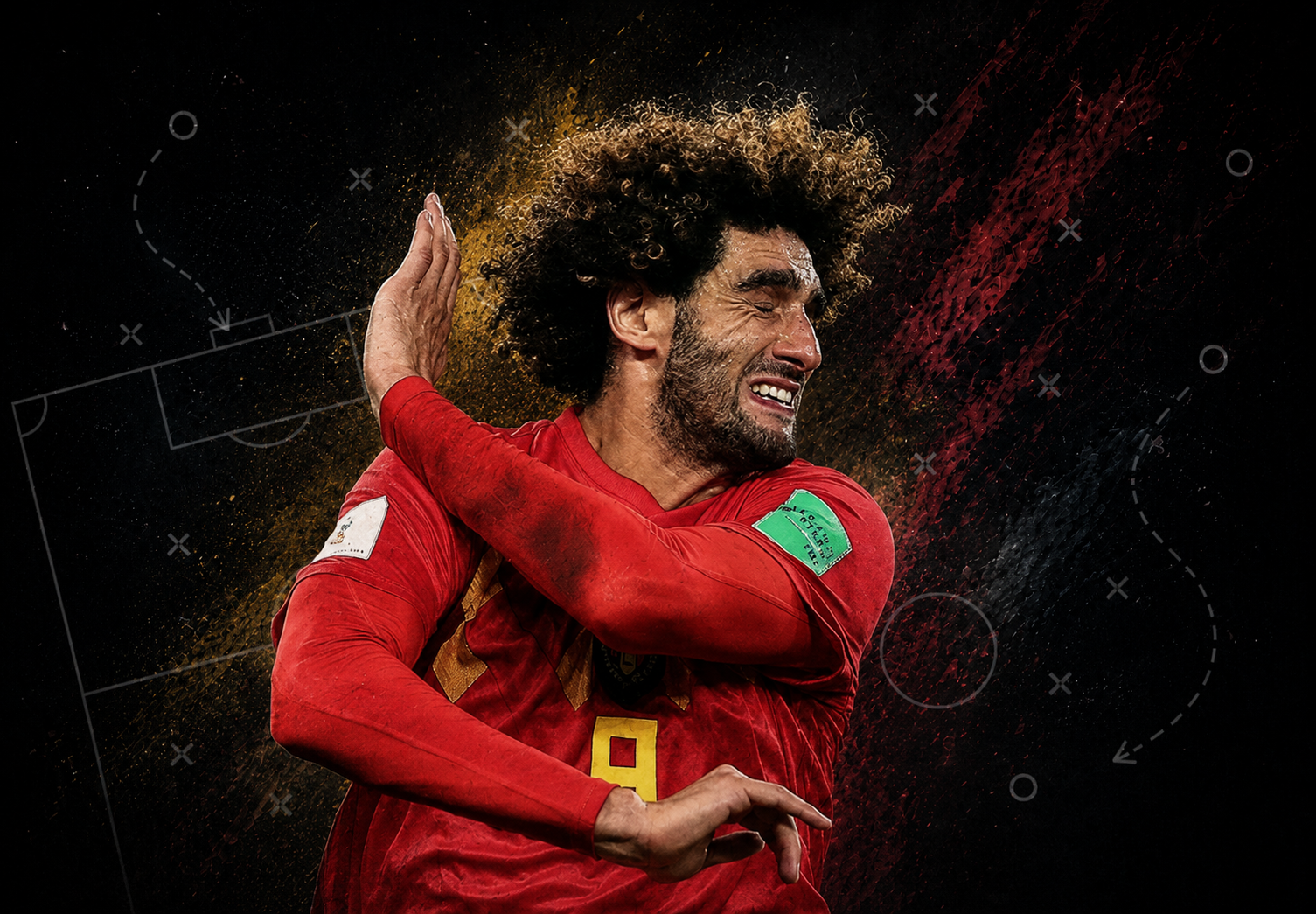
Marouane Fellaini: The Superstar Who Arrived Too Soon
Marouane Fellaini has been retired for roughly two and a half years. His last appearance in English football came about seven and a half years ago. He is 38 years old. There is no realistic scenario in which he walks into a Premier League dressing room tomorrow and starts dictating games from midfield. So, naturally, any statement that suggests Marouane Fellaini would be perfect for the Premier League in 2026 sounds as if designed to create outrage and laughter in equal measure.
At first glance, the idea is ridiculous. Fellaini became something of a footballing punchline during the latter stages of his career. The afro, the elbows, the aerial duels, the long balls, the inevitable appearance whenever a game descended into chaos. In an era that was defined by Pep Guardiola's obsessive possessive positional play, technical security and midfielders who could manipulate space, Fellaini appeared to represent everything football was trying to leave behind.
But perhaps football has come full circle.
The 2025/26 Premier League season was defined by the things Fellaini did exceptionally well. Set pieces became meticulously engineered, direct play became one of the most effective ways to disrupt sides who had meticulous pressing structures and teams increasingly looked to be more physical. In a Premier League landscape where elite quality is widespread, with 39 of 48 nations at the 2026 FIFA World Cup having Premier League players in their squads, physicality has become an indispensable advantage utilised by many sides.
Whilst, given his age, it is too simple to say that Fellaini may have retired at exactly the wrong time, if you strip away the nostalgia and the memes, it is possible to picture a world in which Fellaini, had he been born 15 years later, could be commanding fees similar to that of Elliot Anderson or Mateus Fernandes.
To understand why this hypothetical is not quite as absurd as it first appears, it is necessary to strip Fellaini of the caricature that came to define him.
When you look beyond the memes and beyond the reputation, what remains is a remarkably effective player; a player with a multifaceted skillset that was effective during the 2010s but would be indispensable in 2026.
Standing at 6ft4in, the 87-capped Belgian possessed an obvious physical advantage. However, whilst many players have been blessed with height, few have known how to use it like Fellaini. During the 2016/17 season, the season in which Fellaini made his most appearances for Manchester United, the Belgian won 5.29 aerial duels per ninety, winning 76.4% of his Premier League duels. Whilst, without comparison, these numbers may seem abstract, their remarkable nature becomes clear when compared to the big men of the 2025/26 season. Across the 2025/26 Premier League season Aston Villa’s Amadou Onana, who stands at 6ft5in, and Newcastle’s Dan Burn, who is 6ft7in, won 2.30 and 4.01 aerial duels per ninety respectively, numbers which fall far short of Fellaini’s standards.
Although his excellence aerially was often considered his key asset, Marouane Fellaini was more than just a big lump. A tenacious midfielder who offered both defensive solidity, winning 3.15 tackles and completing 7.82 recoveries per ninety across the 2016/17 Premier League season, and attacking output, taking 1.29 shots and creating 1.01 chances per ninety across the same season, Marouane Fellaini was the full package.
Having played in an era where possession was treated as the ultimate objective, Fellaini’s scrappy ability to win the second ball is often overlooked. As a player whose blend of physicality and anticipation meant that he could compete for the first and second ball, the Standard Liège academy graduate excelled when games broke down and became territorial. Given that in the summer of 2026 Elliot Anderson made an £116m switch to Manchester City on the basis of this very ability, it is not hard to argue that Fellaini would have thrived in 2026, especially given that Fellaini’s 2016/17 rate of 7.82 recoveries per ninety would have placed second only to Anderson across the 2025/26 Premier League season.
Given that Fellaini offered such a presence defensively, it may be difficult to see how he could have had the chance to score 55 goals across his 353 appearances in English football. However, when considering his height, and more importantly his ability to use it, the answer becomes more obvious. Put simply, Marouane Fellaini knew how to handle himself in the box. Any player who has scored 11 Premier League goals in a single season must do. But Fellaini was a special case. Often used late on in games as a plan B to crash the box, Fellaini was more than simply a goal threat, he was a facilitator. This is an aspect of Fellaini’s game that the stats cannot display, one of those intangible elements of football that can only be understood through experience. By having his mere presence in the box, Manchester United and Everton gave their set-piece takers both a target to aim at and their other attackers space. Defenders were, naturally, scared of the Belgian international and it is this ability, alongside his more direct threat, that would make him so valuable in 2026.
The 2025/26 Premier League is widely agreed to be the season of set pieces. Across the season, over 250 goals were derived from set-piece scenarios, with eventual champions Arsenal scoring the most set-piece goals with 23. In such an environment, Fellaini’s value would extend beyond simply being another player to aim for. His presence would demand a specific defensive response. A defender would have to track him, another may be required to block his run, while others could be occupied by the threat of his movement. As a player capable of manipulating defensive structures simply by standing in the right area, Fellaini would have offered coaches another variable to exploit. In a league where the margins are increasingly found in the smallest details, having a player capable of creating advantages before the ball is even delivered would be an invaluable asset.
There is, of course, no suggestion that Fellaini would have been the best midfielder in the Premier League. His limitations were real. He was not going to dictate the tempo of a game like Rodri, glide through the midfield like Rayan Cherki or provide the technical security demanded by many of the league's elite possession sides. But that was never what made Fellaini valuable. His value came from his ability to do things that few others could. He could change the physicality of a game, give his team an advantage in the air, win contested balls, occupy defenders and turn a chaotic match into one played on his terms. In an increasingly specialised Premier League, where clubs spend millions searching for players capable of providing marginal advantages, there is a strong argument that those qualities would be prized rather than mocked.
Perhaps, then, the idea that Marouane Fellaini would be perfect for the Premier League in 2026 says more about football than it does about Fellaini. It may be evidence that the game has begun to rediscover the value of qualities that were dismissed during the possession revolution. Equally, it may say something about the role of football media in shaping a player's reputation. Fellaini became a caricature because it was easier to remember the afro, the elbows and the desperate long balls than the midfielder who made 353 appearances and scored 55 goals. Whether it is a reflection of the changing tactical landscape or an indictment of the way football remembers certain players, one thing is difficult to dispute, had Marouane Fellaini been entering his prime in 2026, rather than in 2016, he would undoubtedly be considered a superstar specialist that was welcome in any top Premier League team.