Coventry City: The Long Road Back and the Fight to Stay
After 25 years away from the Premier League, Coventry City have completed one of English football’s most remarkable rebuilds. Now, Frank Lampard and the Sky Blues face a challenge that could prove even more difficult than promotion itself: establishing a sustainable future amongst England’s elite.
For Coventry City, the road back to the Premier League was never going to be straightforward. When the Sky Blues were relegated from the top flight in 2001, few could have anticipated just how far the club would fall before finding its way back. Administration, financial uncertainty, stadium disputes, and a descent into the fourth tier threatened to turn a once-established top-flight institution into a cautionary tale of English football.
Yet, after a quarter of a century away, Coventry are back. Their return was secured in April 2026, when a 1-1 draw against Blackburn Rovers confirmed promotion before a subsequent victory over Portsmouth crowned them champions of the second division of English football. Under Frank Lampard, Coventry had completed the final stage of a journey that had taken the club from League Two to the summit of the second division.
The achievement was significant not merely because of the time spent outside the Premier League, but because of the instability that threatened to prevent Coventry from ever returning. However, the romanticism surrounding promotion has quickly collided with the realities of top-flight football. Four consecutive league defeats without scoring exposed the gap between the Championship and the Premier League, raising concerns about whether Coventry possessed the personnel and defensive structure necessary to compete at the highest level.
Their subsequent victories, culminating in a remarkable 4-1 win over Newcastle United on October 12, have offered a more encouraging picture. Coventry have moved out of the relegation zone, rediscovered their attacking threat and given their supporters a long-awaited home victory in the top flight. For Coventry, the challenge now extends beyond survival. They must determine whether the identity, unity and attacking principles that powered their return can form the foundations of a sustainable Premier League club.
The Fall: A Quarter of a Century in the Wilderness
Coventry’s decline cannot be understood simply through the results on the pitch. For much of the Premier League’s early history, the Sky Blues were a familiar presence in the top flight. Their relegation in 2001 ended 34 years in the English first division, beginning a period of decline that would eventually take the club all the way to League Two. The deterioration was accompanied by financial and institutional instability. Administration, ownership disputes, and difficulties securing a permanent home undermined the club’s ability to establish continuity.
The stadium situation became particularly damaging. Coventry spent periods playing away from their traditional home, including a ground-sharing arrangement with Northampton Town at Sixfields and a later spell at Birmingham City’s St Andrew’s. For a club attempting to rebuild its sporting identity, the inability to consistently play in its own city represented a significant obstacle.
In 2017, Coventry were relegatd to League Two. Nine years later, they were preparing to face the country’s biggest clubs again. The journey was not a straight line. Coventry won promotion from League Two in 2018-19, reached the Championship in 2020, and gradually re-established themselves as a competitive second-tier side. Their progress under Mark Robins provided the sporting stability that had been absent for so long. There were painful near-misses along the way. Coventry lost the 2023 Championship Playoff Final to Luton Town on penalties, missing out on promotion by the narrowest of margins. In 2024, they came agonizingly close to the FA Cup Final, only for Manchester United to prevail in a penalty-decided semifinal after Coventry produced a remarkable comeback. Those disappointments could easily have become another chapter in a familiar story of frustration. Instead, they showed Coventry could compete with clubs operating at a higher level.
The Rebuild: From Survival to a Sporting Identity
Mark Robins deserves considerable recognition for restoring Coventry’s competitive foundations. When he returned to the club in 2017, the Sky Blues were a League Two side confronting significant uncertainty. His work helped rebuild the team’s competitiveness, reconnect the club with its supporters and establish a pathway back towards the Championship. Robins subsequently guided Coventry through promotion and into the upper reaches of the second tier. The club’s progress was built around a recognizable footballing approach and a squad that developed over time rather than being completely reconstructed every summer with promotion.
Robins' departure in November 2024 represented a major turning point. Coventry had enjoyed considerable success under Robins, and replacing a manager so closely associated with the club’s revival carried obvious risks. The decision to appoint Lampard was therefore an important test of the club’s direction.
Lampard arrived with a high-profile playing career and experience managing Chelsea, Everton, and Derby County. His managerial reputation, however, had been shaped by mixed results, making the Coventry appointment an opportunity to demonstrate that he could build a successful long-term project rather than simply manage an established squad. Lampard ultimately delivered promotion and the Championship title in 2025–26.
Coventry scored 97 league goals during that campaign, finishing comfortably as the division's highest-scoring side. Their attacking production was not dependent on a single goalscorer. Haji Wright, Brandon Thomas-Asante and Ellis Simms contributed in the final third, while midfielders Jack Rudoni and Victor Torp provided additional goals. Set pieces were another major weapon.
In the Championship, Coventry scored a league-high 29 goals from dead-ball situations, demonstrating the value of preparation and a squad equipped to exploit physical advantages. These numbers reveal something important about Coventry's success. Their promotion was not simply a story of momentum or individual brilliance. It reflected an attacking structure that consistently generated opportunities, a variety of goalscoring contributors and a team capable of creating danger through different routes. The challenge is that the characteristics that make a team dominant in the Championship do not automatically translate into Premier League success.
Coventry now face opponents who can punish defensive mistakes more efficiently, press with greater intensity and exploit small gaps in a team's structure. Their next stage of development requires them to preserve their attacking strengths while improving the areas of their game that are exposed by superior opposition. Promotion validated the work already completed. It did not eliminate the need for further evolution.
The Lampard Question: Can Attacking Ambition Survive the Premier League
Coventry’s opening weeks in the Premier League provided a harsh reminder of the difference between competing for promotion and competing for survival. Four consecutive defeats without scoring, including a heavy loss to Brighton, left Lampard’s side searching for answers. The results were concerning, but the underlying performances deserve closer examination. Three of those opening league fixtures came against Arsenal, Manchester City, and Brighton, making the schedule an especially difficult introduction to top-flight football.
The important question was whether Coventry could continue creating chances while limiting the opportunities conceded at the other end. Lampard has generally used a 4-2-3-1 formation, seeking to combine midfield organization with direct, energetic attacking play. During Coventry’s Championship campaign, the side demonstrated an ability to attack quickly, use the width of the pitch and generate chances through both open play and set pieces. Their approach was effective because it allowed them to attack with purpose rather than relying exclusively on prolonged spells of possession.
When Coventry moves the ball forward quickly, they can exploit opponents before their defensive structure is restored. But when an attack breaks down, the spaces left behind can become vulnerable to counterattacks. Against technically superior opposition, losing possession in the wrong area can quickly turn an attacking opportunity into a defensive emergency. This is where Lampard's tactical decisions will be especially important. Coventry do not necessarily need to abandon their attacking identity. Doing so could remove the very characteristics that made them successful. Instead, they must become more selective about when to commit players forward and how to protect the center of the pitch.
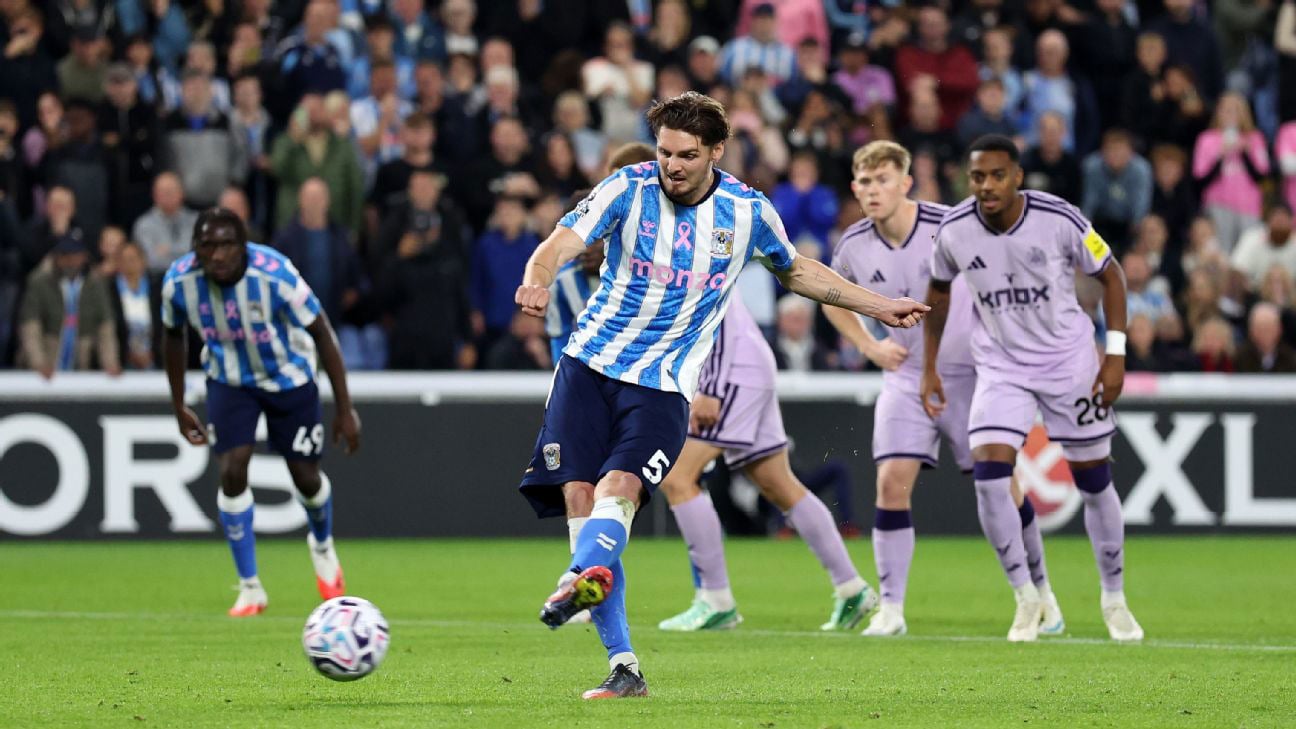
The balance between aggression and control will determine whether Coventry can consistently compete with Premier League opponents. Their recent victory over Newcastle offered an encouraging example of what the approach can produce. Coventry pressed aggressively, worked relentlessly without the ball and took advantage of defensive uncertainty. Jack Rudoni opened the scoring from the penalty spot, Sidiki Cherif added another and second half goals from substitutes Ellis Simms and Stephen Mfuni completed a memorable victory. Nevertheless, a single victory cannot resolve every question surrounding Coventry's defensive organization. Newcastle's own errors contributed to the result, and the challenge is to reproduce the same intensity against different opponents and in different game states. Lampard has rightly emphasized the need to remain grounded. Coventry's recent improvement should encourage belief without creating the illusion that their Premier League status is secure.
The Premier League Test: Building for the Long Term
Coventry's survival will depend on more than tactical adjustments. Recruitment, squad depth and financial discipline will determine whether the club can turn its return to the Premier League into something lasting.
Rather than attempting to match the spending power of established top-flight sides, Coventry must identify players who address specific weaknesses while complementing Lampard's attacking philosophy. Defensive reinforcements and greater protection in midfield will be particularly important for a side whose willingness to commit players forward can leave it vulnerable in transition.
However, abandoning that attacking identity in pursuit of defensive security would be equally dangerous. Coventry's success under Lampard was built on aggressive play, goals from multiple positions and an ability to create opportunities through open play and set pieces. The challenge is to preserve those strengths while becoming more disciplined against superior opposition.
That balance must extend beyond the pitch. Premier League revenue provides Coventry with an opportunity to strengthen their squad and infrastructure, but short-term spending cannot come at the expense of long-term stability. Having experienced years of financial uncertainty and institutional upheaval, the club must avoid repeating the mistakes that once threatened its future.
The Future: The Return Is Only the Beginning
Coventry City's return to the Premier League is the culmination of a remarkable rebuilding process. From relegation and financial instability to Championship champions, the club has spent decades fighting to restore its place among England's elite. Now, the challenge is to ensure that this achievement becomes a foundation rather than a fleeting moment.
Lampard must find the balance between attacking ambition and defensive resilience, while the club's leadership must provide the recruitment strategy and financial discipline necessary to support that progress. Neither task will be straightforward, particularly in a league where the margin for error is so small.
The recent victory over Newcastle offered a glimpse of what Coventry can achieve when their energy, tactical approach and attacking quality come together. But one memorable result cannot guarantee survival. Consistency, adaptability and intelligent decision-making will ultimately determine whether the Sky Blues can establish themselves at this level.
For a club that has spent 25 years fighting its way back, the objective is no longer simply to reach the Premier League. It is to build a future in which returning to the top flight is not the end of an extraordinary journey, but the beginning of a lasting chapter.