How Tottenham Lost Their Way
For much of the 2010’s, Tottenham Hotspur represented one of the Premier League’s clearest examples of sustainable progress.
Under Mauricio Pochettino, Tottenham developed into a consistent Champions League club, challenged for the Premier League title and even reached the Champions League final in 2019. The club’s new stadium provided the infrastructure to support ambitions of competing at the highest level, while a talented young core of players appeared capable of sustaining that progress. Seven years later, the picture is dramatically different. Tottenham have finished 17th in the Premier League in each of the last two seasons, narrowly avoiding relegation in 2025/26. They subsequently spent more than £300 million on a major squad rebuild, only to begin the 2026/27 campaign without a win in five matches and currently sit at the bottom of the table. The issue with Tottenham is much larger than a poor run of form.
Tottenham’s decline has been defined by repeated changes in direction, managerial turnover, and an inability to establish continuity between recruitment and coaching. The appointment of Roberto De Zerbi represents the club’s latest attempt to correct that trajectory. Whether it succeeds may depend less on how much Tottenham spends than on whether they can finally stop starting over.
From Pochettino to Perpetual Change
Pochettino’s Tottenham was not without flaws, particularly when it came to winning major trophies. However, the club's direction was very clear. Tottenham had a recognizable playing style, a relatively young core and a manager who had developed alongside the squad. The club qualified for the Champions League four consecutive times between 2016 and 2019 and reached the competition’s final in 2019. The end of the Pochettino era, however, marked the beginning of a prolonged search for a new identity.
Jose Mourinho replaced Pochettino. Nuno Espírito Santo followed Mourinho. Antonio Conte replaced Nuno. Ange Postecoglou then succeeded Conte, followed by Thomas Frank and eventually De Zerbi. The issue is not simply the number of managers. It is the different footballing philosophies represented by those appointments. Each manager arrived with different tactical preferences, different ideas about squad construction and different requirements from the players around them.
This creates an impossible challenge for player recruitment. A player signed to fit one system may not be the ideal player for the next. A squad assembled for one manager can become an awkward fit for another. Over time, the result can be a collection of individually talented players without a clear cohesive identity.
The Frank Experiment Lasted Less than a Season
Thomas Frank’s appointment in June 2025 was supposed to provide Tottenham with stability. The club gave Frank a contract through 2028 and emphasized his record of player and squad development at Brentford. Tottenham described him as a progressive coach capable of leading the club forward. Just eight months later, Frank was gone. Tottenham announced his departure in February 2026, stating the results and performances had led the board to conclude that a change was necessary. The club’s statement is particularly revealing because Tottenham had previously said it was determined to give Frank the time and support required to build for the future. That contradiction captures one of Tottenham’s central problems. Long-term projects require time. Yet Tottenham have repeatedly found themselves responding to short-term results by changing the person responsible for the long-term project.
The consequence is a cycle in which each manager inherits problems created by the previous regime, attempts to correct them, and then risks being judged before his own work has sufficient time to develop, and the cycle repeats.
The De Zerbi Appointment
Roberto De Zerbi’s arrival in March 2026 was supposed to break that cycle. Tottenham handed the Italian a long-term contract and described an ambition to build a team capable of achieving major success while playing an exciting, possession-based style of football that had shown success during his time at Brighton. The timing of his appointment also made his task unusually difficult. De Zerbi inherited a team fighting relegation with only a handful of matches remaining. He ultimately guided Tottenham to safety, finishing 17th after recording three wins, two draws, and two defeats in his seven league matches. The summer was then used to reshape the squad around his vision.
Tottenham spent approximately £320 million on new first-team players, including an £85 million deal for Savio from Manchester City. On paper, the conditions for a rebuild were finally in place. A new manager had significant financial backing and authority to shape the squad. But that also created a new level of expectation.
Spending Is Not the Same as Rebuilding
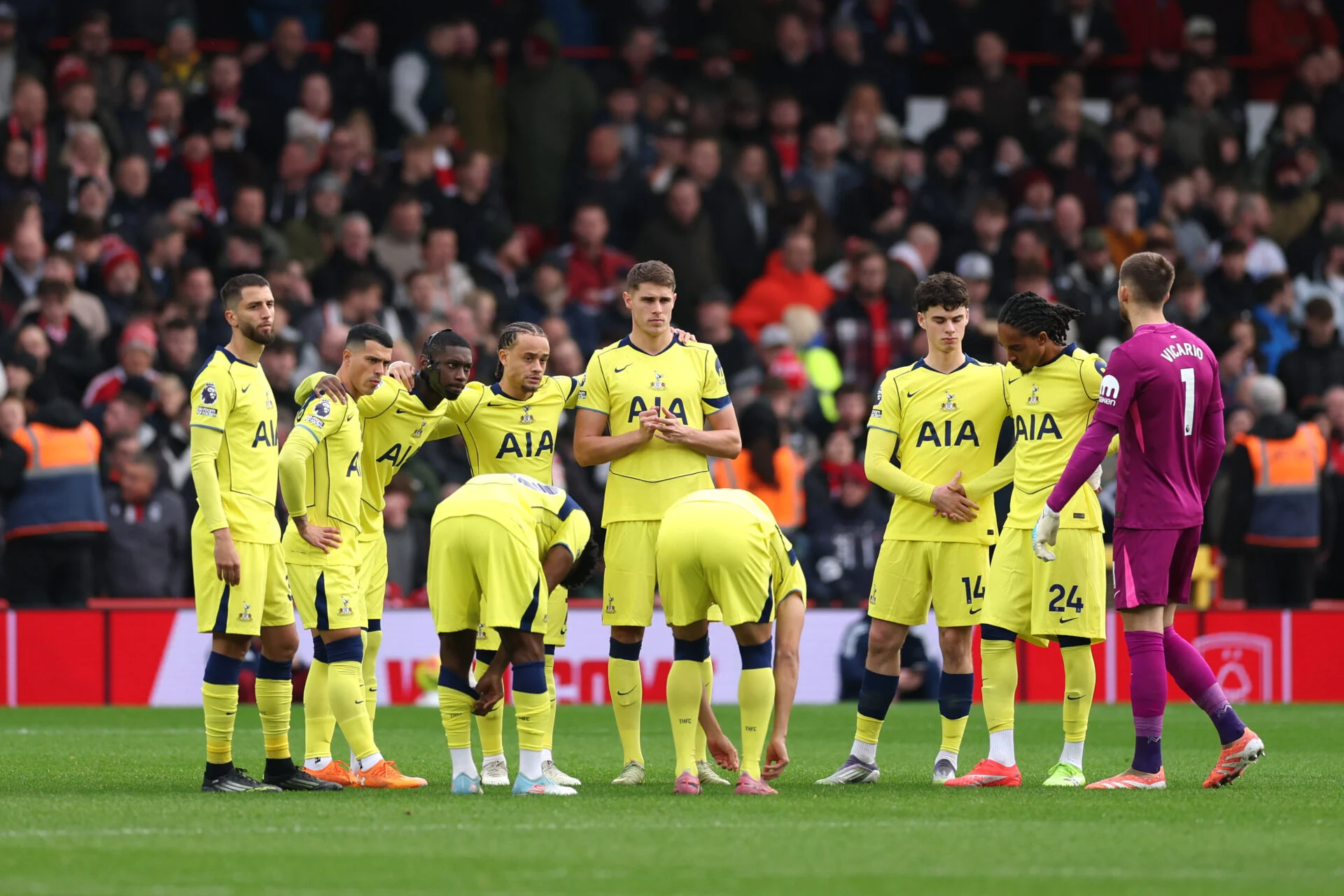
Tottenham’s summer spending was extraordinary, but spending alone does not create a successful team. The club added significant talent, but integrating that talent into a functioning side requires time. De Zerbi acknowledged as much after Tottenham’s opening day defeat to Brentford, saying that the team was not yet a team and described the situation as part of the process of building a new project. The club spent more than £300 million because it needed to overhaul the squad rapidly. Yet the scale of that change makes immediate cohesion more difficult. The opening weeks of the season showcase that problem. Tottenham lost 3-0 to Brentford on the opening weekend, then 2-0 to Newcastle. They subsequently drew with Nottingham Forest and Everton before losing 3-2 to Aston Villa. After five matches, they had two points and two goals, leaving them bottom of the Premier League.
The performances have not simply been unsuccessful; they have frequently lacked attacking efficiency. Against Nottingham Forest, Tottenham failed to register a shot on target, while the club entered the international break having scored only twice in its opening five league matches. For a team that invested so heavily in attacking talent, that is difficult to overlook.
The Problem Goes Deeper Than the Manager
It would be easy to make De Zerbi the central figure in Tottenham’s problems. The results certainly place pressure on him. However, doing so would overlook the broader pattern that has developed at the club over the past several years. Tottenham have experienced similar periods of instability under multiple managers with very different tactical philosophies. That makes it difficult to argue that the club's problems are purely tactical or that another change in manager would provide a straightforward solution. The more fundamental issue is the lack of continuity between the club’s recruitment, coaching, and broader sporting strategy.
Successful clubs do not necessarily avoid poor managerial appointments or unsuccessful transfer windows. What separates them is their ability to maintain a consistent direction when individual decisions do not work. Tottenham have struggled to do that. When a manager leaves, the club has often had to reassess the squad around a new tactical philosophy. Players recruited for one system can be less suitable for the next, while recruitment priorities shift alongside managerial changes.
The Cost of Starting Over
The consequences of that instability extend beyond the manager’s position. Every change creates another period of adaptation. Players must learn new tactical responsibilities. Recruitment strategies shift, and young players have to adjust to different expectations. New signings need time to establish relationships with their teammates.
Eventually, the club risks entering a cycle in which the next rebuild begins before the previous one has had the opportunity to succeed. That is perhaps the clearest explanation for Tottenham's current position. The club has not lacked investment or ambition. It has lacked sustained alignment. The Pochettino era demonstrated what Tottenham can look like when recruitment, player development and coaching move in the same direction for an extended period.
The years since have demonstrated how quickly that progress can disappear when continuity is lost.
De Zerbi Represents Another Opportunity
That makes Roberto De Zerbi's position particularly important. For perhaps the first time in several years, Tottenham have the opportunity to commit fully to a defined project. De Zerbi has been given a long-term mandate. He has received significant financial backing. The squad has been substantially reshaped around a different style of football. That should give him the opportunity to establish something Tottenham have lacked: consistency of approach. But that opportunity comes with a responsibility for the club as much as the manager. Tottenham cannot simply expect De Zerbi to solve every problem on the pitch. They must create an environment in which his project can develop.
That means maintaining consistency in recruitment, resisting the temptation to make drastic changes after short-term setbacks, and ensuring that the club's sporting leadership remains aligned with the manager's vision. If Tottenham do that, the current struggles could eventually become part of the rebuilding process rather than evidence of another failed project. If they do not, the club risks repeating the same cycle once again.
What Does the Future Hold?
The immediate outlook is difficult to predict. Five matches are not enough to determine whether De Zerbi's project will succeed, particularly given the scale of Tottenham's summer rebuild. The club has made too many changes for an instant transformation to be a realistic expectation. But the performances will have to improve.
Tottenham need to demonstrate that the new players are developing defined roles, that the team's attacking structure is becoming more effective and that the football is beginning to reflect the principles De Zerbi was brought in to implement. Most importantly, the club needs to show progress that can be sustained.
That may not necessarily mean competing for the Champions League immediately. It may mean establishing a recognizable style, developing a young core, and building a squad that improves over several seasons rather than several months. For Tottenham, that would represent progress.
Tottenham's Decline Is Not Irreversible
It would be premature to describe Tottenham's current situation as an irreversible decline. The club remains too large, too well-resourced and too well-positioned financially for that conclusion, but there is no denying how far the club's trajectory has shifted.
A team that once reached a Champions League final and regularly competed among the Premier League's elite has now endured consecutive 17th-place finishes and entered the 2026/27 season at the bottom of the table. That decline cannot reasonably be attributed to one manager, one transfer window or one poor season. It is the result of years in which Tottenham repeatedly changed direction without allowing a single project enough time to fully develop.
The club's greatest challenge now is therefore not simply improving the squad. It is breaking that cycle. Tottenham have the stadium. They have the financial resources. They have invested heavily in the squad. And they have a manager who has been allowed to build a long-term project. What remains uncertain is whether the club can finally provide the continuity required to make those advantages meaningful. For years, Tottenham have searched for the next manager, the next signing and the next solution. Their future may depend on doing something much simpler: sticking with one.