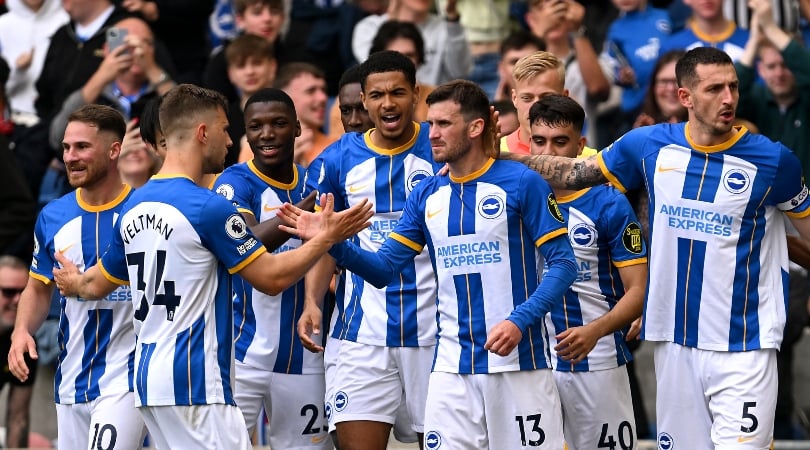
The Brighton Model
In 1997, Brighton & Hove Albion were fighting for their Football League existence. They had lost the Goldstone Ground, their historic home, and were forced to play their football away from Brighton at Gillingham before moving to the Withdean Stadium. The club’s future was uncertain, and the idea of Brighton playing European football would have sounded almost impossible.
Nearly three decades later, Brighton have played in Europe, established themselves as a regular top-half Premier League club, and built a reputation for spotting young talent and turning them into the most valuable asset in English football.
The transformation has been extraordinary.
Brighton’s rise cannot simply be attributed to Graham Potter, Roberto De Zerbi, Tony Bloom or a succession of successful transfers. Each played an important role, but the larger story is the system Brighton have constructed around them. Over the past decade, Brighton have demonstrated an ability to evolve without abandoning the principles that made the club successful in the first place.
The club has built a football club bigger than any individual within it.
From Fighting for Survival to Building the Foundations
To understand Brighton’s rise, it is necessary to go further back than their arrival in the Premier League. The club’s problems in the late 1990s threatened its very existence. After the Goldstone Ground was sold, Brighton spent years without a permanent home while supporters fought to secure the club’s future. The eventual approval and construction of the American Express Community Stadium, which opened in 2011, gave Brighton something they had lacked for years: stability.
Tony Bloom became chairman in 2009 and personally financed the construction of both the Amex Stadium and the club’s Elite Football Performance Center, which opened in 2014. His investments coincided with Brighton’s rise from the lower divisions into the Championship and eventually the Premier League. These new additions represented a change in the club’s trajectory. Brighton could finally begin building an organization capable of sustaining itself at a higher level.
The club earned promotion to the Premier League in 2017 under Chris Hughton. Their first objective was simply to survive. Brighton did. Their initial years in the Premier League were built around defensive organization and experienced players. Lewis Dunk became the face of the club, while Shane Duffy helped form the defensive foundation that kept Brighton competitive. However, surviving the Premier League was never the end goal for Brighton. They wanted to reach another level.
The Potter Revolution:
The next level came in 2019. Graham Potter replaced Hughton with a mandate that extended beyond simply producing results. Brighton had shifted their identity; they wanted to become a younger, more progressive football team. The appointment of Potter represented a change in football philosophy. Brighton increasingly wanted players capable of playing possession-based football, progressing the ball and operating in a flexible tactical structure. Potter was key to this, but not all the credit can fall on his shoulders. The recruitment operation that was supported by the club was crucial in developing the Brighton team.
Tony Bloom’s background in mathematics and statistical analysis became part of Brighton’s approach to player recruitment. The club developed a model that looked far beyond conventional scouting and attempted to identify players whose current ability and future potential could create value for the club.
The basic idea of their strategy was to find players before everyone else does, develop them, and if a larger club comes calling, reinvest the money into the next generation. The execution of this idea is anything but simple.
Players such as Alexis Mac Allister, Moises Caicedo, Kaoru Mitoma, and Marc Cucurella became symbols of the model. These players were not all recruited from the same market or in the same way. Instead, Brighton looked across different leagues and countries for players who fit specific characteristics. That meant that Brighton did not have to compete financially with the big clubs of Europe to find finished products.
Transfer Market:
Brighton’s model became particularly impressive when viewed through the context of the Premier League’s financial hierarchy. The biggest clubs are often able to solve major issues in their team by buying established players. Brighton was not able to operate in that way, so they instead began to focus on who could become the solution. This mindset led the club into markets many large European clubs wouldn’t scout for talent.
Mitoma is perhaps the clearest example of this strategy. Brighton signed the Japanese winger from Kawasaki Frontale in 2021, loaned him to Union Saint-Gilloise, another club Bloom was connected to, then brought him to England. When Leandro Trossard departed for Arsenal in January 2023, Brighton already had his replacement in their system. The same principle applied in other positions.
When Chelsea signed Marc Cucurella, Brighton brought in Pervis Estupinan from Villarreal. As players leave, Brighton are not searching for a replacement; they already have the solution in their system.
Brighton Loses Potter:
In September 2022, Chelsea came calling for Graham Potter. Potter departed Brighton after leading the club to its highest-ever Premier League finish at the time, 9th in the 2021/22 season. Brighton had also made an excellent start in the following season with 13 points in their opening 6 matches before Potter’s departure.
For many clubs, the loss of a manager who had spent years developing young players would have been detrimental, and regressions would have followed. However, Brighton had the answer in the form of Roberto De Zerbi.
The Italian inherited a team filled with talented young players and immediately changed the style of play to a more aggressive and technically demanding style. Brighton quickly became one of the Premier League’s most entertaining teams. They began pressing and positionally rotating, which proved to be challenging for opposition defenses.
During the 2022/23 season, the success of De Zerbi’s tactics became clear. Brighton finished sixth place in the Premier League, their highest-ever finish at the time, which secured them European football for the first time in the club’s history.
The likes of Mac Allister, Caicedo, and Mitoma became increasingly influential, while players such as Solly March and Evan Ferguson developed into important first-team contributors. Achieving European qualification was the reward for years of infrastructure, recruitment, and coaching. It also created the next challenge: that success attracts attention.
The Cycle of Selling and Rebuilding:
Brighton’s greatest test was no longer whether they could discover talented players; it was whether they could survive losing them. Following Brighton’s amazing 2022/23 campaign, Mac Allister moved to Liverpool, Caicedo moved to Chelsea with Cucurella, and Trossard went to Arsenal. Not only players, but several recruitment executives had also departed the club, and eventually De Zerbi also departed.
To prove their methods worked, Brighton needed to prove they weren’t built around a single manager or generation of players but were a model that could continue to push on. The club had to prove that its success was reproducible.
Hurzeler and The Next Chapter
When Roberto De Zerbi left the club in 2024, Brighton turned to another young coach. Fabian Hurzeler arrived from St. Pauli at just 31 years old, becoming the youngest full-time manager in Premier League history. Before joining Brighton, he had guided St. Pauli to promotion as Bundesliga 2 champions.
Rather than searching for the biggest available managerial name, they identified a coach whose ideas and trajectory matched the club's approach.
Hürzeler's first season produced an eighth-place finish in 2024/25 with 61 points, just one point below Brighton's club Premier League record of 62. Then came 2025/26, in which Brighton finished eighth again. This time, the position was enough to send them back into European competition, with the club qualifying for the UEFA Conference League final playoff round. It also marked Brighton's first consecutive top-eight Premier League finishes and their fourth top-half finish in five seasons.
Under De Zerbi, Brighton became synonymous with patient buildup and positional play. Under Hürzeler, they became more aggressive without the ball and more direct in certain attacking situations. In 2025/26, Brighton led the Premier League in high turnovers with 192, while conceding only 46 goals, the club's fewest in a season since 2021/22. They also scored 12 goals through substitutes, the most in the league. The tactical identity had changed, but the organizational identity had not.
The Brighton Model:
Brighton's rise was never supposed to look like this.
A club that was once fighting for its existence has become a regular Premier League side, a European competitor and one of the most respected development clubs in English football. But the most remarkable part of Brighton's rise is not where they have arrived. It is how consistently they have found ways to move forward.
The club has lost managers, executives and some of the best young players in Europe. Yet each departure has created another opportunity to test the structure Brighton have spent years building. Brighton are simply not a good team, but a club designed to continually build good teams. After a decade that has taken Brighton from Premier League survival to European football, the biggest question is no longer whether the model works, but how far Brighton can take it.