Barcelona: the wilderness years (Part 1)
This piece is part of a series on Barcelona's tumultuous era between Johan Cruyff's departure in 1996 and the Blaugrana's Champions League win in 2006 featuring Josep Lluís Núñez, Joan Gaspart, Luís Figo, a host of managerial changes, successes, failures and more.
On the morning of 21 May 1992, an elderly gentleman, Joan Gaspart, completed a promise. This was by the Thames in London, just after Barcelona had beaten Sampdoria in the European Cup final at Wembley the previous night. Earlier that season, Gaspart, the vice-president of Barcelona serving under the hugely unpopular Josep Lluís Núñez, had promised to jump and swim in the Thames had Barcelona won the trophy — which would’ve been their first-ever continental title. He spent the entire game unable to watch. From the moment it kicked-off, he left the stadium to wander around London, unable to take the tension. When he returned, there were still 15 minutes left of the final before extra-time, so he locked himself in a toilet at Wembley Stadium, staying there until a police officer slammed on his door and announced that Ronald Koeman had given the Blaugrana the lead.
Gaspart still refused to come out. Eight minutes remained on the clock, he was still tense. He’d seen Barcelona come close and lose. In 1961, a young Gaspart watched Barça reach the European Cup final in 1961, only to lose to Benfica after hitting the woodwork four times. In 1986, clearly the superior side when taking on Steaua București in Seville, Barcelona lost on penalties in a rather disastrous shoot-out that ended 2-0 to the Romanian side. Now, six years later, this was their chance. After dazzling under Johan Cruyff’s leadership, the Catalans were confident, but the ghosts of finals past dwelled heavily on the club in the build-up. Eight minutes seemed too long, but they held on. The same policeman ran all the way to tell Gaspart in the toilet that his Barcelona had won the European Cup for the first time ever, and the vice-president made it out in time to witness the moment.
As the celebrations continued long into the night, fans remembered Gaspart’s promise and so at 5 a.m., Gaspart and a small group of directors made their way to the Thames, undid their clothes and wearing a blue-and-red Barcelona top, took a dive into the river and after a short swim, came out and realised on unclean the water was. They didn’t care, though. Barcelona were European champions — the trophy they started to feel was never going to arrive in Catalonia, finally did.
Cruyff’s Dream Team, as they later came to be known, were the paramount side in Spanish football at the time, winning four league titles (with the latter three by the barest of margins) and a Copa del Rey to go with their European Cup. With a combination of astute signings from abroad, a distinct change in mentality and a desire to grow from within, revamping La Masia, they were slowly becoming the model European club too. But as Núñez, Gaspart and Cruyff were planning ahead, the cracks were starting to show from within. After the European Cup final loss in 1994 — a 4-0 embarrassment by Fabio Capello’s Milan in Athens, the wheels started to fall off. After the final, Cruyff, despite showing confidence pre-match, cited emotional and physical exhaustion as the reason behind their downfall. Players felt less confident in the months after, and slowly started to leave. Michael Laudrup, so often the star for Cruyff’s Barça, would move to Real Madrid after rifts with Cruyff while Romário, who was a fan favourite in his short stay thus far, feuded with his team-mates and was isolated after the 1994 World Cup.
Behind the scenes, tensions rose. Cruyff and Núñez were never the best of friends and after Athens, the relationship worsened. Accusations of nepotism as Cruyff used his son Jordi in midfield and son-in-law Jesús Mariano Angoy in goal caused friction and debate amongst the media, and Barcelona would go trophyless for two years. By the summer of 1996, the writing was on the wall. Four years after Cruyff gave Gaspart his finest moment as a Barcelona director and fan, he went to visit the Dutchman to tell him he was being relieved of his duties. Word had already spread that Gaspart had met with Bobby Robson to be his successor, and when Cruyff learned about it, he wasn’t pleased. “Why are you trying to shake my hand, Judas?” Cruyff asked as Gaspart entered the dressing room to inform him of the news. A war of words ensued, Cruyff threw a chair and then left — a glorious era had come to an end.
Johan Cruyff’s departure grew the divide in Barcelona even further. Amongst the fans, division rose, as those that were pro-Cruyff took one side, and those that were pro-president, backing Josep Lluís Núñez’s administration, took another. Núñez was a polarising figure in Barcelona and in the club’s history. Everyone who had any connection with the club had an opinion on his work, and as time went by, his reputation started to dwindle. By the time of Robson’s arrival, Núñez had been in the role 18 years — the longest-serving and most successful president in Barça history — but things weren’t getting easier. Pressure was mounting, and Núñez had to deliver.
Born in the Basque country in 1931 as José Luis Núñez, his family moved to Catalonia when he was just six months old, and his love story with Barcelona started there. Like many in the region, he supported the blaugrana and had ambitions of playing for the club, which were hampered by the time he turned 20. Not long after, he switched over to a career as an insurance salesman, and after his marriage to Maria Lluïsa Navarro i Obón, he began a career in accountancy, joining the affluent Navarro family, owners of the company Construcciones Navarro. With a penchant for business and a keen eye for what could make him richer, he made the most of Barcelona’s booming property scene, and in 1966, formed Núñez i Navarro, the company that would make him a fortune.
Towards the end of the 1960s, as the Franco government began to promote greater free-market housing rather than social housing that saw more than four million homes be built between 1961 and 1975, Núñez saw opportunity and took advantage. His wealth rose drastically, and his company formed over a hundred subsidiary companies, all of them designed to take advantage of the free-market economy. By now, Núñez had become well-known for his business ethics and acumen across Barcelona and with his prominence growing, he decided to chase his most ambitious goal: become the president of FC Barcelona — the club he always loved.
Núñez’s mission statement when first declaring his presidency was simple: he wanted to get rid of the “Dutch clan”, as he called it, referring to coach Rinus Michels, who had demanded interest for the ten days the club had delayed paying the first-team players' wages that year. The statement didn’t extend to the team’s star player — Cruyff — who the year prior, had endorsed Núñez for the presidency. It was later revealed by Michel Basilevitch, Cruyff’s former business partner, that Núñez had struck a deal with the former Ajax star for his support, telling COM Ràdio: “He offered us $500,000 to back his candidacy. Johan thought that was too little and in the end, he paid us a million dollars. He paid us religiously through a property sale on Passeig de Gràcia.”
Núñez won the presidency that year, and whether or not he had Cruyff’s support internally did not matter — the Dutchman was gone by the following season, and Barcelona would herald in the post-Cruyff years with a new man at the helm of the club. Núñez’s first task was to reshape the structure of the club and to do so, he brought in a new board, including Joan Gaspart. Initial years were tough, and changes were plenty, with trophies few and far in between. Several figures managed the first-team, including Helenio Herrera, László Kubala, Udo Lattek, César Luis Menotti and Terry Venables but none were able to stick around for long enough to make a lasting impact.
While all this was happening, business continued to improve, but fans of the club wanted success on the pitch. His companies employed hundreds of people and developed thousands of properties including homes, offices and parking spaces which propelled Núñez into becoming one of Spain’s top developers, even after the end of the Franco dictatorship. But while his property efforts were doing excellently, business wasn’t quite as rosy at the Camp Nou. In February 1988, a complaint was filed against the club and its German star, Bernd Schuster, citing tax evasion. The courts had discovered two contracts — one where the club where they were paid very little and another from a private firm where they were paid a great deal, in what essentially became known as an image rights deal. The tax authorities noticed that Barcelona had done this for several players, and the wages they delivered from the club accounts were taxed at 56 percent, compared to 35 percent from the private channels. As a result of this, along with the reputational damage suffered by the club, Núñez and Schuster were fined but as the offence didn’t exceed five million pesetas, both president and player were acquitted.
The incident prompted a revolt amongst the Barcelona squad, who believed that they were advised to have to contracts by the club. This led to many of them, along with head coach Luis Aragonés calling for his resignation at the Hesperia Hotel, citing they were unfairly treated despite having a season in which they won the cup. Núñez, usually calm and almost paternalistic with all his players, abandoned his kindness and chose to sell almost the entire squad in retaliation. "I was very disappointed; over a money issue, some players I had looked after very well got together and held that assembly. From that time on, I kept a bit more distance from living so personally with them, but it's curious that everyone who was there, individually, has always told me it wasn't their fault and that they did it out of solidarity," he said about the incident.
The departure of many players paved the way for Cruyff to return, this time as head coach, and form the Dream Team. La Masia was revamped, bringing in more talent from across Spain, the club no longer discriminated based on height at the academy, and they raised money to sign top players from Spain and abroad. In four years, Barcelona would enjoy their finest hour in London, winning the European Cup, and all seemed fine.
But again, while things were going well on the pitch, the Spanish courts had their sights set on the financial meddling by Barça. Between 1990 and 1993, Barcelona evaded its tax obligations with image rights contracts signed between the club and holding companies set up by footballers, which allowed them to pay tax on 33 percent of their income rather than the standard 56 percent. Getting wind of this, the courts threatened a fine of five billion pesetas on the club on the grounds of taxes owed, but yet again, the case never came to light as it was leaked before being filed and Núñez’s administration found their way around it.
As Robson joined the club in 1996, Núñez’s battles with the Spanish courts didn’t stop — this time, it was Cruyff himself filing against Barcelona, citing unfair dismissal. He demanded he be paid his entire contract, which ran all the way up until the 1996/97 season, where he wasn’t in charge, as he felt the agreement ran until then and was valid. The fee would be an additional 186 million pesetas, but the courts ruled in favour of the club again, saying the agreement was never set in stone. Many fans, though, still took the side of their greatest idol — they felt regardless of results, Cruyff was always in the right and that only furthered tensions within the club, and calls for Núñez to go only rose. Too often, Barcelona had spent too much time dealing with legal matters off the pitch, making football the secondary focus and loyalists felt the club’s ‘més que un club’ motto was being severely tarnished.
Robson, meanwhile, was filling big shoes. With fans divided, the team trophyless for two seasons and mounting pressure across the club, it was up to him to change the mood around the club. Barcelona’s chase of the English manager didn’t come out of the blue — Núñez and Gaspart identified him as a potential manager of the Blaugrana nearly two decades ago when his Ipswich Town side played the Catalans on multiple occasions in the 1970s in the UEFA Cup and Cup Winners’ Cup.
He was first offered the job in the 1980-81 season, but an agreement couldn’t be reached as Núñez refused to pay £200,000 to Ipswich to release the manager from his contract. Then, the conversation took place again in 1984, but Robson, then England manager, felt it would be wrong to leave his country’s top job just before the World Cup. Still, relations between the two were healthy, with Robson suggesting Núñez hire Terry Venables, another bright manager in England who would spur Barcelona on to the league title in his first season.
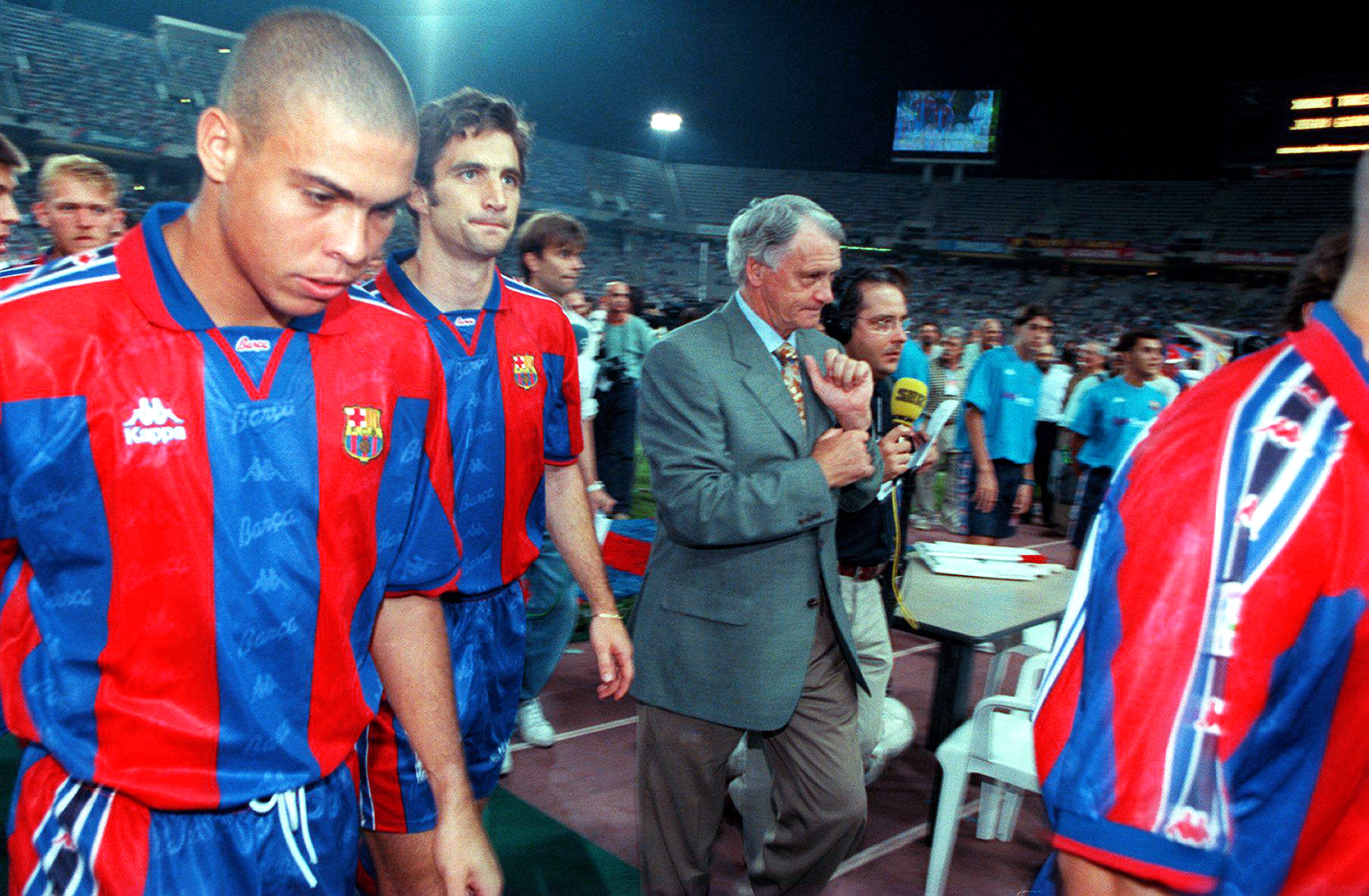
By 1996, after Cruyff’s best days, the conversation happened again and with Robson gaining experience across Europe, working in the Netherlands with PSV and in Portugal with Sporting and Porto, he took on the biggest role of his club career. To welcome him, Barcelona splashed the cash on a host of new signings, taking advantage of increased TV revenues and the post-Bosman transfer world. The most notable of all signings was a 20-year-old Ronaldo, who moved for a world-record €15 million fee from PSV. In negotiations, Barcelona were reluctant to pay the hefty fee, but Robson, having heard good things about the Brazilian from his former club, was adamant his new side were signing a world-beater who would shine at the Camp Nou for years to come.
They started strongly, winning the Supercopa against Atlético Madrid and going unbeaten in the league for the first two months — with Ronaldo, despite a relatively complicated first few games, finding his feet and the back of the net on the regular. They were scoring for fun, netting 39 times in the first 13 games and reaching the top of the league before their first defeat. In Europe, they also thrived, winning the first two rounds through the autumn to make it to the last eight. But for the fans, who were still reeling after the betrayal of Cruyff, it wasn’t enough. There was a large section of those that were anti-Robson, not necessarily because of any animosity against the Englishman, but rather to express their displeasure towards Núñez and Gaspart, who were losing popularity by the day across the city.
Speaking to Jimmy Burns for his book, Barça: A People’s Passion, Robson said: “I came here afterJohan Cruyff. He was a god, a hero here, he’d been here eight years and during it had been magnificent. I didn’t realise the political battle I was coming into, to be honest — what he meant to the city, with half the club thinking he should have gone, and half thinking he should not have gone, and how those who were with him were against the president and were therefore against the new coach.
He continued: “This is what football here is all about, it’s about power, about the necessity of winning, it’s about this city and about Catalonia. The army cannot be defeated. It’s a good job I was experienced because a younger coach would have cracked under the pressure. It was relentless. Meeting the press every day, seeing the power of the press, half of it attacking me all the time, hoping that I’d fail. I used to say to myself, “Do I need this in my life? I didn’t come here for this political battle; I came here to try and win football games.”
But while Barcelona were thriving, so were their rivals in the capital. Real Madrid were looking just as healthy domestically, and when the two met in the first Clásico of the season in December, it was to be the litmus test of the strength of Robson’s team. The meeting at the Bernabéu didn’t go as planned: goals from Davor Šuker and Predrag Mijatović gave Real Madrid a comprehensive win, and Barcelona wouldn’t see the top of the table from there on out. Tempers flared further, but Robson, aware that this was a team that had struggled in previous years towards the end of Cruyff’s tenure, felt the Blaugrana were doing as well as they could.
Going into the new year, the manager received an offer to manage Newcastle, his boyhood club and the city where he grew up, but turned it down. He felt he was stable enough at the Camp Nou, and felt he had the assurances that he would be in the job for years to come. More than that, he was confident of a strong end to the season. Still, there were those that didn’t quite see the vision, and those that didn’t have faith in Robson or Barcelona as a whole. Speaking to Esquire, Robson said in the middle of the campaign: “If I was second place in England and in the last eight of the FA Cup and European Cup Winners Cup with a great chance of going through, I’d be a hero and king of the city. But you have to win every game and be above Real Madrid. You know, when I took over from Johan Cruyff, he was a legend both as a player and as a manager, and no one remembers that he hadn’t won anything for two years. We’ve scored sixty goals in half a season and they’re still bitching.”
Amongst the squad, Ronaldo, who had a fine first half of the season, was also starting to get cold feet. The forward was playing the finest football of his young career and interest in him from Europe’s top clubs was rising. He didn’t help matters by confirming in an interview in the middle of the campaign that he had received several offers, and that he wanted to resolve his long-term future with Barcelona as soon as possible, something the club were unable to do. Still, many fans felt he was dispensable. A poll by local paper Sport revealed they found the midfielder, Luis Enrique, more important to the club than the Brazilian, perhaps adding to Ronaldo’s insecurity in Catalonia.
There wasn’t a superstar quite like Ronaldo. On the pitch, he regularly delivered, even winning the FIFA World Player of the Year award in 1997 and off it, his marketability was unmatched — TV shows constantly tried to have him on while he was a frequent feature on front and back pages of newspapers across the world, even in the US, where football wasn’t quite as prominent. Controversy hit its maximum in February 1997, when pictures of him and his girlfriend at the annual Brazilian carnival in Rio de Janeiro. That he was given permission to go while the team was chasing Real Madrid was seen as a sign of weakness by the media against Robson.
With the league title proving to be a tough challenge against a consistent Real Madrid, Barcelona focused on the two cups. In the Copa del Rey, they were able to dispatch their greatest rivals on the way to the final, and in Europe, Sweden’s AIK and Fiorentina from Italy were beaten in the spring to put Barcelona in the Cup Winners’ Cup final in Rotterdam, where they would face Paris Saint-Germain.
The final against PSG came first, and in a rather dull game in the Netherlands, Barcelona came out 1-0 victors. Ronaldo, who was scoring through the season, netted the winning penalty just before half-time, and it was a success in defensive strategy. Despite the goal, many noted how he, and his coach, looked deflated. Ronaldo lacked energy through the game, while even in celebrations, Robson seemed as though the politics of the club was getting to him. Still, the Englishman would be able to leave the club with some silverware. A month later, Barcelona took on Real Betis in the Copa del Rey final - fittingly at the Santiago Bernabéu, a good enough replacement for not winning the league.
In a more thrilling encounter, Barcelona won this too - beating their opponents 3-2 — despite going behind twice. It was Luís Figo’s double that would secure the win, in what would be the Portuguese star’s finest hour in his short Barcelona career thus far. The season was exhausting, but to be able to end it with the Barça hymn and thousands of jubilant Catalans at the home of Real Madrid was an excellent reward. By the end, as many had expected, Ronaldo found the offer from Inter in Italy better for his future, and Robson, after disagreements with those above him, would leave too. “I’ve made history,” Robson said in his final interview. “I must be the first coach to win three out of four titles in his first season at a club and not get the chance to carry on.”