Argentina vs Cape Verde Tactical Analysis: How the Blue Sharks Made the World Champions Lose Control

TP
0subscribers
4 Jul 202616 min

Yesterday, the world did not merely watch Cape Verde.

It paused.

It leaned forward.

It remembered why football became the world's language long before it became the world's business.

For one extraordinary night, the map became irrelevant. Population became irrelevant. Reputation became irrelevant. Only courage remained.

Cape Verde did not lift the trophy. They lifted the imagination of millions. They reminded Argentina that giants still bleed, and reminded the rest of us that the distance between impossible and inevitable is sometimes no more than ninety—or one hundred and twenty—minutes of unwavering belief. Their performance drew admiration around the football world despite the extra-time defeat.

Years from now, the statistics will tell you Argentina won.

Memory will tell you something richer.

It will tell you that the world stood still for Cape Verde.

And in that stillness, football whispered its oldest truth

Miracles do not always wear medals.

Sometimes, they simply wear blue.


 How Argentina Constructed Possession but Lost Control

Argentina finished the match with more possession, more passes and more territorial dominance, yet those numbers disguised an important tactical reality. They controlled where the game was played, but not how the game evolved

Scaloni's team built patiently from the first line. Cristian Romero and Lisandro Martínez stretched across the width of the pitch, inviting Cape Verde's first line of pressure before releasing Enzo Fernandez between them. From there, Rodrigo De Paul and Alexis Mac Allister occupied staggered heights, constantly offering diagonal passing lanes while Lionel Messi drifted away from the forward line to become an additional midfielder. It was a familiar positional structure, designed to create superiorities through occupation rather than direct movement.

The intention was clear. Argentina did not want to attack Cape Verde immediately after recovering possession. Instead, they sought to move the defensive block horizontally until a passing lane into the half-space finally appeared. Every circulation across the back line was therefore an investment in a future action. The possession itself was not the attack; it was the preparation for the attack. However,Cape Verde's compact 4-1-4-1 continuously reduced the distance between midfield and defence, preventing Argentina from connecting successive vertical passes. Messi often received possession, but rarely while facing the opposition goal. Lautaro Martínez found himself surrounded before combinations could develop, while Mac Allister and De Paul were constantly forced into receiving under pressure instead of receiving between defensive lines. Argentina therefore enjoyed access to harmless zones while being denied entry into decisive ones.

This distinction gradually altered the psychological rhythm of the game. Argentina completed long passing sequences that generated territorial occupation but produced surprisingly little disorganisation inside Cape Verde's defensive block. Every completed pass appeared to reinforce Argentine dominance, yet every failed vertical progression reinforced Cape Verde's confidence. The underdogs began to recognise that surviving without the ball did not necessarily mean suffering.

The consequence became increasingly visible after each Argentine attack broke down. Because so many players had advanced to sustain positional superiority around the ball, losing possession immediately transformed their attacking structure into a defensive vulnerability. Cape Verde escaped the first wave of pressure with remarkable composure before accelerating vertically into spaces left behind Argentina's advanced midfielders. Rather than controlling transitions through their possession, Argentina inadvertently created the conditions that made those transitions increasingly dangerous.

Perhaps that explains why Lionel Messi's post-match assessment focused not on what Argentina achieved with the ball, but on what happened after they lost it. "We lost the ball, we sat back," he admitted afterwards, acknowledging that the team's greatest problem was not the construction of possession itself but the inability to maintain control once that possession disappeared. The paradox of Argentina's performance, therefore, was not that they lacked the ball. It was that they possessed it for long enough to believe they controlled the match, while Cape Verde quietly controlled the moments that ultimately mattered most.

 Cape Verde's Relational Compactness

What made Cape Verde's defensive display exceptional was not simply their compactness, but the intelligence behind it. Too often, compact defending is described as reducing distances between players, as though organisation were merely a question of geometry. Bubista's side demonstrated something far more sophisticated. Their objective was not to close space for its own sake, but to preserve the relationships between defenders, midfielders and forwards so that Argentina could never connect one dangerous action to the next.

This became evident every time Cristian Romero or Lisandro Martinez carried the ball into midfield. Rather than allowing Lionel Messi's movement to lure individuals out of position, Deroy Duarte and Kevin Pina constantly adjusted their positions relative to one another. When Messi drifted away from the front line and into the left half-space, Kevin Pina rarely followed him all the way. Instead, he delayed Messi just long enough for Laros Duarte to narrow his position while Roberto Lopes and Diney Borges held the defensive line. Messi could receive possession, but he could never receive it inside a chain reaction of open passing lanes

That is the essence of relational compactness. The individual does not solve the problem. The relationship between individuals does.

One sequence midway through the first half captured this beautifully. Enzo Fernández broke Cape Verde's first line by finding Alexis Mac Allister between the lines. Ordinarily, this is where Argentina become dangerous. Yet before Mac Allister could even turn, Kevin Pina had stepped across his shoulder, Laros Duarte had closed the passing lane back into Messi, while Steven Moreira tucked inside to remove Thiago Almada's run beyond the full-back. Mac Allister still had possession, but every progressive option had disappeared.

The same collective intelligence surrounded Lautaro Martínez throughout the evening. Roberto Lopes was rarely interested in winning the duel immediately. Instead, he concentrated on preventing Lautaro from facing goal, trusting Diney Borges to provide cover from behind while Kevin Pina screened any bounce pass into Messi or Rodrigo De Paul. Lautaro was therefore never truly isolated against one defender. Every duel became a three-player problem, solved collectively before it became individually.

Cape Verde's wingers also defended with remarkable discipline. Ryan Mendes and Jovane Cabral did not simply recover into wide positions; they defended diagonally. Whenever Nahuel Molina advanced on Argentina's right, Jovane Cabral recovered inside first, protecting the half-space before engaging the full-back. This subtle movement prevented De Paul from exploiting the inside channel while simultaneously allowing Steven Moreira to confront Molina without exposing the centre. On the opposite flank, Ryan Mendes mirrored the same behaviour with Facundo Medina, constantly narrowing to protect Borges before releasing himself towards the touchline only when the pass became inevitable.

Perhaps the clearest evidence of Cape Verde's organisation came after Argentina switched play. Positional teams often expect a long diagonal pass to create temporary superiority because the far-side block requires time to travel. Cape Verde almost eliminated this delay. As Romero searched for Medina with cross-field passes, the entire block moved together as though connected by invisible strings. There were no desperate sprints, no emergency recoveries, only synchronised movement. The ball travelled faster than the players, yet the defensive relationships somehow arrived first.


Messi As  The  Moving Reference Point

Lionel Messi has long since stopped being a conventional centre-forward. Against Cape Verde, he was something far more influential: a moving reference point around which Argentina's entire positional structure continuously reorganised itself. Rather than occupying one position, Messi occupied multiple reference frames. His movements did not simply create passing options; they constantly redefined where teammates should stand, when they should move and which spaces Cape Verde were forced to protect. Argentina's possession, therefore, was less about circulating around zones than circulating around Messi himself.

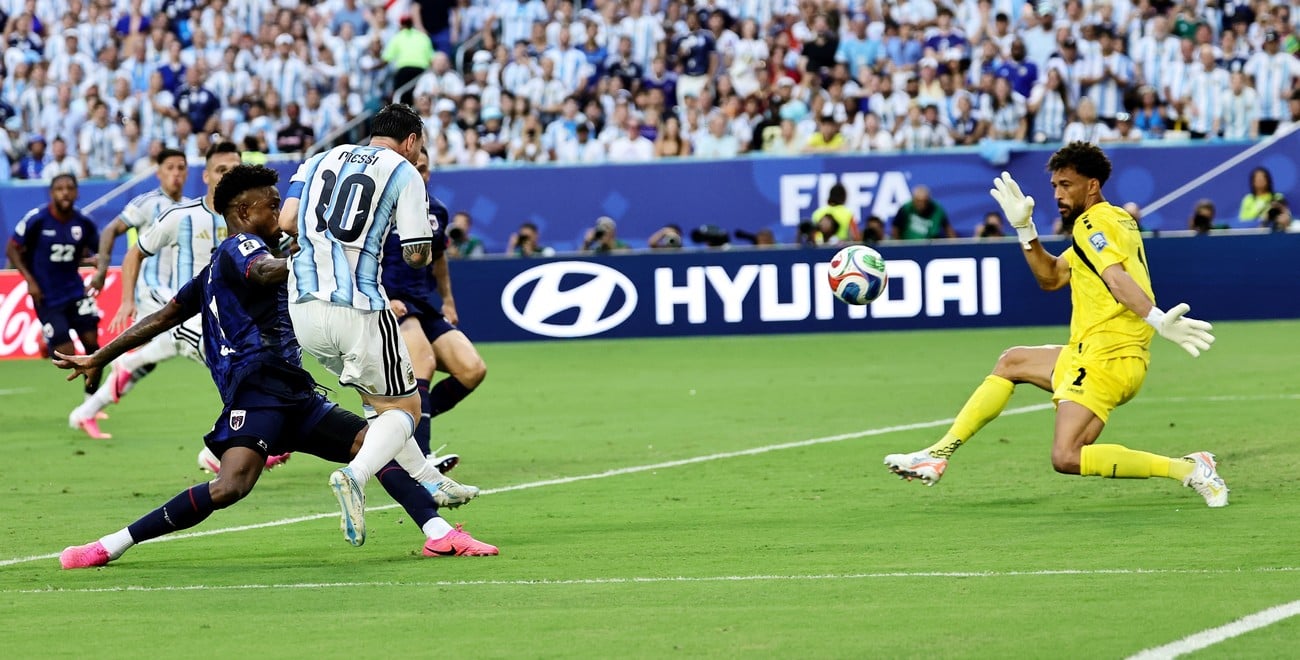
The opening goal illustrated this principle perfectly. As Cristian Romero and Lisandro Martinez patiently recycled possession across the first line, Messi initially remained close to Lautaro Martínez, pinning Roberto Lopes and Diney Borges. Then, almost imperceptibly, he drifted away from the defensive line into the inside-right channel. The movement was not explosive. It was timed. Lisandro Martinez immediately recognised the changing structure  threaded a flat diagonal pass into the newly created corridor. Messi's first touch carried the ball into his stride before Vozinha could adjust his positioning, and his finish into the roof of the net completed a move that had been constructed by movement long before it was finished by technique.

Yet Cape Verde refused to interpret Messi's movement as an invitation to abandon their structure. Kevin Pina rarely chased him into deeper positions, while Deroy Duarte shifted laterally to reduce the angle into Alexis Mac Allister. Behind them, Roberto Lopes resisted stepping into midfield, trusting Diney Borges to maintain the defensive line instead of following Messi's gravitational pull. This restraint was perhaps Cape Verde's greatest tactical achievement. They acknowledged Messi's freedom without allowing his freedom to dictate their own behaviour.

That forced Messi to become something different as the match progressed. Rather than receiving between the lines and immediately accelerating attacks, he increasingly dropped alongside Enzo Fernandez during the first phase of build-up. This created a temporary numerical superiority against Cape Verde's first line of pressure, allowing Argentina to progress into midfield with greater security. However, each successful progression also revealed the limits of that superiority. Because Cape Verde's midfield and defensive lines remained so closely connected, Messi often received facing his own goal rather than the opposition's. He could organise possession, but he could not always transform it into penetration.

This distinction became increasingly important in the second half. Argentina continued to funnel attacks through Messi, but Cape Verde gradually altered the conditions under which he received the ball rather than attempting to prevent the reception altogether. Every touch became slightly slower, every passing lane slightly narrower and every combination slightly more difficult. Messi remained Argentina's reference point, yet the reference itself had been repositioned further from the spaces where matches are ultimately decided

Perhaps that was the deeper tactical story of the evening. Argentina's dependence on Messi was not merely creative but structural. Every attacking pattern sought his involvement, every positional rotation revolved around his movement and every decisive moment still seemed to require his intervention, whether through his goal or the decisive corner that eventually forced the winning own goal. Cape Verde could never silence Messi completely, but by controlling the spaces around him rather than the man himself, they ensured that the world's greatest organiser spent far more time constructing attacks than completing them. In doing so, Bubista's side demonstrated that even against football's most gifted reference point, the collective can still shape the individual

Transitions  From Hell: Why  Cape Verde Transitions Repeatedly Broke Argentina's Counterpress

For much of the last four years, Argentina's counterpress has functioned as the  foundation of their possession game. The objective is not merely to recover the ball quickly after losing it, but to prevent the opposition from transforming defence into attack. Possession therefore extends beyond the moment the ball is lost. If the first few seconds after losing possession are controlled, the attack has not truly ended. Against Cape Verde, however, those first seconds repeatedly belonged to the underdogs.

The reason was not that Argentina counterpressed poorly. On the contrary, Rodrigo De Paul immediately sprinted towards the ball after turnovers, Enzo Fernandez aggressively stepped forward to close the central lane, while Alexis Mac Allister narrowed from the left to compress the immediate passing options. Behind them, Cristian Romero and Lisandro Martínez held an unusually high defensive line, attempting to squeeze Cape Verde inside a thirty-metre zone. The structure itself remained intact. It was the timing of Cape Verde's solutions that repeatedly dismantled it.

The first pass after recovery was always the most important. Rather than forcing ambitious vertical balls, Kevin Pina consistently offered himself as the immediate outlet in front of Roberto Lopes and Diney Borges. Instead of playing forwards under pressure, he often received side-on, using his first touch to escape De Paul's pressing angle before releasing Deroy Duarte or Laros Duarte with a simple pass. That seemingly conservative action completely changed the transition. Argentina's counterpress thrives on chaotic first touches. Cape Verde refused to provide them.

Once the first pressure had been escaped, the attack accelerated almost instantly. Deroy Duarte became the bridge between recovery and progression, constantly turning into open space before Argentina's midfield could recover its compactness. Ryan Mendes and Jovane Cabral immediately stretched the pitch with opposite movements. One attacked the outside shoulder of Nahuel Molina or Facundo Medina, while the other narrowed inside to occupy the attention of Romero and Lisandro Martinez. The transition was never random. Every run created space for the next action.

Cape Verde's equaliser illustrated these principles beautifully. Argentina had committed numbers around the ball in sustained possession, expecting their usual rest defence to secure the inevitable turnover. Instead, Cape Verde escaped the first wave of pressure through calm circulation before Deroy Duarte arrived into the space vacated by Argentina's advancing midfield. His low finish was the final action of a transition that had been won not by speed alone, but by composure during its opening seconds.

Perhaps the most revealing aspect of Cape Verde's transitions was their refusal to confuse pace with haste. Many underdogs respond to recoveries by immediately searching for the longest possible pass. Bubista's side understood that the fastest attack is often the one delayed by a single controlled touch. Kevin Pina repeatedly slowed the game just enough to eliminate Argentina's nearest presser before the vertical acceleration began. That brief pause transformed disorder into structure for Cape Verde —every successful escape forced Romero and Lisandro Martinez into retreat rather than anticipation. 

The Battle for Width and Half-Spaces

Argentina's attacking structure has never been built around width for its own sake. The touchline merely serves as the first movement in a longer positional sequence. By placing Nahuel Molina high on the right and Facundo Medina aggressively on the left, Lionel Scaloni sought to stretch Cape Verde's defensive block horizontally so that Lionel Messi, Rodrigo De Paul and Alexis Mac Allister could receive inside the half-spaces. Width was therefore not the destination of the attack. It was the mechanism through which Argentina hoped to manufacture central superiority.

From the opening exchanges, Cristian Romero and Lisandro Martínez repeatedly searched for Molina with diagonal passes whenever Cape Verde's midfield shifted towards the ball. As Ryan Mendes narrowed to support Kevin Pina, Molina immediately advanced into the newly opened lane. Yet instead of attacking Molina directly, Ryan Mendes curved his recovery run to block the passing lane back inside towards Rodrigo De Paul. Steven Moreira therefore had time to move across and confront Molina on the touchline, knowing the more dangerous interior connection had already disappeared. Argentina reached the wing exactly as planned, but never reached the half-space they truly desired.

The same pattern developed on Argentina's left. Facundo Medina constantly pushed beyond the halfway line, attempting to pin Steven Moreira's opposite full-back, Sidny Lopes Cabral, deep into his own defensive third. Thiago Almada drifted inside towards Alexis Mac Allister, hoping that Medina's overlapping movement would force Sidny Lopes Cabral wide and create a passing lane into the inside-left corridor. Instead, Jovane Cabral repeatedly tracked Medina's run before releasing him only once Sidny Lopes Cabral had recovered into position. The responsibility was shared rather than transferred. Every defensive action protected the relationship between teammates before confronting the ball itself.

This collective understanding repeatedly frustrated Messi. Whenever he abandoned the forward line and drifted into the inside-right channel, Roberto Lopes resisted stepping out from central defence. Kevin Pina shuffled across to reduce the passing angle, Laros Duarte narrowed from midfield to screen Enzo Fernandez,while Ryan Mendes recovered inside to deny the combination with Molina. Messi still received possession, but the supporting triangle around him had quietly dissolved. Cape Verde were not denying the first pass; they were denying the second and third.

As Argentina struggled to access the interior, they gradually altered the behaviour of their full-backs. Molina became more aggressive with underlapping runs inside Ryan Mendes, while Medina began arriving later on the outside rather than remaining permanently high. These changes briefly unsettled Cape Verde's defensive references because Steven Moreira and Sidny Lopes Cabral were now forced to decide whether to pass runners on or follow them into unfamiliar zones.

What made Cape Verde's performance remarkable was that they understood the true objective of Argentina's positional play. Bubista's side never interpreted Molina or Medina as the principal threat. They recognised that the danger lay in the chain reaction those wide movements were designed to create. Ryan Mendes and Jovane Cabral therefore defended from the inside out, Kevin Pina constantly shifted across to seal the nearest half-space, while Roberto Lopes and Diney Borges refused to leave the defensive line unless absolutely necessary. Argentina repeatedly occupied the width of the pitch. Cape Verde repeatedly protected its most valuable areas.


Winning the Second Ball: The Set-Piece That Finally Stretched Cape Verde

Lisandro Martínez's goal early in extra time appeared to come from a simple corner, but its origins lay in Argentina's manipulation of the second phase rather than the initial delivery. Instead of attempting to score directly from Lionel Messi's inswinging corner, Argentina overloaded the near-post zone with Alexis Mac Allister, Cristian Romero and Lautaro Martínez. The objective was not necessarily to produce a clean header on goal. It was to destabilise Cape Verde's zonal structure and redirect the ball into a less protected area.

Cape Verde defended the corner with a compact zonal line led by Roberto Lopes and Diney Borges, while Kevin Pina and Deroy Duarte were positioned to attack second balls outside the six-yard box. Initially, the structure held. However, Alexis Mac Allister's near-post flick subtly changed the trajectory of the delivery. Instead of travelling into the zone Cape Verde had prepared to defend, the ball skipped beyond the first defensive line towards the back post. In one touch, Mac Allister transformed a predictable aerial duel into an unpredictable second-ball situation.

This was precisely where Lisandro Martinez became decisive. Rather than attacking the first contact like Romero or Lautaro, he deliberately held a deeper starting position behind Cape Verde's defensive line. As Roberto Lopes and Diney Borges reacted to Mac Allister's flick, both defenders momentarily lost sight of Martinez. Their body orientation remained towards the original flight of the corner rather than the redirected ball. Martinez, meanwhile, had already adjusted his run.The timing of that movement was perhaps the most important aspect of the goal. Martinez did not sprint into the space before the flick. He waited until Mac Allister altered the ball's direction, ensuring he arrived as the ball arrived.

When the ball dropped inside the six-yard box, Vozinha's positioning became equally difficult. Goalkeepers organise themselves according to the expected trajectory of the cross. Mac Allister's flick forced Vozinha to shift laterally while simultaneously adjusting his depth. Before he could reset his feet, Martinez attacked the loose ball with an aggressive first-time finish into the roof of the net, giving the goalkeeper almost no reaction time.

 The Tactical Evolution After the Equalisers

Cape Verde's equalisers

Cape Verde's equalisers did more than restore parity on the scoreboard; they fundamentally altered the tactical landscape of the match. Until Deroy Duarte's strike made it 1-1, Argentina had remained patient in possession, trusting their positional structure to eventually create decisive openings. After each equaliser, however, the game became increasingly transitional. Instead of dictating the rhythm through circulation, Lionel Scaloni's side were forced into a contest of repeated attacks, where emotional urgency gradually replaced positional patience.

One noticeable adjustment came in the positioning of Enzo Fernández and Rodrigo De Paul. Earlier, Enzo had remained close to Cristian Romero and Lisandro Martínez during the first phase, ensuring stability against counterattacks. Following Cape Verde's first equaliser, he began operating much higher, often arriving alongside Alexis Mac Allister between the lines. De Paul simultaneously abandoned his conservative supporting role, making more aggressive runs beyond Lionel Messi into the right half-space. Argentina were no longer satisfied with circulating around Cape Verde's block. They attempted to occupy it with greater numbers.

This inevitably changed Cape Verde's defensive behaviour as well. Kevin Pina and Deroy Duarte could no longer remain exclusively focused on screening central passing lanes. They were increasingly drawn towards individual duels with Enzo and Mac Allister, while Roberto Lopes and Diney Borges defended deeper inside their own penalty area. Rather than stepping forward to compress space, Cape Verde gradually prioritised protecting the box. Their compactness remained, but its reference point shifted several metres closer to Vozinha's goal.

The second equaliser, scored spectacularly by Sidny Lopes Cabral, produced an even more significant transformation. At 2-2 in extra time, Argentina almost abandoned the measured positional play that had characterised much of their tournament. Cristian Romero began carrying possession forward instead of simply recycling it across the defensive line, Lisandro Martínez advanced aggressively into midfield after releasing passes, while Nahuel Molina and Facundo Medina remained permanently high, effectively pinning Cape Verde's wide players inside their own defensive third. Sustained pressure replaced controlled possession

What This Means for Argentina Against Egypt

Argentina survived Cape Verde, but survival alone will not be sufficient against Egypt. Hossam Hassan's side arrive in the Round of 16 with a different tactical profile, one built around defensive compactness, disciplined midfield spacing and the transition threat of Mohamed Salah. While Cape Verde primarily attacked through collective combinations after escaping the counterpress, Egypt possess an individual outlet capable of turning defensive recoveries into immediate attacking opportunities. Argentina therefore face a different problem, but one exposed by many of the same weaknesses against Cape Verde.

The greatest concern for Lionel Scaloni will be the behaviour of Argentina's rest defence. Against Cape Verde, Cristian Romero and Lisandro Martínez were repeatedly forced to defend large spaces after the first line of pressure had been bypassed. Egypt will actively seek those moments. If Enzo Fernandez and Rodrigo De Paul continue to advance simultaneously during sustained possession, Salah will repeatedly find himself attacking the channels outside Argentina's centre-backs, particularly if Nahuel Molina or Facundo Medina are caught high up the pitch. The issue is therefore not merely defending Salah, but preventing the situations in which he becomes decisive

Equally important will be Argentina's ability to convert possession into genuine control. Cape Verde demonstrated that circulating the ball is not enough if the opponent's defensive relationships remain intact. Egypt are likely to defend with similar compactness around the central corridor, inviting Argentina towards the wings before collapsing around the penalty area. That means Lionel Messi, Alexis Mac Allister and Julian Álvarez—or Lautaro Martínez, depending on Scaloni's selection—must create superiority through coordinated movements rather than waiting for individual moments of inspiration. Against a compact block, the timing of movement becomes more valuable than the quality of the pass.

Perhaps Cape Verde provided Argentina with the ideal warning at precisely the right moment. Their victory exposed that possession without stable rest defence creates vulnerability, while territorial dominance without penetration produces frustration. If Argentina absorb those lessons, they remain favourites. If they repeat the same structural imbalances, Egypt possess both the organisation to absorb pressure and the attacking quality to punish every misplaced transition. In knockout football, improvement is often less about playing better than the previous match and more about solving the tactical questions the previous match revealed.

 Conclusion

When the World Cup is over, the trophy will find a home.

But the stories—The stories will find a forever.

They will drift across generations, carried by fathers to sons, mothers to daughters, whispered wherever a football rolls across concrete, sand or grass.

And somewhere, years from now, someone will ask,

"Did Cape Verde really make Argentina suffer like that?"

The answer will come with a smile.

"You had to be there."

By Tobi Peter

@keepIT_tactical


TP
0subscribers