Argentina vs Egypt WC 2026 Tactical Analysis: The Egyptian Miracle That Lasted 80 Minutes
Before there was football, there were stories.
Stories of deserts that tested the limits of human endurance. Stories of Pharaohs who believed greatness was measured not by what was possessed, but by what survived the passing of time. Egypt has always understood that immortality is never just inherited. It is also earned.
On this World Cup night, another Egyptian generation arrived carrying that same belief.
Their opponent required no introduction.Three stars stitched above the crest. Three World Cups won across nearly half a century. Argentina were not simply chasing another trophy; they were pursuing permanence. Lionel Scaloni had rebuilt a champion, but champions discover quickly that history grants no discounts. Every knockout match begins with the same question: Can yesterday's glory survive today?
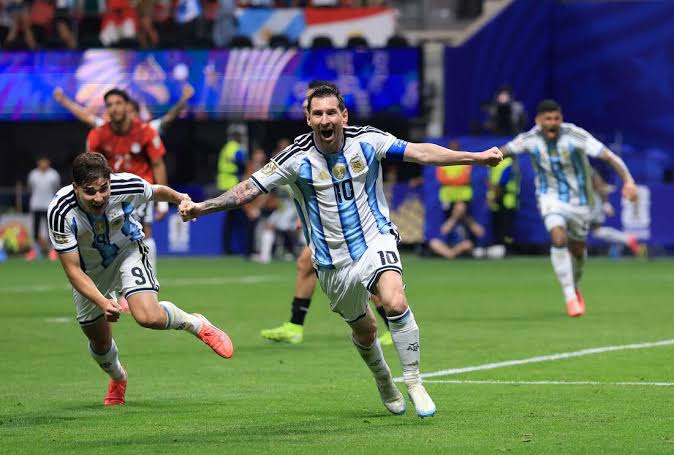
At the heart of that ambition stood Lionel Messi.From Argentina's opening match of the group stage to this Round of 16, he had scored in every single game. Five matches. Five goals. Every touch carried the strange weight reserved for football's rarest figures. The world was no longer simply watching a player. It was watching one of the greatest treasures the game has ever entrusted to mankind, fully aware that such gifts are borrowed, never owned
Yet football has always reserved a peculiar fascination for kings confronting kingdoms that refuse to kneel.
Egypt arrived without the glitter of favourites or the weight of expectation. They arrived carrying discipline, conviction and a defensive structure that asked uncomfortable questions of even the most gifted opponents. For nearly eighty minutes, the Pharaohs did not merely resist Argentina—they persuaded the world that perhaps football's greatest treasure could finally be locked inside an ancient tomb of their own making.
Then the game changed,The scoreline would eventually read Argentina 3, Egypt 2.The match, however, was never really about five goals.
It was about two civilisations of football—one built on centuries of history, the other on ninety minutes of extraordinary collective belief—meeting on the narrowest bridge between elimination and eternity.
Egypt's Defensive Structure: Defending the Destination, Not the Ball
One of the greatest misconceptions about low-block defending is that it is passive. Egypt's performance against Argentina demonstrated the opposite. Their defensive organisation was highly active, not because they constantly pressed the ball, but because they constantly adjusted their positions relative to the spaces Argentina wanted to attack.This principle could be seen immediately in the behaviour of Egypt's midfield three. Mohanad Lasheen remained the structural anchor, rarely abandoning the space in front of Yasser Ibrahim and Ramy Rabia. Ahead of him, Marwan Attia and Emam Ashour worked laterally rather than vertically, constantly adjusting their body orientation to block the passing lane into Lionel Messi while remaining close enough to press Enzo Fernandez or Alexis Mac Allister if either received facing forward. Their movements were remarkably economical. Rather than sprinting toward the ball, they simply arrived early enough to ensure that the next Argentine pass was never the obvious one.
Argentina therefore encountered an unusual paradox. Cristian Romero and Lisandro Martinez completed countless passes between themselves, while Emiliano Martínez calmly recycled possession whenever necessary. Yet every progressive option became increasingly expensive. Whenever Romero attempted to pierce the first midfield line into Enzo Fernandez, Lasheen would narrow the angle before the pass arrived. If Lisandro Martinez looked for Messi between the lines, Marwan Attia immediately shifted inside while Ramy Rabia held his position behind him instead of following Messi into midfield. Egypt were not defending individual players; they were defending the relationships between them.
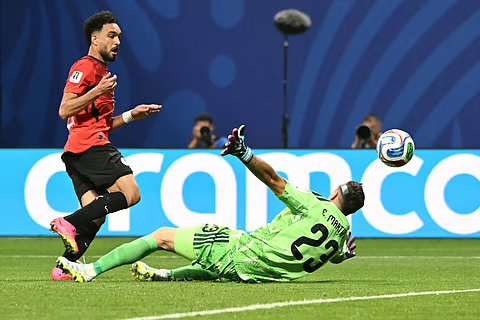
The distinction was particularly evident in how they handled Messi. Many teams attempt to solve the Messi problem with aggressive man-marking, inevitably opening new spaces elsewhere. Egypt chose a subtler solution. Messi often appeared free, but he was free only in places where the ball could not reach him. As he drifted into the right half-space, Attia screened the direct lane while Lasheen remained underneath to protect the second line. If Messi dropped deeper to receive, Haissem Hassan narrowed from the flank to help compress the passing window without abandoning Nahuel Molina completely. The objective was never to surround Messi after his first touch; it was to prevent that first touch from occurring in a dangerous position.
Egypt's back four complemented this strategy with exceptional restraint. Mohamed Hany and Karim Hafez resisted the temptation to jump aggressively toward Argentina's wide players, trusting the midfield to recover inside.Meanwhile, Yasser Ibrahim and Ramy Rabia refused to be dragged out of the defensive line by Julian Alvarez's constant movement across the front. Alvarez repeatedly attempted to pin one centre-back before creating a channel for Messi to exploit, but the Egyptian pairing rarely lost their horizontal connection. By staying compact and passing runners between themselves rather than following them individually, they prevented Argentina from creating the dislocations that normally define Scaloni's attacking play.
Perhaps the clearest example of Egypt's defensive intelligence came whenever Rodrigo De Paul tried to accelerate the tempo. De Paul repeatedly positioned himself outside Egypt's midfield block, hoping to receive and immediately switch play toward the advancing Nicolas Tagliafico or Nahuel Molina. Egypt anticipated these rotations brilliantly. The ball-near winger, usually Mostafa Ziko or Haissem Hassan, would recover just enough to delay the switch while the entire midfield line slid across together. Instead of arriving after the ball had travelled, Egypt's block often reached its new position before Argentina completed the switch itself. What looked like slow lateral movement from the stands was, in reality, outstanding collective timing—For almost eighty minutes, this structure transformed Argentina's possession into a fruitles exercise in repetition.
Why Messi Was Invisible And Why That Wasn't Enough
Messi's first instinct whenever Argentina struggled to progress was to move closer to the ball. Rather than remaining between Egypt's midfield and defensive lines, he repeatedly drifted toward Rodrigo De Paul and Enzo Fernandez to help construct attacks. On paper, this created numerical superiority in the first two phases of possession. In practice, it removed Argentina's greatest creative threat from the spaces where Egypt were most vulnerable. Every time Messi received thirty-five metres from goal instead of fifteen, Mohanad Lasheen could protect the central corridor without abandoning the defensive line, while Marwan Attia simply adjusted his position to screen the next forward pass. Argentina gained an additional passer but lost their most dangerous receiver.
Egypt's midfield recognised this dilemma almost immediately. Lasheen never chased Messi into deeper territory unless the movement genuinely threatened the defensive structure. Instead, he passed responsibility to Emam Ashour or Marwan Attia while remaining connected to Yasser Ibrahim and Ramy Rabia. This constant exchange of defensive references prevented Messi from creating the dislocations that usually emerge when opponents follow him individually.
The consequence extended beyond Messi himself. Julian Alvarez continually attempted to stretch Egypt's back four by making diagonal runs across Ramy Rabia and Yasser Ibrahim, hoping to create a passing lane for Messi to exploit. Yet because Messi was forced deeper to receive possession, Alvarez's often found himself occupying defenders without anyone positioned close enough to exploit the spaces he created. Alexis Mac Allister occasionally advanced beyond Messi, while De Paul underlapped from the right half-space, but these movements rarely arrived simultaneously. Argentina possessed runners without a creator in the final third, and a creator without runners close enough to combine with.
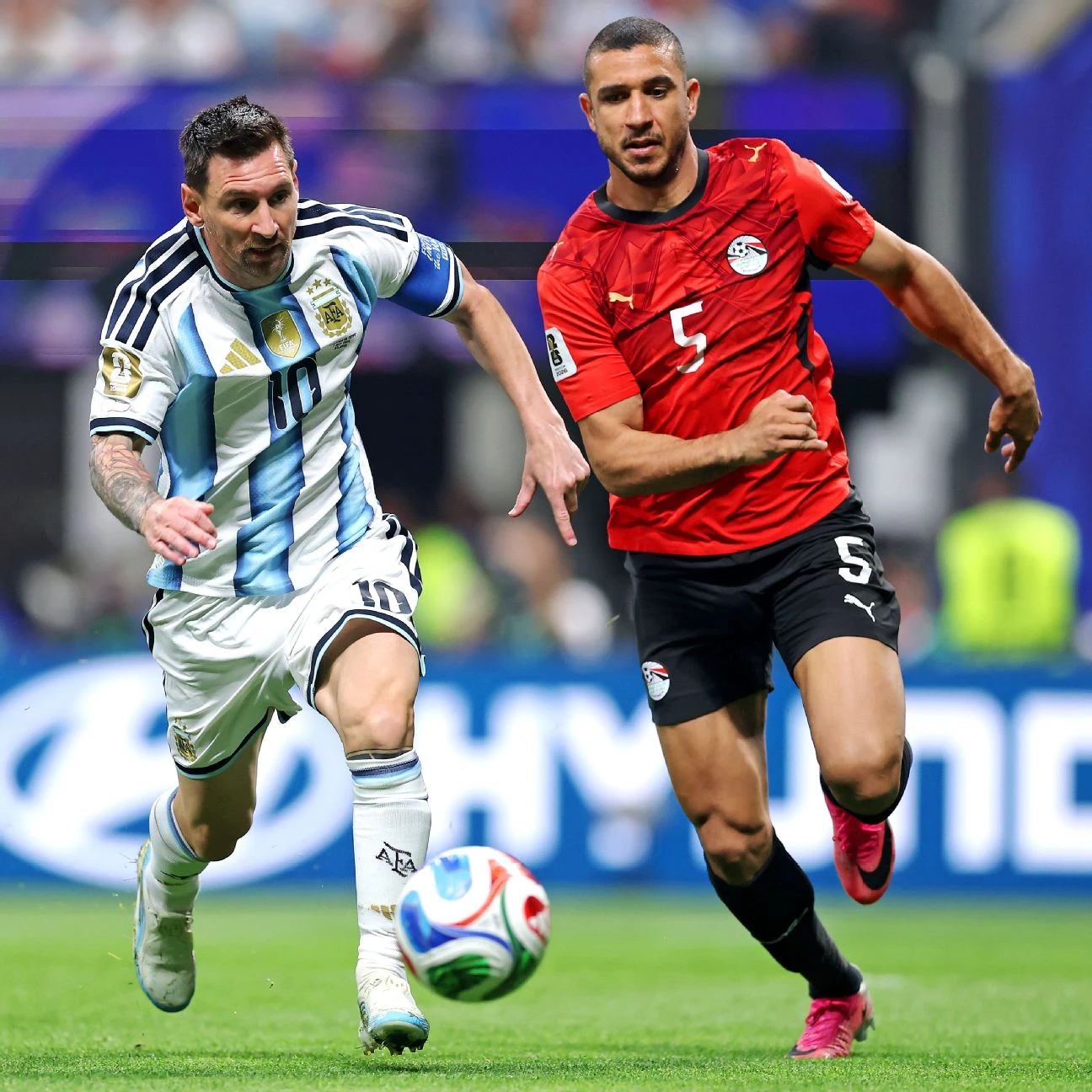
Throughout the opening hour, Messi's touches became increasingly isolated events. He would receive from Enzo Fernandez, turn away from immediate pressure and immediately confront a second defensive line already organised in front of him. Molina remained wide and Tagliafico held the opposite flank. The distances between those players were simply too large for quick combinations. Egypt had not reduced Messi's quality; they had reduced the number of meaningful options available after his first touch.
However, there was a hidden cost to this defensive success. Every collective shift toward Messi required perfect synchronisation between Egypt's midfield and defensive units. Lasheen had to remain connected to the centre-backs. Attia had to recover diagonally after stepping toward Enzo Fernandez. Ashour needed to narrow inside without leaving Tagliafico completely free. These were not physically spectacular actions, but they demanded relentless concentration and repeated lateral movement. As fatigue accumulated, those synchronisations became fractionally slower. The spaces remained small, yet they no longer appeared at precisely the right moment.
Argentina immediately recognised the change. Rather than asking Messi to descend into midfield, De Paul and Enzo Fernandez began advancing the ball higher before releasing it into him. Romero also became more aggressive carrying possession beyond Egypt's first line, forcing Lasheen to make difficult decisions about whether to confront the ball or continue protecting Messi's zone. For the first time, Messi started receiving with teammates already occupying complementary positions around him instead of waiting for support to arrive. Suddenly, his first touch no longer ended the attack; it began it.
The equaliser captured this transformation perfectly. Messi had become the central reference within a much denser attacking structure. Argentina shortened the distances between De Paul, Enzo Fernandez, Álvarez and Messi, increasing the number of immediate passing possibilities available after every reception. Egypt's earlier strategy had succeeded because it limited Messi's relationships. Once Argentina restored those relationships, merely restricting Messi's touches was no longer enough. The same player who had appeared almost invisible for more than an hour suddenly became the organiser of Argentina's comeback.
Rest Defence, Transition Windows And Salah
Perhaps the most fascinating duel of the evening did not occur when Argentina had possession, but in the brief moments immediately after they lost it. Football rewards teams that can organise themselves for the next phase before the current one has even ended. This is the logic behind rest defence: the positioning of players during possession to control the opponent's transition once possession is lost. Argentina usually excel in this aspect under Lionel Scaloni, yet Egypt repeatedly exposed the small imperfections within that structure. They did so not through prolonged counter-attacks but by recognising the few seconds during which Argentina's attacking shape had not yet become a defensive one.
Argentina's positional attack naturally stretched the pitch. Nahuel Molina advanced aggressively on the right, Nicolas qTagliafico often joined the last line on the left, while Rodrigo De Paul and Alexis Mac Allister occupied the half-spaces ahead of Enzo Fernandez. This structure created excellent conditions for sustaining attacks, but it also increased the distances Cristian Romero and Lisandro Martinez had to defend if possession changed hands unexpectedly. Whenever one of Argentina's vertical passes into Messi or Julian Alvarez was intercepted, Egypt immediately attacked the spaces beside those centre-backs rather than the players themselves. The destination of the first pass mattered less than its timing.
Mohamed Salah was the central reference for these transitions, but describing him as a traditional counter-attacking outlet understates his tactical role. He did not simply sprint into open grass waiting for long passes. Instead, he constantly positioned himself on the shoulder of Nicolas Tagliafico, inviting the Argentine left-back to advance one step higher before exploiting the space behind him. Salah's movements therefore manipulated Argentina's rest defence before the turnover even occurred. When Egypt regained possession, he rarely had to create separation through speed alone because his starting position had already created the advantage.
Egypt's midfield made those moments possible through the quality of their first pass after recovery. Mohanad Lasheen resisted the temptation to clear possession aimlessly and instead looked immediately for Marwan Attia or Emam Ashour between Argentina's advancing midfielders. If the central route remained closed, Mohamed Hany quickly found Salah's feet or the channel in front of him. These decisions were consistently made within the first two touches after regaining possession—every additional touch gave De Paul, Enzo Fernandez and Romero another opportunity to recover their defensive positions.
What made Salah particularly dangerous was his choice of movement once he received possession. Rather than dribbling directly toward goal, he frequently carried the ball diagonally inside from the right flank. This forced Lisandro Martinez into an uncomfortable dilemma:step out to confront Salah and leave Alvarez-like running lanes for Mostafa Mohamed beyond him, or hold the defensive line and allow Salah to advance toward the edge of the penalty area. Several of Egypt's most promising attacks emerged precisely because Salah transformed one defender's decision into two equally uncomfortable options.
Argentina's response gradually evolved as the match progressed. Romero became noticeably more proactive in stepping into midfield after attacks broke down, attempting to compress the space before Egypt could release Salah. Enzo Fernandez also began positioning himself closer to the ball during sustained attacks, reducing the distance he needed to cover after turnovers. These adjustments did not eliminate Egypt's transition threat, but they shortened the transition window itself. Salah still received possession, yet increasingly did so with Romero already advancing toward him rather than retreating.
The closing stages revealed another important dimension of rest defence. As Argentina committed greater numbers forward in search of an equaliser, conventional wisdom would suggest that Egypt's transition opportunities should have become even more dangerous. Instead, the opposite occurred. Argentina accepted greater numerical risk but dramatically improved their counterpressing. De Paul, Mac Allister and Enzo Fernandez immediately collapsed around the ball after every loss of possession, delaying Lasheen's first forward pass by just enough to allow Romero and Lisandro Martinez to regain compactness. Egypt's earlier transition windows, which had remained open for three or four seconds, now closed almost instantly.This little change ultimately shifted the balance of the match. For over an hour, Salah had represented Egypt's escape route whenever sustained defending became exhausting. Once Argentina reduced the quality and duration of those transition moments, Egypt lost their ability to relieve pressure. Defensive blocks rarely collapse because they suddenly forget how to defend. More often, they collapse because they are denied opportunities to breathe. Argentina's improved rest defence gradually removed those moments of recovery, trapping Egypt inside an increasingly relentless cycle of defending until the structural precision that had frustrated the world champions for so long finally gave way.
The Final Fifteen Minutes: Pressure Becomes Momentum Because Relationships Change
Until Cristian Romero scored in the 79th minute, Egypt's defensive references remained remarkably stable. Mohanad Lasheen knew when to remain connected to Yasser Ibrahim and Ramy Rabia. Marwan Attia knew when to leave Rodrigo De Paul and when to protect the lane into Lionel Messi. Haissem Hassan recovered alongside Mohamed Hany at precisely the moments Nahuel Molina attempted to advance. Each Egyptian player was solving one problem because the collective structure had already solved the others. Defensive football becomes surprisingly calm when every player recognises exactly which question belongs to him.
Argentina's improvement began when they stopped asking the same questions. Earlier, possession had travelled through predictable routes. Romero into Leandro Paredes. Paredes into Enzo Fernandez. Enzo searching for Messi. Egypt had rehearsed these pictures throughout the evening. During the final 12mins, however, Romero increasingly ignored the first pass altogether. Instead, he carried possession directly into midfield, forcing Egypt's midfield line to collapse toward the ball. That single action transformed the entire landscape. Lasheen could no longer protect space while simultaneously controlling Romero's advance. The first defensive reference had disappeared.
The consequence was not that Romero became the decisive attacking player. Rather, he changed the work everyone else had to perform. As Lasheen stepped toward Romero, Enzo Fernandez occupied the space behind him. When Marwan Attia narrowed to help, Rodrigo De Paul drifted into the vacant half-space. If Mohamed Hany followed De Paul inside, Nahuel Molina advanced outside him. Argentina were no longer attacking Egypt's block. They were attacking the connections inside that block. Every movement created another movement, until Egypt's compactness became a sequence of recoveries rather than anticipations.
The equaliser altered far more than the scoreline. It changed Egypt's perception of time. Before Romero's goal, every defensive action felt measured. After it, every action felt urgent. Marwan Attia pressed slightly earlier than before. Lasheen covered a little wider. Yasser Ibrahim stepped forward while Ramy Rabia remained behind. None of these actions were individually incorrect. Together, however, they dissolved the synchronisation that had frustrated Argentina for so long. Elite defensive systems rarely collapse because players stop working. They collapse because players begin solving tomorrow's problem before today's problem has been collectively resolved.
By the time Enzo Fernandez scored the winner,Argentina had recovered every second ball, sustained every attack and prevented alot of meaningful Egyptian transition. Pressure had acquired continuity. It no longer arrived in waves but existed as a permanent condition. Egypt's defensive block never truly left its own third because every clearance immediately became another Argentine possession.
Conclusion
Argentina continue to walk the narrowest of roads.
Against Cape Verde in the Round of 32, they stared into the abyss before finding a way back. Against Egypt, they looked into the same darkness once more, only to discover that football sometimes reserves its greatest rewards for those willing to suffer the longest.
Champions are not always recognised by how comfortably they win. Sometimes, they are recognised by how often they survive.
Yet survival should never be mistaken for invincibility.
Waiting in the quarter-finals is a Switzerland side whose greatest strength is not brilliance but conviction. They defend not merely with numbers, but with patience, precision and collective belief. They ask opponents to solve the same question again and again, until frustration becomes the greatest opponent of all.
Lionel Messi walked away from this Egyptian night with tears—not of despair, but of relief. The burden of expectation was lifted for another evening, another chapter, another heartbeat. But football has a habit of demanding a new examination from those who escape the previous one.
Cape Verde pushed Argentina to the edge. Egypt left them hanging over it. Switzerland will wonder whether this team can be pushed just a little further.
The World Cup has shown Argentina mercy twice.In tournament football, however, mercy is a guest who never stays for long. The next tears Messi sheds may again be those of joy or they may be the hot, unforgiving tears that mark the end of a champion's journey. The margin between glory and elimination has rarely felt so impossibly thin.
By Tobi Peter
@keepIT_tactical
More from Tobi Peter coming soon.
Visit the profile to follow and get notified when the next piece lands.