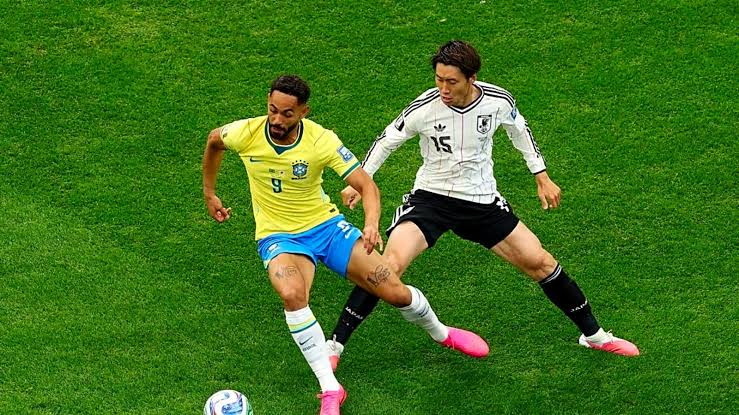
Brazil vs Japan Tactical Review: The Logic of a Knockout Comeback
Knockout football asks unusual things of the human mind. It invites us to believe that victory belongs to the team with the clearest ideas, only to remind us that clarity is often hostage to nerves, chance and the irreversible weight of a single mistake. League football permits regret; there is always another weekend to repair a misjudgement. A knockout tie offers no such mercy. Every decision acquires the gravity of a confession. The tactical landscape therefore becomes less about imposing perfection than about surviving uncertainty. The match between Brazil and Japan was shaped by precisely this tension, revealing that in football's most unforgiving moments, success belongs not to the side that controls every moment, but to the one
Brazil's Build-up: Why Escaping the First Line Was Never the Real Problem
Much of the post-match discussion focused on Japan's first line of pressure, as though Ayase Ueda's duel with Brazil's centre-backs explained the game. It is an understandable conclusion because the first line is the most visible. Yet visibility should not be confused with influence. Brazil escaped Japan's initial pressure relatively comfortably. Marquinhos circulated possession to Gabriel Magalhães, Alisson remained available as the free player, and Casemiro regularly dropped into the first line to create temporary superiority. The real difficulty began only after that first problem had been solved.
Build-up is not measured by escaping the first defender. It is measured by arriving in the next space under favourable conditions. Brazil repeatedly progressed beyond Ueda's cover shadow but almost never reached midfield with the stability needed to attack the next line. Japan wanted Brazil to believe they had escaped, only to confront them with a second, tighter network of references a few metres higher.
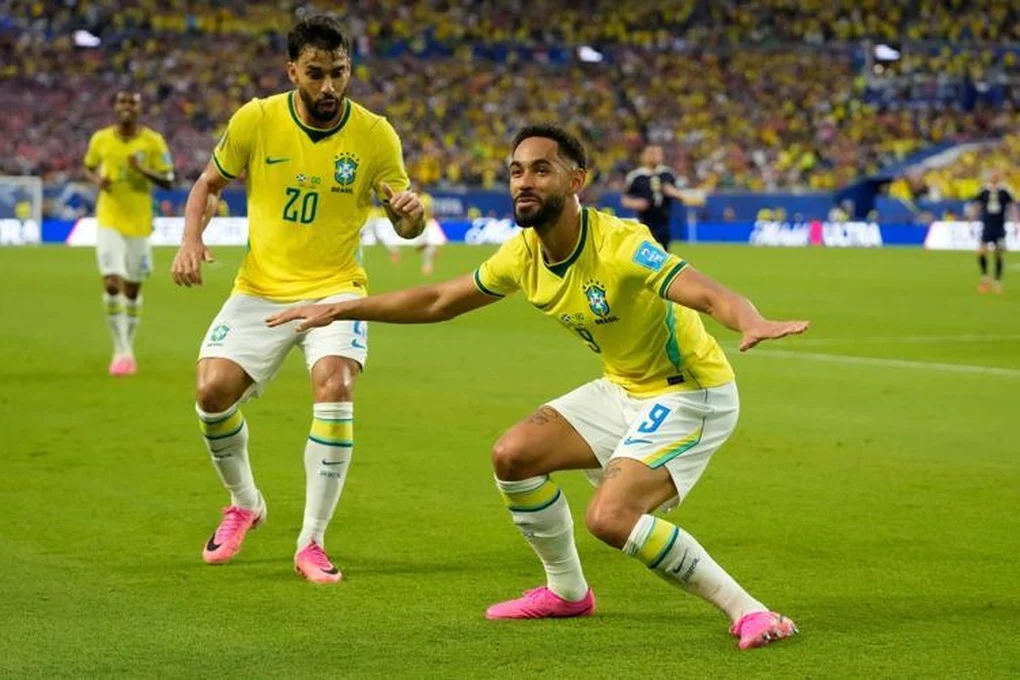
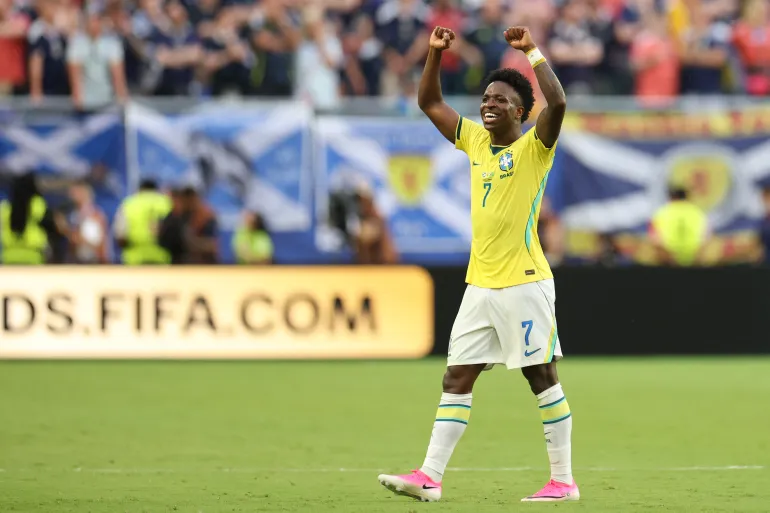
That responsibility belonged chiefly to Kaishu Sano and Daichi Kamada. Rather than pressing early, both delayed their movements until the pass had travelled. Only when Casemiro or Bruno Guimarães committed to receiving did they accelerate, arriving as the Brazilian midfielders attempted to turn. Japan were not pressing the passer; they were pressing the reception.
This timing transformed Brazil's possession. Casemiro was rarely dispossessed, yet he seldom received on the half-turn. Instead of opening his hips towards Lucas Paquetá or Vinícius Júnior, he frequently controlled the ball facing Marquinhos or Alisson. A player facing his own goal loses more than time; he loses possibilities. Japan did not steal possession—they stole orientation.
Bruno Guimarães encountered the same problem through different references. Whenever he drifted into the right half-space, Kamada adjusted from inside while Keito Nakamura narrowed from the wing, leaving Bruno receiving inside a corridor that narrowed with every touch. The space technically existed, but its geometry denied progression.
The same pattern appeared higher up the pitch. Vinícius often dropped towards Douglas Santos to create superiority on the left, yet Takehiro Tomiyasu's aggressive stepping and Ritsu Doan's recovery runs ensured he received facing the touchline rather than the penalty area. Paquetá, meanwhile, found pockets between the lines only to discover that Hiroki Ito, Kamada and Sano had already shaped his first touch. Japan cared less about denying receptions than determining the quality of those receptions.
The clearest illustration came whenever Brazil attempted to accelerate through the centre. Marquinhos found Casemiro, Casemiro attracted Sano, and the obvious pass appeared to be into Paquetá. Yet before the ball arrived, Kamada had narrowed, Tomiyasu stepped forward, and Hiroki Ito shifted across to provide cover. Brazil had broken one line only to enter another already prepared for their arrival.
What made Japan's defensive display so impressive was that it required remarkably few tackles. Their superiority emerged through curved pressing runs, delayed pressure, subtle narrowing movements and perfectly timed defensive steps. Each adjustment reduced Brazil's body orientation, scanning time and forward options before the first touch had even been taken.
This reveals a broader tactical principle. Build-up is not a sequence of isolated phases but a continuous relational process. Ueda's pressing run shaped Sano's angle, Sano's pressure determined Kamada's positioning, and Kamada's movement allowed Tomiyasu to defend aggressively from behind. Japan did not simply defend passes. They defended the relationships between them.
The Asymmetrical Rest-Defence Trap
One of the defining characteristics of Carlo Ancelotti's Brazil has been the balance between attacking occupation and defensive security. Rather than committing both full-backs simultaneously, Brazil usually constructed their attacking shape around an asymmetrical rest-defence. Danilo often remained alongside Marquinhos and Gabriel Magalhaes, while Douglas Santos advanced aggressively to support Vinicius Junior and Lucas Paqueta on the left. Behind the ball, Casemiro acted as the stabilising reference, creating what frequently resembled a 3+1 structure. On paper, this offered both numerical protection against transitions and sufficient freedom for Brazil's positional play to flourish.
The effectiveness of such a structure, however, depends less on its shape than on its stability. Rest-defence is not something a team possesses automatically because players occupy certain positions. It only exists as long as possession itself remains structurally secure. Every attacking action temporarily stretches the distances between teammates, and if the ball is lost before those distances can be reorganised, the rest-defence immediately changes its character. It ceases to be a platform for controlling transitions and instead becomes a collection of isolated defenders attempting to recover positional relationships.
Japan recognised this distinction remarkably well. Rather than forcing turnovers at random moments, Hajime Moriyasu's side appeared to wait until Brazil's asymmetry reached its maximum expression. Whenever Douglas Santos advanced high to combine with Vinícius Júnior and Lucas Paquetá, Brazil's left side naturally became overloaded. At the same time, Danilo remained deeper on the opposite flank, while Casemiro shifted slightly towards the ball to maintain central security. These movements created local superiority for Brazil in possession, but they also established the exact spatial conditions Japan wished to attack once possession changed.
Kaishu Sano's opening goal emerged from precisely this relational imbalance. The decisive mistake was not simply Danilo's misplaced pass. Technical errors occur in every match. What transformed this error into a dangerous transition was the positional moment in which it occurred. Douglas Santos had already advanced, Lucas Paquetá had moved into the left half-space, Vinícius Júnior occupied Takehiro Tomiyasu deep, and Casemiro had adjusted towards the developing attack. When Sano intercepted, Japan did not need a prolonged counterattack. Brazil's carefully constructed asymmetry suddenly became a vulnerability because the collective distances required for rest-defence no longer existed.
Ayase Ueda's contribution to this transition deserves equal attention. Although Sano finished the move, Ueda's positioning prevented Marquinhos and Gabriel Magalhães from stepping aggressively towards the ball immediately after possession was lost. By remaining available as a vertical reference, Ueda occupied both centre-backs simultaneously, delaying Brazil's first defensive reaction. This allowed Sano to drive into the exposed central corridor before Gabriel or Marquinhos could leave the defensive line without risking space behind them. The transition therefore succeeded because Japan attacked Brazil's defensive references rather than merely exploiting open grass.
The wing-backs also interpreted these moments intelligently. Ritsu Doan and Junya Ito spent much of the match defending deep alongside Takehiro Tomiyasu, Shogo Taniguchi and Hiroki Ito. Yet upon recovery, both immediately transformed from defenders into width providers. Instead of carrying the ball individually, Japan expanded the pitch horizontally, forcing Danilo and Douglas Santos into difficult recovery decisions. Every additional metre stretched Brazil's remaining defenders further apart, making it increasingly difficult for Casemiro to restore central compactness before Japan reached the final third.
This illustrates an important tactical principle. Rest-defence is fundamentally relational rather than numerical. Coaches often describe it using numbers—three defenders, two midfielders, or a 3+2 structure—but numbers alone explain very little. The decisive question is whether those players remain sufficiently connected to one another at the exact moment possession changes. Brazil still had four players behind the ball for Sano's goal. Yet those four players no longer formed a connected defensive network. They had become separated by the very attacking movements designed to create superiority in possession.
The second half revealed Ancelotti's response to this problem. Brazil did not abandon their asymmetrical structure; instead, they improved its connectivity. Endrick's introduction altered the occupation of the highest line, reducing the need for Lucas Paquetá to drop excessively towards the ball. Bruno Guimarães remained closer to Casemiro after attacks broke down, while Danilo narrowed more quickly to compress the central corridor whenever Douglas Santos advanced. As a result, Brazil's rest-defence became less dependent on fixed positions and more dependent on collective distances. Their security was restored not because more players stayed behind the ball, but because the players behind the ball remained connected to one another.
Perhaps this was the most fascinating paradox of the match. Japan scored because Brazil's rest-defence briefly ceased to function as a collective organism. Brazil eventually completed the comeback because they solved precisely that problem. Once the distances between Danilo, Marquinhos, Gabriel Magalhães, Casemiro and Bruno Guimarães became shorter after each attacking sequence, Japan's transitions lost their immediacy. Recoveries that had previously led directly towards Alisson now encountered immediate pressure from multiple directions. Brazil's asymmetrical structure itself was never the flaw. The flaw lay in the fleeting moments when that structure lost its relational coherence—and the victory belonged to the team that learned to restore it first.
Endrick and the Structure of Depth
Football frequently attributes tactical change to substitutions because a new player appears to transform the game. Yet substitutions rarely alter a match through individual quality alone. More often, they reorganise the spatial relationships around everyone else. Endrick's introduction at half-time in place of the injured Lucas Paquetá belongs firmly to this category. He did not suddenly make Brazil a more technically gifted team, nor did he dominate possession through spectacular dribbling or constant involvement. His influence was structural rather than statistical. By changing Brazil's relationship with depth, he gradually changed Japan's relationship with space.
Throughout the first half, Brazil's attack had been overwhelmingly oriented towards receiving to feet. Matheus Cunha repeatedly dropped into midfield to combine, Vinícius Júnior often came short to escape the attention of Takehiro Tomiyasu, while Rayan drifted inside searching for connections with Bruno Guimarães. These movements improved Brazil's access to possession, but they simultaneously reduced their occupation of the deepest spaces. Hiroki Ito, Shogo Taniguchi and Tomiyasu therefore defended with remarkable confidence. Their defensive line could step forward because there was little immediate threat behind them. Every metre they gained compressed the space available for Casemiro and Bruno Guimarães to operate.
This is one of the central paradoxes of positional football. Players naturally move towards the ball because the ball promises involvement. Yet every movement towards the ball leaves another space unoccupied. During the opening hour, Japan benefited enormously from Brazil's desire for connection in front of the defensive line. Moriyasu's back three rarely had to defend their own goal. Instead, they defended the spaces in front of them, knowing that Endrick's profile—a player constantly threatening the last line—was still on the bench.
Endrick immediately changed that reference. His first instinct was not to receive between Japan's lines but to threaten the space behind them. Every curved run towards Zion Suzuki's goal forced Tomiyasu and Taniguchi to reconsider the aggressive stepping that had defined Japan's defensive success during the first half. The significance of these runs lay less in whether Endrick actually received the ball than in the decisions they imposed upon the defenders. A centre-back preoccupied with protecting depth cannot simultaneously compress midfield with the same conviction.
The consequences quickly spread through Japan's entire defensive network. Earlier in the match, Kaishu Sano could attack Casemiro's first touch almost without hesitation because he trusted Tomiyasu and Taniguchi to close the space behind him. Once Endrick repeatedly threatened that space, such certainty disappeared. Every forward step by Sano now carried greater risk because a single vertical pass could immediately expose the retreating back line. Defensive compactness therefore became fractionally looser—not because Japan defended worse, but because the priorities of their structure had changed.
Daichi Kamada experienced a similar dilemma. During the first half, he narrowed aggressively onto Bruno Guimarães whenever the Newcastle midfielder drifted into the right half-space. After Endrick's introduction, Kamada increasingly found himself caught between two responsibilities. Should he continue protecting Bruno's reception, or should he remain deeper to support Sano against Endrick's movements between the centre-backs? Neither decision was entirely satisfactory. For perhaps the first time in the match, Japan's midfielders began defending uncertainty rather than certainty.
This illustrates an important relational principle. Depth is not valuable simply because it stretches the pitch vertically. It is valuable because it reorganises defensive attention. Endrick occupied defenders even when the ball travelled elsewhere. His presence altered Tomiyasu's starting position, delayed Hiroki Ito's lateral movements, and reduced the frequency with which Shogo Taniguchi could leave the defensive line to attack aerial deliveries. A player can therefore reshape an entire defensive block without recording a decisive action himself. Geometry often precedes execution.
Brazil's wider attackers also benefited from these altered reference points. Vinícius Júnior began receiving with marginally more space because Tomiyasu could no longer abandon the last line as quickly as before. Rayan found greater freedom to attack the inside channel because Hiroki Ito increasingly respected Endrick's movement across his shoulder. Bruno Guimarães suddenly discovered passing lanes that had been invisible during the first half, not because his technique had improved, but because Japan's defensive triangle no longer closed around him with the same synchronisation.
Ancelotti later described the second-half improvement as a consequence of greater patience and a different attacking approach. Yet beneath those broader adjustments lay Endrick's quieter contribution. His introduction gave Brazil a genuine reference in depth, allowing the team to connect vertically instead of circulating exclusively around Japan's compact block. Brazil's attack acquired a third dimension. Possession no longer moved only from side to side or backwards and forwards through midfield. It now constantly threatened the space behind Japan's defence, forcing Moriyasu's side to expand in ways they had successfully avoided for the opening sixty minutes.
Now let's do it
Counterpressing Through Proximity Rather Than Intensity
One of the most noticeable tactical changes after the interval was not Brazil's increased crossing volume or the introduction of Endrick. It was the way they behaved immediately after losing possession. Throughout the first half, Brazil's counterpress had often been reactive. The nearest player would sprint towards the ball, while the remaining attackers attempted to recover their positions. The intention was correct, but the collective distances were too large to sustain pressure. In the second half, however, Brazil no longer counterpressed primarily through speed. They counterpressed through proximity. That distinction fundamentally altered the rhythm of the match. Ancelotti himself highlighted that Brazil reorganised its "vigilance" against transitions after the break while maintaining patience in possession.
Counterpressing is frequently misunderstood as an exercise in aggression. Images of Jurgen Klopp's Borussia Dortmund or Liverpool have reinforced the idea that successful counterpressing is simply a matter of running harder than the opponent. Yet the first principle of counterpressing is not intensity but distance. If the nearest four players occupy connected positions before possession is lost, the recovery sprint becomes shorter, the pressing angles become cleaner, and the opponent has fewer opportunities to escape. Brazil gradually rediscovered these relational distances after half-time.
This change began with the occupation of the final third. During the first half, Vinícius Júnior, Rayan, Matheus Cunha and Lucas Paquetá frequently searched for the ball in different horizontal zones. Their movements improved circulation but stretched the attacking structure. Whenever possession was lost, Kaishu Sano or Ao Tanaka often had immediate access to Ayase Ueda because the Brazilian attackers were too far apart to surround the ball collectively. Japan therefore escaped Brazil's first defensive action with surprising regularity, even without constructing elaborate passing sequences.
The introduction of Endrick subtly changed these relationships. Rather than constantly dropping into midfield, he remained close to Shogo Taniguchi and Hiroki Ito, allowing Matheus Cunha and Bruno Guimarães to operate underneath him. Vinícius Júnior held a narrower starting position after combinations on the left, while Rayan attacked the weak side without disconnecting himself from the central occupation. Brazil's attacking players therefore became compressed around the zone where possession was most likely to be lost. The counterpress had effectively been prepared before the attack had even begun.
The consequences became immediately visible after turnovers. When Douglas Santos lost possession near the left touchline, Vinícius did not simply chase the ball. He closed Ritsu Doan's outside passing lane. Simultaneously, Bruno Guimarães jumped towards the ball carrier from the inside, Casemiro positioned himself underneath the duel to collect any loose second ball, and Gabriel Magalhães stepped several metres higher to compress the available space behind them. Each action was individually modest. Together they transformed a transition into another Brazilian attack.
This collective synchronisation gradually suffocated Japan's escape routes. Earlier in the match, Zion Suzuki could find Hiroki Ito, who would then connect with Kaishu Sano before releasing Ayase Ueda into space. After the interval, those connections disappeared one after another. Ueda found himself isolated against both Marquinhos and Gabriel Magalhães. Sano frequently received with Bruno Guimarães already arriving from his blind side. Ao Tanaka had fewer opportunities to become the stabilising outlet because Casemiro occupied the corridor beneath the first duel. Brazil were not recovering possession because they tackled more successfully. They were recovering it because Japan increasingly lacked an available second pass.
This illustrates an important relational principle. Every counterpress consists of two battles. The first concerns the ball. The second concerns the receivers around it. Coaches often focus on attacking the current ball carrier, but the most effective counterpress usually attacks the future receiver instead. Brazil became increasingly effective because Vinícius, Bruno, Casemiro and Danilo each assumed responsibility for different exits from Japan's possession. By the time Kaishu Sano or Hiroki Ito looked up, their next pass had already become considerably more difficult than their first touch.
Japan's substitutions unintentionally reinforced this dynamic. As Moriyasu introduced fresher legs and gradually lowered the defensive block to protect the lead, the distances between Ayase Ueda and the supporting midfield line became noticeably larger. Recoveries that had previously produced immediate combinations increasingly became individual actions. Brazil's compact attacking occupation meant that these isolated moments were almost impossible to survive repeatedly. Every clearance returned possession to Marquinhos or Gabriel Magalhães, who could immediately restart another attack from an advanced position. The match slowly became territorial rather than transitional.
Perhaps the most fascinating aspect of Brazil's improvement is that very little changed in terms of raw effort. Vinícius had already been working tirelessly during the first half. Casemiro had already covered enormous distances. Bruno Guimarães had already attempted to press aggressively after losing the ball. What changed was the relationship between their movements. Running became connected rather than individual. Pressure became layered rather than isolated. The collective shortened the distances each player had to cover, and in doing so increased the effectiveness of every sprint.
By the final twenty minutes, Brazil had transformed the game into one of continuous territorial compression. Japan no longer experienced transitions as opportunities to attack but as brief interruptions before the next Brazilian wave arrived. That is perhaps the highest expression of counterpressing. It is not merely recovering possession quickly. It is denying the opponent the psychological certainty that possession has truly been regained. Brazil reached that point not by becoming more intense, but by becoming more connected. In football, proximity is often the hidden source of intensity.
Territorial Compression and Casemiro's Equaliser
Football often encourages us to analyse goals as isolated moments. A cross arrives, a header is won, the ball enters the net, and attention immediately shifts towards the quality of the delivery or the finish. Yet the most interesting tactical questions usually begin several minutes before the goal itself. Casemiro's equaliser was not created by Gabriel Magalhaes' cross or by Casemiro's exceptional timing in the penalty area. It was the inevitable consequence of Brazil gradually compressing the match into Japan's defensive third. By the fifty-sixth minute, the equaliser had become lessthe logical outcome of an increasingly one-sided territorial relationship. The header itself merely gave visible form to a process that had already been unfolding since the beginning of the second half.
Territorial dominance should never be confused with possession dominance. Brazil had controlled possession for significant periods during the first half, but much of it occurred forty or fifty metres away from Zion Suzuki's goal. After the interval, the location of possession changed. Marquinhos and Gabriel Magalhaes no longer restarted attacks from deep inside their own half. Instead, Brazil increasingly recovered loose balls around Japan's midfield line, allowing every subsequent attack to begin considerably closer to the penalty area. The field itself appeared to shrink. Japan were no longer defending eighty metres of space; they were defending thirty.
This compression originated from Brazil's improved counterpress. Whenever Hiroki Ito attempted to clear towards Ayase Ueda, Gabriel Magalhaes attacked aggressively from behind while Casemiro anticipated the second ball underneath the duel. If the clearance travelled towards Kaishu Sano or Ao Tanaka instead, Bruno Guimarães immediately accelerated into the receiving lane before either midfielder could establish control. Japan therefore struggled to construct the short passing sequences that had relieved pressure during the first half. Every clearance merely delayed the next Brazilian attack by a few seconds rather than initiating a genuine transition.
The front line completed this territorial trap. Endrick remained high against Shogo Taniguchi and Hiroki Ito, preventing Japan's back three from stepping confidently into midfield. Vinicius Junior Júnior and Rayan positioned themselves close enough to immediately attack second balls without disconnecting from Brazil's central occupation. Douglas Santos continued to advance on the left, while Danilo narrowed inside whenever possession was secured. Collectively, these movements shortened the vertical distances between Brazil's lines. The consequence was profound: Japan no longer escaped pressure in phases. They escaped it only in isolated actions.
This growing territorial compression gradually altered Japan's defensive behaviour inside the penalty area. Earlier in the match, Takehiro Tomiyasu had stepped aggressively into Vinícius whenever the winger received between the lines because Shogo Taniguchi and Hiroki Ito could maintain sufficient cover behind him. As Brazil sustained attack after attack, such proactive defending became increasingly risky. The Japanese back line retreated deeper, preferring to protect the space behind rather than contest every reception in front. While this reduced the immediate danger of Endrick's runs, it simultaneously surrendered control of the edge of the penalty area and the zones from which Brazil could recycle possession.
The equalising goal emerged from precisely this positional evolution. Before Gabriel Magalhaes delivered the cross, Brazil had already forced Japan's defensive line onto the edge of its own six-yard box through successive recoveries and recycled attacks. Casemiro, recognising that Hiroki Ito and Shogo Taniguchi had become preoccupied with Endrick and Matheus Cunha, delayed his movement rather than attacking the space immediately. His late arrival disrupted Japan's marking references. When Gabriel's delivery arrived, Casemiro attacked the gap between defenders instead of challenging directly against them, rising to head beyond Zion Suzuki. The goal was later confirmed as onside, with Ito playing Casemiro onside at the moment of the cross.
From a tactical perspective, the delivery itself deserves attention. Gabriel Magalhaes did not cross because Brazil had abandoned positional football in favour of hopeful deliveries. Rather, the cross became available because Japan's compact block had become almost permanently established inside the penalty area. Once a defensive line retreats to such depth, the relationship between the crosser and the defenders changes fundamentally. The defenders can no longer step aggressively towards the ball without exposing the six-yard area behind them. Gabriel therefore enjoyed both the time and the angle required to deliver with precision, something Japan had consistently denied Brazil throughout the first half.
An equally revealing detail concerns what happened immediately after the goal. Brazil did not celebrate as though they had rescued an unlikely equaliser. Instead, they immediately reorganised and searched for the winner. This reflected the underlying tactical reality. By that stage, the momentum of the match had already shifted decisively. Casemiro's header altered the scoreline, but the territorial balance had changed long beforehand. Brazil had inherited control over the game's spatial rhythm, while Japan were increasingly confined to reacting within a shrinking defensive landscape. Ancelotti later explained that Brazil's greater patience, increased use of crosses and improved organisation after half-time gradually wore Japan down.
Ultimately, Casemiro's equaliser serves as a reminder that goals often emerge from cumulative positional superiority rather than isolated moments of inspiration. Brazil did not score because one cross happened to find one outstanding header. They scored because they had progressively removed Japan's ability to expand the field again. Every counterpress, every recovered second ball, every shortened distance between Casemiro, Bruno Guimaraes, Gabriel Magalhaes and Marquinhos compressed the game a little further towards Zion Suzuki's goal. Once that territorial compression became complete, the equaliser was no longer merely possible—it had become increasingly probable.
Martinelli's Winner: When Counterpressing Becomes Attack.
Throughout the second half, Brazil had gradually transformed their counterpress into an attacking mechanism rather than a defensive reaction. Earlier in the match, every Japanese recovery still carried the possibility of becoming a counterattack. By the closing stages, that possibility had almost disappeared. Marquinhos and Gabriel Magalhaes compressed the field from behind, Casemiro positioned himself beneath every aerial duel, Bruno Guimaraes anticipated the next receiver rather than the current ball carrier, while Vinicius Junior and Endrick remained sufficiently close to immediately attack loose balls. Possession no longer changed the rhythm of the game. It merely changed the colour of the shirt touching the ball.
This is one of the deepest principles of modern positional football. Counterpressing is often described as an attempt to win the ball back. Yet the real objective is to ensure that possession never truly belongs to the opponent. Brazil were no longer interested in recovering the ball after Japan had established possession. They wanted to recover it before Japan could establish possession in the first place. The distinction is subtle, but tactically enormous. Japan were not losing the ball during organised attacks. They were losing it before organised attacks could even begin.
The winning sequence perfectly illustrated this relational superiority. Japan initially appeared to have escaped Brazil's immediate pressure, but the escape remained incomplete because the supporting distances around the ball had already deteriorated. Ao Tanaka received without a nearby triangle of support from Kaishu Sano or Daichi Kamada, while Ayase Ueda had become isolated against both Marquinhos and Gabriel Magalhães. Bruno Guimarães recognised this fragile moment instantly. Rather than retreating into Brazil's defensive shape, he accelerated forward, dispossessed Tanaka, and immediately transformed the recovery into an attacking action. The transition from defence to attack lasted only a single touch because, tactically speaking, Brazil had already prepared the attack before the ball had been regained.
Equally important was Martinelli's movement after the recovery. Many forwards instinctively move towards the ball during chaotic transitions, hoping to become immediately involved. Martinelli did the opposite. As Bruno regained possession, Martinelli's first movement was away from the ball and towards the space between Takehiro Tomiyasu and Shogo Taniguchi. This decision prevented Japan's defensive line from immediately collapsing around Bruno. Instead of offering another short passing option, Martinelli stretched the defensive network vertically, creating the very corridor Bruno would exploit seconds later.
Bruno's assist deserves to be understood through the same relational lens. Technically, it was a simple pass. Tactically, it reflected excellent perception. Rather than forcing an ambitious through ball at the first opportunity, he delayed his release by a fraction of a second, waiting until Hiroki Ito shifted towards Endrick and Tomiyasu momentarily lost sight of Martinelli's blind-side run. The quality of the pass therefore lay less in its execution than in its timing. Football often rewards the player who waits longest while still arriving first.
Japan's defensive reaction also revealed how dramatically the match had changed. During the first hour, Kaishu Sano, Kamada and Ao Tanaka consistently arrived underneath defensive duels, ensuring that the first clearance immediately connected with the second pass. In stoppage time, those supporting relationships no longer existed. Fatigue undoubtedly contributed, but fatigue alone cannot explain such moments. Brazil's sustained territorial occupation had gradually expanded the distances Japan needed to cover after every transition. Once those distances became too large, collective behaviour inevitably gave way to individual reactions.
The finish itself reflected the composure Brazil had increasingly acquired after half-time. Martinelli did not rush despite the emotional weight of the moment. His first touch stabilised the situation, allowing him to open his body before guiding the finish beyond Zion Suzuki at the far post. What appeared to be an individual act of calmness was, in reality, the final expression of Brazil's restored collective stability. The team had spent forty-five minutes reducing chaos within their own possession while increasing chaos within Japan's. Martinelli merely concluded a process already set in motion long before he entered the penalty area.
Perhaps that is why the winning goal feels so tactically satisfying. It did not emerge from improvisation or isolated brilliance. It emerged from a gradual transformation in Brazil's collective behaviour. By the closing stages, their counterpress had become indistinguishable from their attack. Recoveries occurred so high, supporting distances became so short, and positional references remained so stable that every defensive action simultaneously contained the beginning of the next offensive sequence. For the opening hour, Japan had controlled the connections that determined the game. By the ninety-fifth minute, those connections belonged completely to Brazil .
By Tobi Peter
@keepIT_tactical
More from Tobi Peter coming soon.
Visit the profile to follow and get notified when the next piece lands.