France vs Morocco Tactical Analysis:Dealing With A Farmilar Foe
Long before we learn to understand the world, we learn to imagine it.
A child closes his eyes and sees tomorrow before tomorrow exists. He scores the winning goal in an empty garden. He hears a crowd that is not there. He lifts a trophy that his hands have never touched. Dreams are strange like that. They ask permission from nobody. They arrive long before possibility does.
Growing up teaches us to negotiate with reality.
To dream a little less. To expect a little less. To believe only what our eyes can prove.
The World Cup has always refused that lesson.
Every four years it invites millions of people to become children again. To believe that twenty-two players can carry an entire nation's hope. To believe that ninety minutes can rewrite history. To believe that somewhere, beyond exhaustion and expectation, the impossible is simply another possibility waiting for its moment.
But dreams are demanding companions.
They never ask only for talent. They ask for patience when urgency feels easier. They ask for courage when doubt grows louder than belief. They ask teams to survive nights that seem determined to end the story before its final chapter.
France understand that better than most.
They earned the right to keep walking towards the dream that first belonged to a child, long before it ever belonged to a nation.
Why France Delayed The Decisive Attack
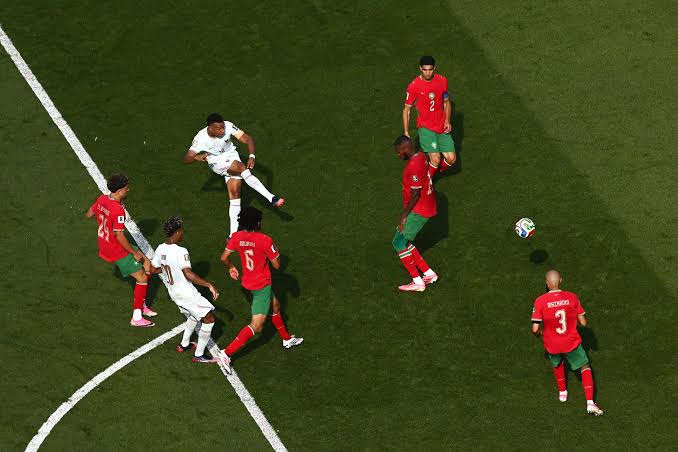
Morocco's defensive organisation was built around reducing central access before anything else. Mohamed Ouahbi instructed Azzedine Ounahi, Neil El Aynaoui and Ayyoub Bouaddi to remain compact around the centre, while Bilal El Khannouss and Chemsdine Talbi narrowed from wider positions to deny passes into Michael Olise and Desire Doue between the lines. Behind them, Issa Diop and Noussair Mazraoui protected the last line aggressively, leaving very little space for Kylian Mbappe to receive with his back to goal. France therefore resisted the temptation to attack immediately. Instead, they accepted that Morocco's block first had to be moved before it could be broken.
That objective shaped almost every French possession during the opening hour. Dayot Upamecano and William Saliba recycled the ball across the defensive line, with Mike Maignan acting as an additional distributor whenever Morocco attempted to increase pressure. Lucas Digne and Jules Kounde maintained maximum width, stretching Morocco's first line horizontally instead of searching for immediate penetration. The circulation appeared conservative, but each sideways pass gradually forced Morocco's midfield to shift another few metres, increasing the distances they eventually had to defend.
The important detail was that France's possession was never an end in itself. Manu Kone and Adrien Rabiot continually adjusted their positions behind Morocco's midfield line, rarely occupying the same vertical space. When Ounahi stepped towards Kone, Rabiot drifted into the opposite half-space. When El Aynaoui followed Rabiot, Olise moved inside to occupy the space that had just been vacated. France were therefore not simply moving the ball; they were moving Morocco's reference points until their compactness became increasingly difficult to maintain.
Only after these horizontal shifts had accumulated did France begin accelerating play. Rather than forcing ambitious passes through compact central zones, Upamecano and Saliba waited until Morocco's midfield four had become sufficiently stretched before finding Olise, Doue or Mbappe between the lines. The decisive vertical passes were therefore consequences of earlier horizontal circulation rather than isolated moments of individual quality.
Pressing to Win Tomorrow's Ball
France's defensive organisation was built around an unusual objective. Rather than attempting to regain possession at the earliest opportunity, Didier Deschamps' side sought to predetermine the location of Morocco's eventual turnover. The press was therefore more concerned with manipulating Morocco into playing passes that France had already prepared to defend. This distinction transformed pressing from an aggressive act into a strategic one. Morocco were rarely dispossessed by spectacular tackles; instead, they were guided towards decisions that steadily reduced their available solutions until a turnover became almost inevitable.
Out of possession, France generally settled into a compact 4-4-2 pressing structure. Kylian Mbappe joined Desire Doue on the first defensive line, but their movements were carefully coordinated; Instead of sprinting directly towards Morocco's centre-backs, they curved their pressing runs to block the passing lane into the deepest midfielder while simultaneously encouraging circulation towards the outside. Every approach run carried two intentions: apply pressure to the player on the ball while removing the safest central passing option through the cover shadow. Morocco therefore appeared to have time in possession, but very little freedom in deciding where possession could actually go.
Behind the front two, Manu Kone and Adrien Rabiot completed the trap by protecting central access instead of chasing individual opponents. Their starting positions remained narrow enough to deny passes into Azzedine Ounahi and Neil El Aynaoui, forcing Morocco's centre-backs to search for more difficult alternatives. Once those central connections disappeared, the most attractive solution became a clipped pass towards the flanks or a direct ball beyond France's first line. Yet this was precisely the outcome France had been constructing. The long pass was not a pressing failure. It was the pressing objective.
This became particularly evident in the aerial duels. Dayot Upamecano consistently stepped forward to attack Morocco's first long ball before their forwards could establish body position. His timing prevented Morocco from securing controlled first contacts, but the more important work happened immediately afterwards. Kone, Rabiot and Michael Olise anticipated where Upamecano's headers were likely to fall, arriving around the second ball before Morocco could reorganise. France therefore did not simply contest aerial possession; they controlled the spaces surrounding the duel itself.
The result was a continuous cycle of territorial control. Morocco repeatedly escaped France's first line only to encounter a second line that had already occupied the decisive spaces. By organising themselves around the second ball rather than the first, France ensured that every forced clearance became the beginning of another French attack. Their pressing was therefore not measured by how often they won possession directly, but by how consistently they determined where, how and under what conditions Morocco would eventually lose it.
Manu Kone And the Structure of Prevention
One of the easiest mistakes when analysing defensive performances is to focus exclusively on visible actions. Tackles, interceptions and duels naturally attract attention because they represent the moments when defending becomes tangible. Yet the highest level of defensive organisation often seeks to avoid these moments altogether. France's midfield, led by Manu Kone, demonstrated this distinction throughout the match. His performance was defined less by winning the ball than by preventing Morocco from ever playing the passes that would have required France to defend more aggressively.
Kone operated as the structural reference point of France's midfield. Rather than following Azzedine Ounahi or Neil El Aynaoui wherever they moved, he consistently prioritised the spaces between them. Whenever Morocco attempted to circulate possession across their back line, he adjusted his position by only a few metres, ensuring that the passing lane into central midfield remained partially blocked. His movements appeared understated because they were rarely directed towards the ball itself. Instead, they were directed towards the possibility of the next pass. Every small adjustment forced Morocco's defenders to hesitate for an extra second before looking elsewhere for progression.
This positional discipline became particularly important during defensive transitions. As soon as France lost possession, Kone resisted the instinct to sprint directly towards the ball carrier. Instead, his first movement was almost always backwards or diagonally infield to occupy the corridor between Morocco's recovery and their nearest central midfielder. The intention was simple but highly effective: Morocco could recover possession, but they could not immediately progress through the centre. That delay proved invaluable. While Kone blocked the first forward connection, Adrien Rabiot recovered alongside him, Jules Kounde and Lucas Digne narrowed their positions, and Dayot Upamecano stepped higher behind the midfield. By the time Morocco found an alternative route, France had already restored their compact defensive structure.
This reflected a broader principle of positional defending. The objective is not to chase the opponent who currently has the ball, but to influence the options available after they receive it. Koné consistently defended future possibilities instead of present situations. His body orientation invited passes towards the touchline while simultaneously discouraging central progression. Morocco therefore retained possession in areas that appeared harmless but were increasingly disconnected from the players capable of accelerating attacks.
As a consequence, Morocco rarely established clean attacking transitions. Their first forward pass was delayed, their central midfielders received under immediate pressure, and promising recoveries gradually lost momentum before they could develop into genuine attacks. Koné's influence was therefore difficult to quantify through conventional defensive statistics. His greatest contribution lay in the actions that never occurred: the vertical passes Morocco never attempted, the counter-attacks that never gathered speed, and the spaces that never became available. France's defensive stability began not with a tackle, but with a midfielder quietly removing the opponent's best option before it could ever become a decision.
Disconnecting Morocco's Strongest Relationship:How France Broke UP Hakimi And Diaz
Morocco's most dangerous attacking patterns throughout the tournament had rarely depended on isolated moments of individual brilliance. Instead, they emerged from the relationship between Achraf Hakimi and Brahim Diaz on the right flank. Hakimi's forward runs created the initial imbalance, while Diaz movements inside connected the full-back with Morocco's midfield and forward line. One player's movement consistently enabled the next. France recognised that this relationship, rather than either player in isolation, was Morocco's primary source of progression. Their defensive plan therefore focused on disrupting the sequence before it could gather momentum.
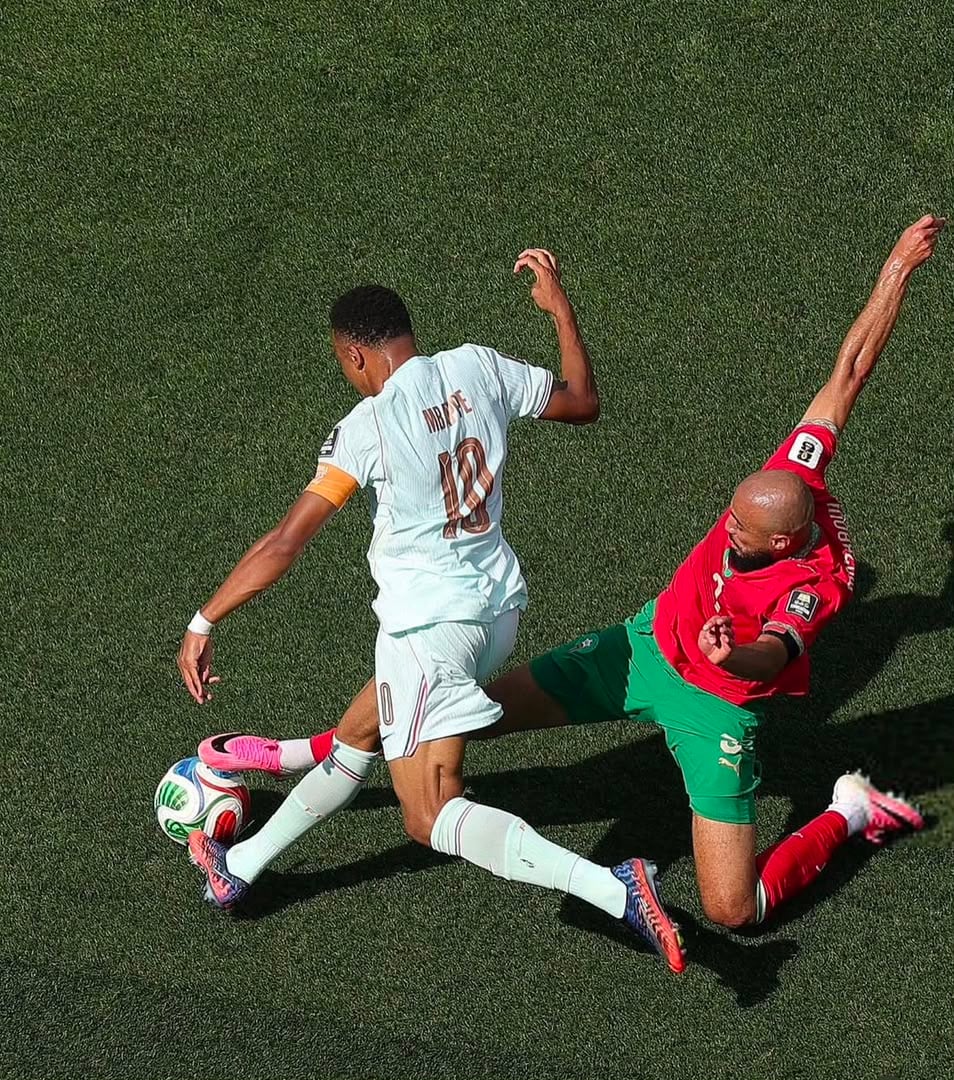
Instead of assigning a dedicated marker to Hakimi, France constructed a series of coordinated movements around him. Whenever Morocco built towards the right side, Lucas Digne stepped forward aggressively to reduce the time available for Hakimi's first touch. This early pressure was supported rather than isolated. Kylian Mbappe deliberately remained in a higher starting position instead of retreating all the way alongside Digne. At first glance, this appeared to leave Hakimi with additional space, but it created a different tactical problem. Hakimi knew that every attacking run increased the amount of space Mbappe could exploit behind him if France regained possession. The possibility of transition therefore influenced Morocco's attacking decisions before France even touched the ball.
Adrien Rabiot completed the defensive picture. Instead of drifting wide to engage Hakimi directly, he occupied the passing lane between Hakimi and Brahim Diaz. This positioning prevented Morocco from establishing the quick interior combinations that had characterised much of their attacking play during the tournament. If Hakimi received possession, the immediate pass inside was rarely available. If Brahim moved wider to receive instead, Digne could engage earlier while Rabiot remained compact enough to protect the central area. France consistently defended the connection rather than the individuals.
Behind these movements, Dayot Upamecano provided the final layer of security. Every time Lucas Digne stepped out of the defensive line, Upamecano shifted diagonally towards the left channel to cover the space that naturally opened behind the full-back. His positioning ensured that Morocco could not simply bypass the first layer of pressure with an early run in behind. France's defensive line therefore behaved like a connected structure in which each aggressive movement was balanced by immediate cover elsewhere.
Rest Defence As An Attacking Principle
One of the most revealing aspects of France's performance emerged not during Morocco's attacks, but during France's own periods of possession. Their attacking structure was never organised solely to create chances. It was simultaneously designed to prepare the defensive transition that might follow. Every forward movement carried an accompanying movement of protection behind the ball, ensuring that France remained structurally stable even while committing numbers into advanced areas. In this sense, their attacking organisation and defensive organisation were not separate phases of play but two expressions of the same positional framework.
As France established possession, Jules Kounde and Lucas Digne advanced to support the attack, while Michael Olise, Desire Doue and Kylian Mbappe occupied different vertical heights across Morocco's defensive line. Manu Kone and Adrien Rabiot positioned themselves close enough to sustain circulation while remaining aware of potential transition spaces. Yet despite committing six players into attacking positions, France consistently retained a compact defensive platform behind the ball. Dayot Upamecano and William Saliba remained connected centrally, with one midfielder holding a deeper supporting position depending on the location of possession. Rather than chasing maximum attacking numbers, France deliberately preserved the balance required to defend the next phase.
The distances within this supporting structure were particularly significant. Upamecano, Saliba and the covering midfielder rarely became stretched across the width of the pitch. Instead, they maintained short horizontal and vertical distances that allowed immediate collective pressure after any turnover. When Morocco recovered possession, there was rarely an obvious route into open space because the nearest passing lanes were already occupied by French players. The defensive line did not retreat instinctively. Instead, it stepped forward together, compressing the available space before Morocco's first forward pass could gather momentum. Numerical superiority was therefore achieved less through the number of defenders than through their positioning relative to the ball and each other.
Conclusion
There are teams that arrive at a World Cup.
And there are teams the World Cup seems unable to let go of.
France have become the latter.
Every four years, they find each other again, as though football's greatest stage keeps a place reserved for them. The lights grow brighter, the air grows thinner, the stakes become heavier and still they remain. Not by accident. Not by nostalgia. But because they have learned the rarest lesson the game can teach: how to make pressure feel like home.
Now, somewhere beyond the next horizon, another rendezvous awaits.
Perhaps Spain, carrying the echoes of a legend's farewell after Cristiano Ronaldo's final World Cup became part of their own story. Perhaps Belgium, who escaped the embrace of elimination when Senegal had almost closed the book, before finding another chapter against the hosts. One opponent arrives with authority. The other arrives with survival stitched into every step.
France will meet either.
Because this is where they always seem to belong.
Football has always borrowed the language of love. It speaks of first touches, faithful supporters, heartbreak, devotion, impossible reunions and dreams that refuse to fade. And every so often, it produces a partnership that feels destined rather than constructed.
At this World Cup, France and the semi-finals have found each other once more.As though the tournament looked into the crowd of nations, smiled and whispered
"You again.”
Perhaps that is the closest football comes to romance.The feeling that no matter how long the road, no matter how many storms gather along the way, two old companions will always meet again beneath the same floodlights.
Tobi Peter
@keepIT_tactical
More from Tobi Peter coming soon.
Visit the profile to follow and get notified when the next piece lands.