Brazil's Greatest Challenge Since 2010: Selection, Not Talent !!?
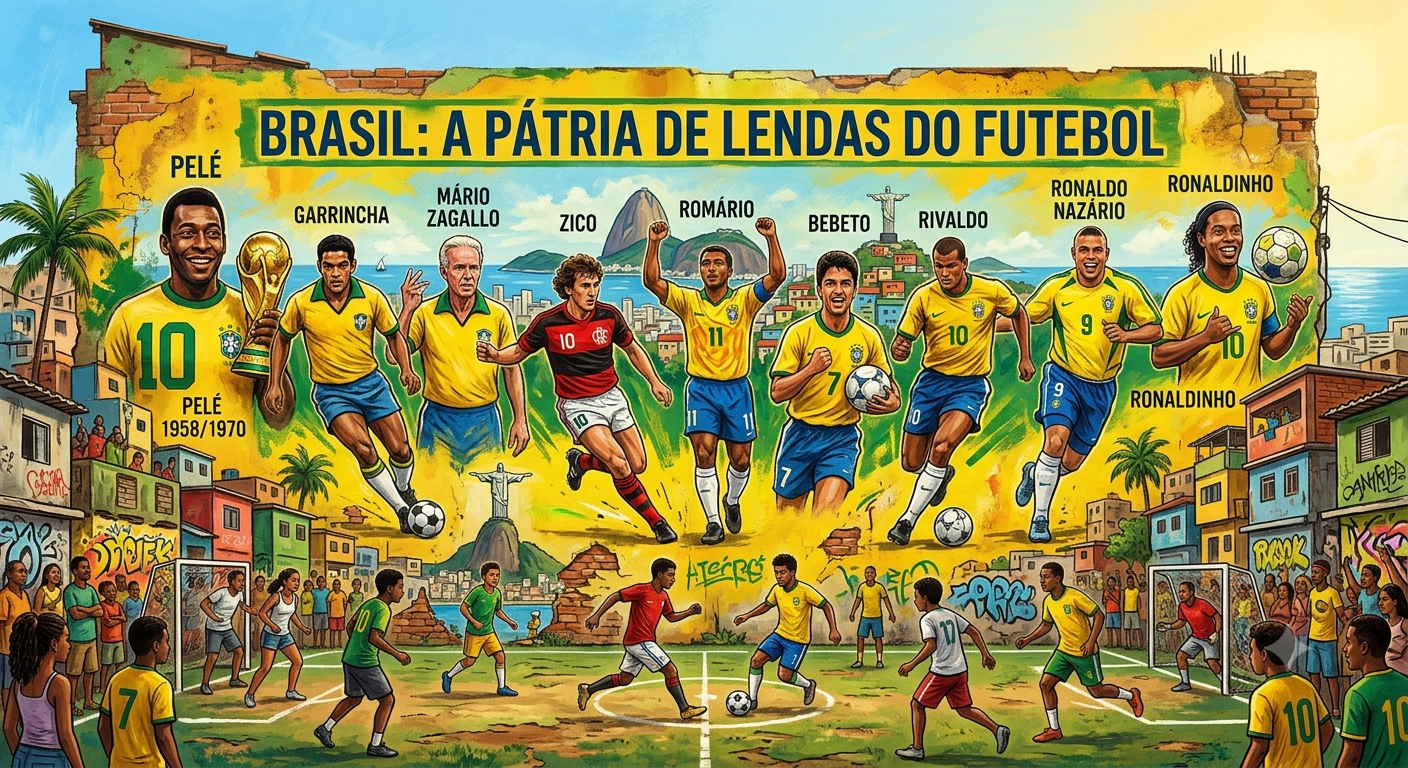
No country in football history has consistently produced more elite talent than Brazil. Yet since lifting the World Cup in 2002, generations of extraordinary players have come and gone without bringing the trophy home. The question is no longer whether Brazil has enough talent—but whether they have consistently chosen the right players at the right time. If we take a closer look at Brazilian football, we quickly realize that it remains the greatest production line of football talent in the world. The country's greatest strength has always been the endless stream of gifted young players emerging from every city, neighborhood, and street across Brazil. That is why Brazil has consistently produced football legends throughout history. It would be impossible to mention them all, but names such as Pelé, Garrincha, Mário Zagallo, Zico, Romário, Bebeto, Rivaldo, Ronaldo Nazário, and Ronaldinho represent only a small part of a nation that has become the world's leading factory for homegrown football talent—players who often reach their full potential on Europe's biggest stages. Considering Brazil's status as the most successful nation in FIFA World Cup history, with the highest number of titles and numerous appearances in the final, it is remarkable to realize that their last World Cup triumph came in 2002—twenty-four years ago. This means that more than one generation of outstanding Brazilian footballers has failed to lift the World Cup trophy. The only generation I will exclude from this discussion is the 2006 squad, which was filled with world-class stars but was eliminated by France, led by Zinedine Zidane and Thierry Henry, for a variety of reasons. However, let us begin with the 2010 generation. At that time, Brazil was coached by Carlos Dunga, whose squad selection surprised many Brazilian supporters due to several controversial omissions. Among the players left out were Ronaldo Nazário, Ronaldinho, Adriano, the attacking full-back Marcelo, AC Milan striker Alexandre Pato, and the emerging Santos sensation Neymar Jr., along with several other talented Brazilian players. The result was an early quarter-final elimination against the Netherlands. The situation did not change significantly in 2014. Despite hosting the tournament and appointing Luiz Felipe Scolari—the coach who had led Brazil to their last World Cup title in 2002—the national team once again left out several well-known players, including Ronaldinho, Kaká, Robinho, Filipe Luís, Miranda, Philippe Coutinho, Lucas Moura, Alexandre Pato, and others. The tournament ultimately ended in one of the darkest moments in Brazilian football history: the unforgettable semi-final defeat to Germany, forever remembered as the "Mineirão disaster." In 2018, Tite took charge of Brazil. Although the attacking talent was perhaps not as extraordinary as in previous generations, several recognizable names were still absent from the squad, including David Luiz, Alex Sandro, Arthur Melo, Rafinha Alcântara, and others, even if they were no longer considered among Brazil's very best players. Four years later, with Tite still in charge, Brazil again omitted several notable players such as Roberto Firmino, Douglas Luiz, Matheus Cunha, and others, while Philippe Coutinho missed the tournament through injury. Once again, Brazil's World Cup journey ended in the quarter-finals, this time after a penalty shootout defeat to Croatia. In the current World Cup, many supporters were optimistic following the appointment of Carlo Ancelotti. Nevertheless, several high-profile players were again left out, including Rodrygo, Richarlison, Antony, João Pedro, and Andrey Santos. It will be interesting to see what Brazil can achieve under Ancelotti after beginning the tournament with a draw against Morocco. Conclusion You may possess some of the world's finest players and greatest talents, but if key selection decisions are not made correctly—whatever the reasons behind them—you may fail to benefit from those players when it matters most. That is often one of the hidden factors that can negatively influence a team's World Cup campaign. Brazil's history suggests that producing world-class footballers has never been the country's greatest challenge. The real challenge has often been transforming extraordinary individual talent into the right collective squad. Whether Carlo Ancelotti can finally solve that puzzle remains one of the defining questions of this World Cup. Author's Note: This article was originally written immediately after Brazil's opening match against Morocco in the 2026 FIFA World Cup. It is republished here while preserving its original analysis and conclusions.
More from Mohamed Khirallh coming soon.
Visit the profile to follow and get notified when the next piece lands.