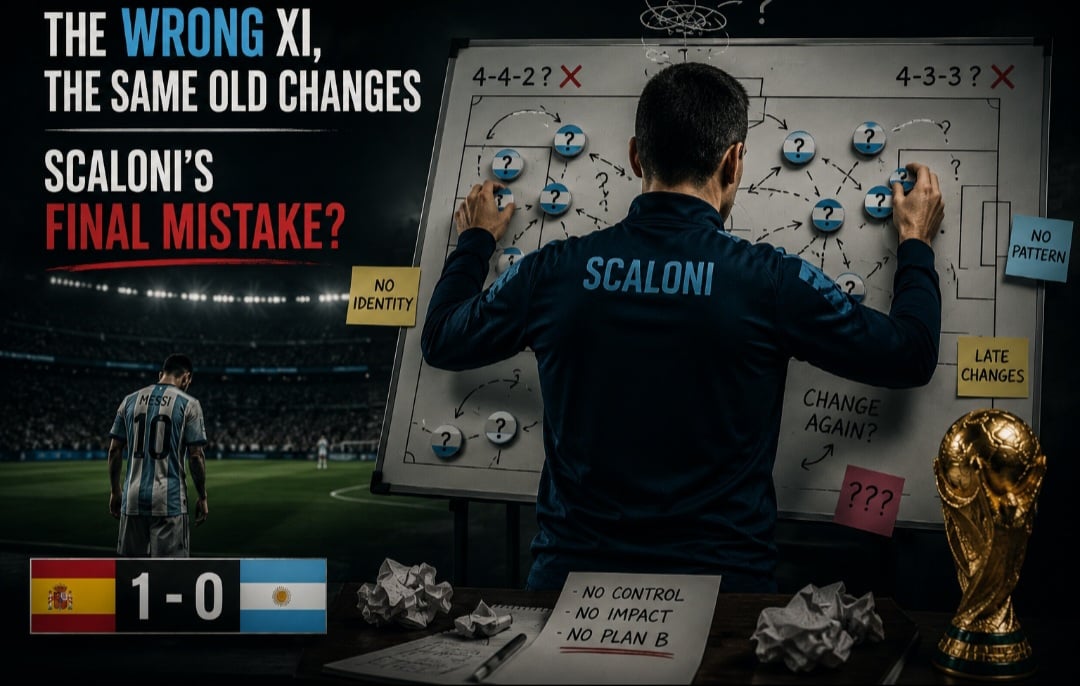
How Argentina's Wrong Starting XI and Predictable Substitutions Led to a Tactical Collapse Against Spain !?
Can a World Cup final be lost before the referee even blows the whistle? Sometimes, the biggest mistake isn't made during the 90 minutes—it happens when the starting lineup is announced. Argentina's defeat against Spain may have been decided by tactical choices long before kick-off.
When you read your team's starting lineup before a major final, you immediately begin imagining how the match is likely to unfold. However, Argentina's lineup for the 2026 World Cup Final surprised almost everyone. Several players unexpectedly found themselves in the starting XI despite barely featuring throughout the knockout rounds—or, in some cases, throughout the tournament itself. So, what exactly happened? Nahuel Molina had started every knockout match, yet suddenly found himself on the bench for the biggest game of the tournament. Meanwhile, Nicolás González, who had repeatedly made an impact as a substitute—particularly during the knockout stage—was unexpectedly handed his first start of the World Cup without any obvious tactical explanation. The same confusion surrounded Giuliano Simeone. His first start of the tournament came against England in the semi-final, where he delivered an excellent tactical and physical performance. Logically, many expected him to keep his place for the final. Instead, Rodrigo De Paul—who had been on the bench in the semi-final—returned to the starting lineup. Another surprise came in midfield. Leandro Paredes produced one of his best tactical performances against England after starting for the first time in the knockout rounds, yet he was dropped for the final without a convincing footballing reason. The Cost of These Decisions These changes created several tactical problems. The first was that Scaloni lost one of his most effective second-half weapons. Nicolás González had consistently changed matches from the bench throughout the tournament. Starting him from the beginning removed one of Argentina's strongest impact substitutes, and after failing to influence the first half, he was substituted at half-time. Ironically, Molina—who had been unexpectedly dropped before kick-off—returned later as a substitute in what became another routine, predictable change. But perhaps the biggest mistake came with Argentina's final substitution. Scaloni replaced Julián Álvarez—who had received little service due to Spain's dominance—and introduced a central defender who had not played a single minute during the knockout rounds. That decision left Lautaro Martínez on the bench. The same Lautaro who had scored the winning goal against England and repeatedly changed important knockout matches. More importantly, Scaloni appeared not to consider a simple possibility: Spain were dominating possession and creating chances. A goal always looked possible. If Spain scored after Argentina had already used all six substitutions, Argentina would be left chasing the game without introducing another striker. This completely contradicted Argentina's successful approach in previous knockout matches, where both Lautaro Martínez and Julián Álvarez eventually played together whenever Argentina needed a goal. A Tournament Full of Tactical Mysteries Anyone who closely followed Argentina throughout the knockout stage probably noticed the same pattern. Starting with Cape Verde, Scaloni introduced surprising tactical changes almost every game. Thiago Almada started regularly during the group stage and against Cape Verde before reports suggested a minor muscular injury. Yet despite expectations of a quick return, he never appeared again throughout the tournament. Every knockout match seemed to bring a new surprise—particularly in midfield, the striker selection and the substitution patterns. Interestingly, Scaloni repeatedly found himself abandoning his preferred system. Normally, he prefers playing with a single striker. However, whenever Argentina fell behind, he was forced to introduce a second forward to rescue the match. At the same time, several substitutions became almost automatic regardless of individual performances, with players such as Molina, De Paul, Lautaro Martínez, Julián Álvarez and Romero regularly entering or leaving at similar moments. Many other squad members barely featured at all, effectively becoming spectators for most of the tournament apart from the already-decided group-stage match against Jordan. Another Self-Inflicted Problem Argentina also suffered from unnecessary disciplinary issues. Enzo Fernández, one of Argentina's standout performers throughout the tournament, received a red card after an avoidable challenge that significantly weakened Argentina for much of the final. Paredes also made several reckless tackles after coming on, challenges that could easily have resulted in another dismissal. For players of their experience and quality, these moments were difficult to explain. Before concluding, one point deserves special recognition.
Throughout the tournament, Argentina's attacking identity relied heavily on Lionel Messi.
At 39 years old, he still produced extraordinary numbers, scoring eight goals and providing four assists, becoming the tournament's leading creator while extending his record as the greatest assist provider in World Cup history.
He also came remarkably close to finishing as the tournament's top scorer before Kylian Mbappé's two goals against England moved the French forward ahead in the Golden Boot race.
Messi once again proved why he remains one of football's greatest competitors, doing almost everything possible to carry his team on the world's biggest stage.
Conclusion :
Football's biggest matches are often decided long before the final whistle. Team selection, tactical balance, and in-game management can be just as important as individual brilliance.
Throughout the knockout rounds, Argentina repeatedly found solutions after making attacking adjustments, particularly when playing with two forwards. Yet in the World Cup Final, Lionel Scaloni abandoned many of the patterns that had previously brought success. Surprising selection decisions, predictable substitutions, and the failure to respond effectively to Spain's dominance in midfield ultimately left Argentina chasing a match they never truly controlled.
The final also reinforced another important lesson. Even the greatest player in football history cannot compensate for tactical confusion, questionable team selection, and ineffective game management on football's biggest stage. Against opponents of Spain's quality, tactical uncertainty is rarely forgiven—and this final became the clearest example of that.
More from Mohamed Khirallh coming soon.
Visit the profile to follow and get notified when the next piece lands.