There Are No More "Small Teams" in International Football ?
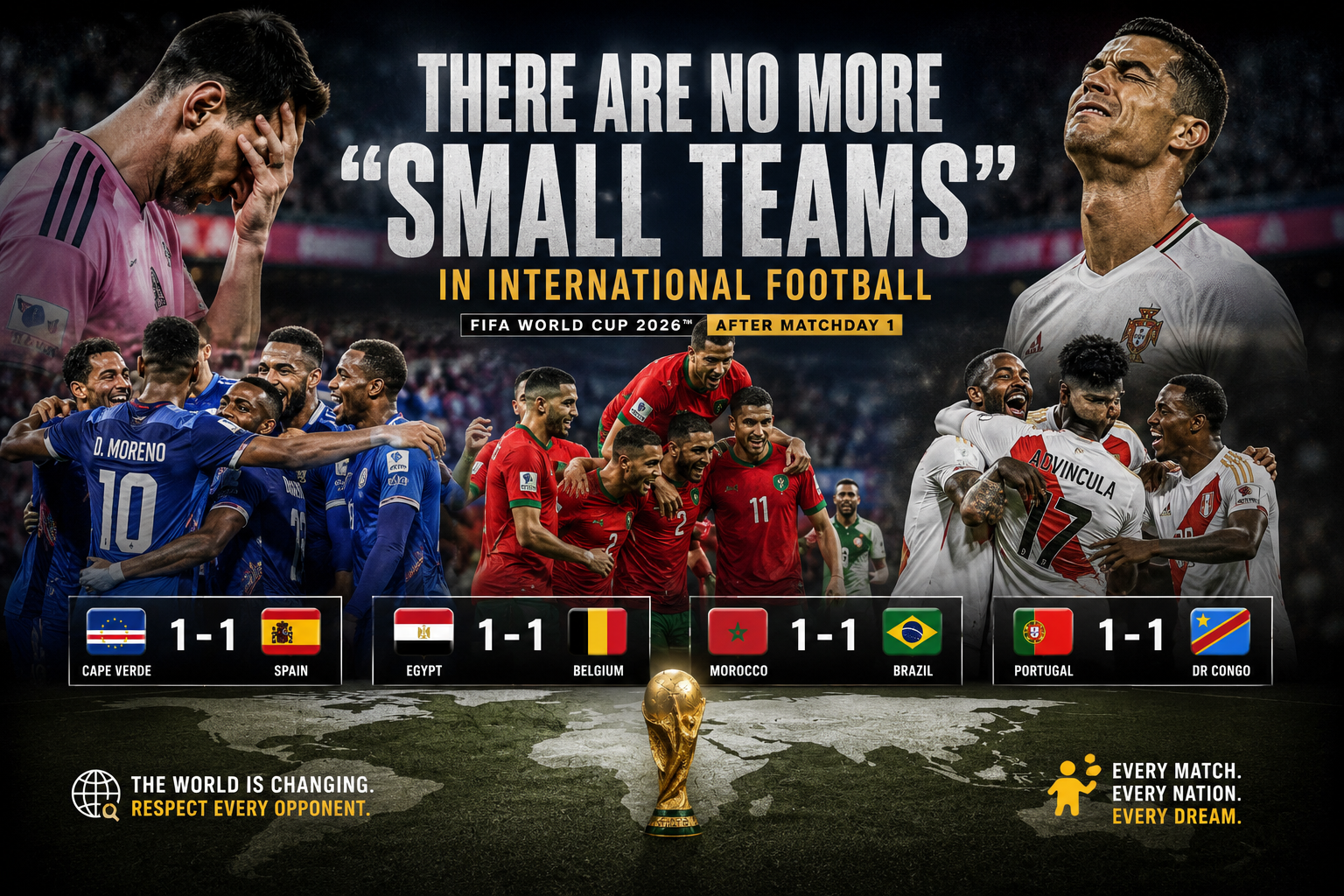
The opening round of the 2026 FIFA World Cup delivered a familiar reminder: reputations no longer guarantee results. From Spain being held by Cape Verde to Brazil drawing with Morocco, football continues to prove that the gap between traditional giants and emerging nations is becoming smaller than ever.
Modern football has changed dramatically. Because of countless tactical, physical, and technological developments, the old idea of "big teams" versus "small teams" has become increasingly outdated—especially in international football.
The opening round of this World Cup offered several surprising results that challenged pre-tournament expectations. More importantly, they highlighted how preparation, organization, and modern football methodologies can reduce the gap between nations, regardless of their historical reputation.
The Opening Round Told the Story ;
Cape Verde held one of the tournament favorites, Spain. The Democratic Republic of Congo earned a draw against Portugal. Morocco shared the points with five-time world champions Brazil. Egypt produced an impressive performance to draw with Belgium.
On paper, these results may have appeared unlikely. On the pitch, however, they reflected the growing competitiveness of international football. Why Has the Gap Become Smaller? Several factors have contributed to this evolution.
1. The Growth of Sports Science :
Sports science has transformed modern football. Training methodology, workload management, physical conditioning, injury prevention, sports medicine, nutrition, sports psychology, biomechanics, and performance optimization have become essential parts of preparing elite athletes. Today, access to these disciplines is no longer limited to football's traditional powerhouses.
2. The Evolution of Performance Analysis :
Modern national teams now rely heavily on performance analysts and data specialists. Most coaching staffs include multiple analysts responsible for tactical preparation, opponent scouting, video analysis, statistical reports, and detailed match planning. This level of preparation allows teams with fewer individual stars to compete collectively against technically superior opponents.
3. The Expansion of International Football :
Playing abroad has become the ambition of talented footballers across every continent. European clubs now scout extensively in Africa, Asia, and North America, giving talented players opportunities to develop in some of the world's strongest leagues.
As a result, national teams benefit from players who return with higher tactical understanding, greater experience, and improved physical standards. Football Has Changed Recent World Cups have already shown this trend.
Morocco's historic fourth-place finish demonstrated how tactical organization can overcome traditional football hierarchies. South Korea's famous victory over Germany at the 2018 FIFA World Cup was another reminder that preparation and collective discipline can defeat even the strongest favorites.
These are no longer isolated surprises—they are becoming part of modern international football. Conclusion Football will always have differences in quality, resources, and individual talent. Those gaps have not disappeared.
However, the distance between the world's biggest football nations and the emerging ones has become significantly smaller than it was two or three decades ago.
In today's game, organization, preparation, sports science, tactical intelligence, and performance analysis often matter just as much as famous names. That is why predicting international football has become more difficult than ever—and perhaps that is what makes the modern World Cup so fascinating.
Author's Note This article was originally written after the opening round of the 2026 FIFA World Cup. It is republished here while preserving its original analysis and conclusions.
More from Mohamed Khirallh coming soon.
Visit the profile to follow and get notified when the next piece lands.