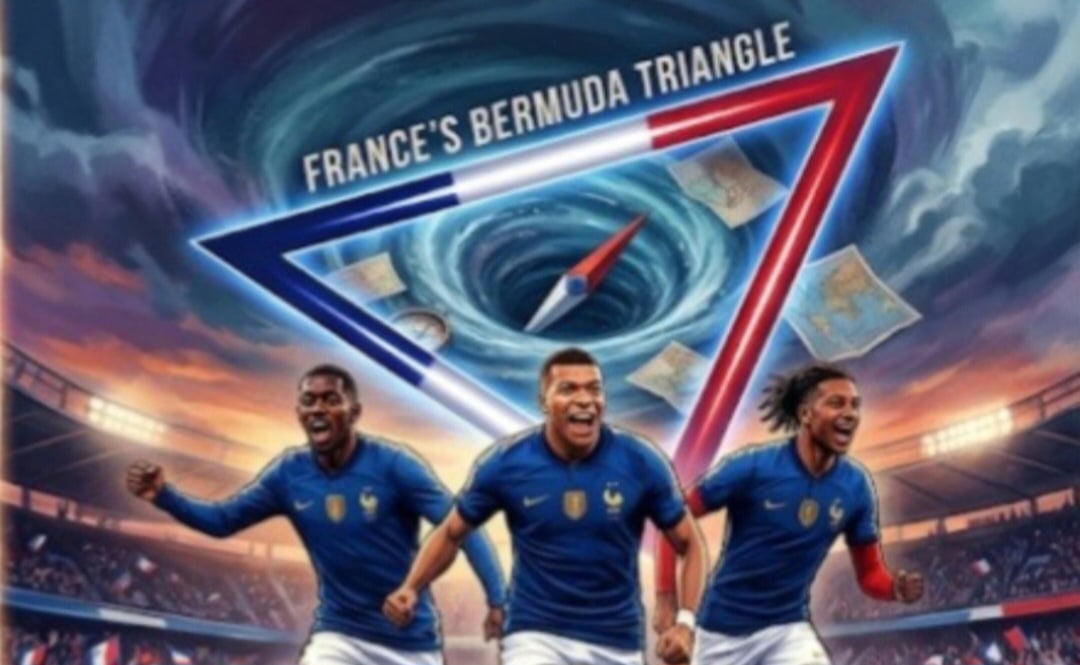
France's Bermuda Triangle: Can Anyone Stop Mbappé,Olise and Dembélé ?
Have you asked yourself this question before? What happens when three world-class attackers combine pace, creativity, relentless movement, and clinical finishing in the same frontline? So far in this World Cup, no opponent has found a convincing answer. Looking at France's attacking line in this World Cup, and focusing on their front three rather than the entire attacking unit, it is hard not to be impressed. Kylian Mbappé, Ousmane Dembélé, and Michael Olise form a trio that very few opponents have managed to stop individually at club level. The question becomes even more fascinating when they play together with their pace, creativity, technical quality, relentless movement, and countless ways of breaking down defenses through combinations with the midfielders, overlapping full-backs, and even the build-up from the defensive line. It is no surprise that many football fans have started asking the same question: How do you stop this front three? Is There an Answer? To be honest, if I told you that I had a definitive answer to this question, I would not be telling the truth.
This is simply what we have seen throughout the French national team's group-stage matches, including their game against Sweden, which was largely a one-sided contest thanks to the outstanding chemistry of this attacking trio. They are also supported by Barcola and his world-class substitute, Paris Saint-Germain star Désiré Doué, who may well play an even bigger role in the upcoming matches as the level of opposition continues to rise.
Whether France face a strong and well-organized Paraguay side—which eliminated Germany—or Morocco, who appear the favorites on paper to advance against one of the tournament's hosts, Canada, the challenge will undoubtedly become much tougher.
Morocco, in particular, possess world-class full-backs such as Achraf Hakimi and Noussair Mazraoui, who could make life very difficult for France's dangerous attacking trio, especially in the wide areas if the two teams meet. France's attacking production tells its own story. Across the group stage and the Round of 32, approximately 85% of France's goals have involved Mbappé, Dembélé, or Olise either as scorers or creators. Including Barcola's contributions pushes that figure to well over 90%, highlighting just how influential this attacking unit has been during France's opening four matches of the tournament. These numbers reinforce what the eye test already suggests: France possess one of the most dangerous attacking trios in this World Cup. How Far Can France Go? The next question is obvious. How far can France go with such an explosive attacking unit? Alongside their impressive front three, France have also benefited from a solid midfield, a reliable central defense, and a defensive structure that has conceded only two goals so far in the tournament. Even more importantly, Didier Deschamps can still rely on high-quality substitutes such as Désiré Doué and Rayan Cherki, whose creativity and technical ability could become decisive whenever opportunities arise later in the competition. Conclusion France's success cannot be explained by individual brilliance alone. It is the combination of elite attacking talent, tactical balance, squad depth, and defensive stability that makes them one of the strongest contenders to lift the World Cup trophy. Whether any team can finally solve the puzzle of France's "Bermuda Triangle" remains one of the tournament's most intriguing tactical questions. France's attacking trio has turned every match into a tactical puzzle for their opponents. The biggest question now is no longer whether Mbappé, Dembélé, and Olise are among the tournament's best attacking units—but whether any team can find a way to stop them when the knockout rounds become even more demanding.