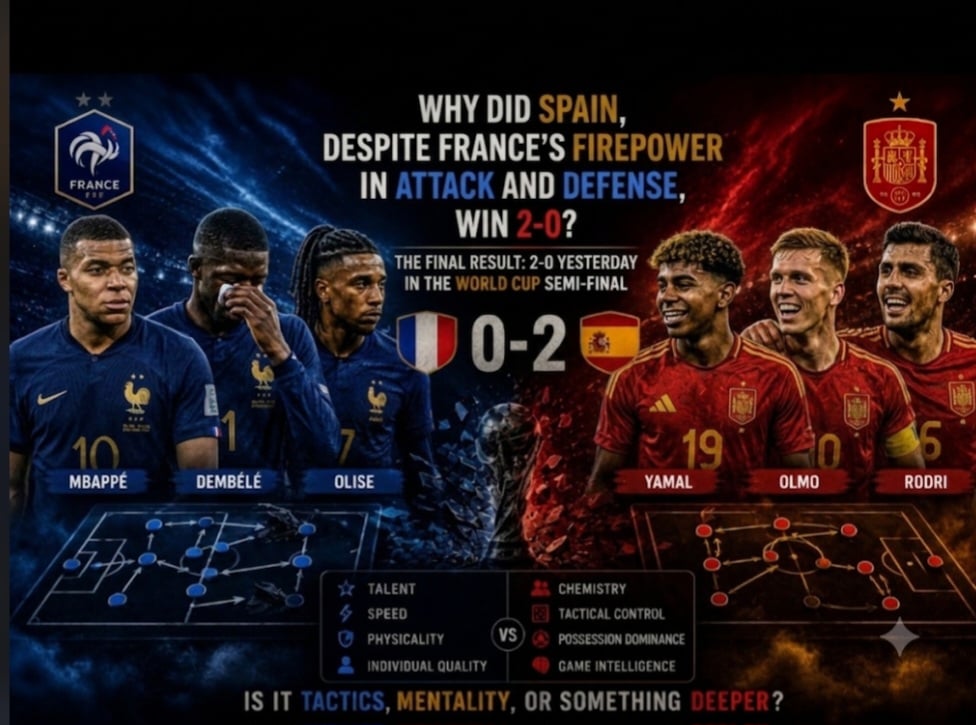
Why France's Firepower Wasn't Enough Against Spain ?

MK
0subscribers
15 Jul 20263 min

France arrived at the 2026 FIFA World Cup with what many considered the tournament's most frightening attack. Kylian Mbappé, Ousmane Dembélé, Michael Olise, and a wealth of attacking depth made Les Bleus one of the favorites to lift the trophy. Yet in the semi-finals, Spain managed to do what no previous opponent had achieved: silence France's greatest weapon. Why?

If you had asked football fans before the tournament who would win the World Cup, most answers would probably have mentioned between four and six traditional football powers.


Among them, France often stood out because of one particular reason: their attack.


In a previous article, I described France's front three as football's "Bermuda Triangle." Kylian Mbappé, Ousmane Dembélé, and Michael Olise possess exceptional pace, creativity, finishing ability, and individual quality. Behind them, Didier Deschamps also had outstanding options such as Désiré Doué and Bradley Barcola, while Rayan Cherki remained another highly talented attacking player waiting for opportunities.


On paper, few national teams could match France's attacking depth.
Yet football is not played on paper.

France's Attack Was Outstanding Throughout the Tournament :


Looking back at France's World Cup campaign, their attacking trio proved decisive almost every time.


They overcame a physically demanding Senegal side thanks to their attacking quality after a difficult first half.


Against Iraq, they secured a comfortable victory through the brilliance of their frontline.


Norway were defeated convincingly, although several Norwegian starters were rested.


France then dominated Sweden in the Round of 32 before overcoming a disciplined Paraguay side through another decisive contribution from Kylian Mbappé.


In the quarter-finals, they defeated Morocco with two goals from Mbappé and Dembélé despite facing another well-organized defensive opponent.


Everything suggested that France's attack could solve almost any tactical problem.

Spain Changed the Game :


The semi-final against Spain presented an entirely different challenge.
For the first time in the tournament, France faced a midfield capable of controlling possession, dictating the tempo, and limiting the influence of their attacking stars.
Spain may not have looked spectacular throughout the competition, but they consistently demonstrated one characteristic that has defined several generations of Spanish football:


Winning the midfield battle.


Although this Spanish team is different from the famous generation of Busquets, Xavi, and Iniesta, they continue to dominate matches through intelligent positioning, collective pressing, and excellent spacing.
By reducing the space between the lines, Spain prevented France from delivering the ball consistently to Mbappé, Dembélé, and Olise.
France's greatest strength became isolated.

Squad Management Also Raised Questions :


Another aspect that caught my attention throughout the tournament was Didier Deschamps' squad management.


His substitutions became increasingly predictable.


Désiré Doué and Rayan Cherki regularly entered from the bench, but often received only limited minutes, while several other squad members barely featured throughout the competition.


As a result, France relied heavily on a relatively small core of players, leaving much of the squad with little competitive rhythm.

The Case of Rayan Cherki :

Perhaps the biggest tactical question concerns Rayan Cherki.


Rather than being used as an attacking midfielder operating between the lines, Cherki was frequently introduced in wider positions, often replacing Michael Olise.

In my view, this limited many of his greatest qualities.


Cherki is at his best when he receives the ball centrally, connects midfield with attack, creates numerical superiority, and produces decisive passes around the penalty area.

Using him in a central creative role could have offered France another playmaker capable of linking midfield to their explosive front three.


Instead, France often lacked that extra creative connection whenever Spain controlled possession.

Conclusion :


France's defeat was not simply the result of Spain producing a better performance on the day.
It was also a reminder that football is won by controlling spaces as much as by collecting stars.
Spain dominated the midfield, limited the service to France's exceptional attackers, and demonstrated once again that tactical balance often outweighs individual brilliance.
Even the world's most dangerous attacking trio cannot consistently decide matches when the connection between midfield and attack is disrupted.

MK
0subscribers