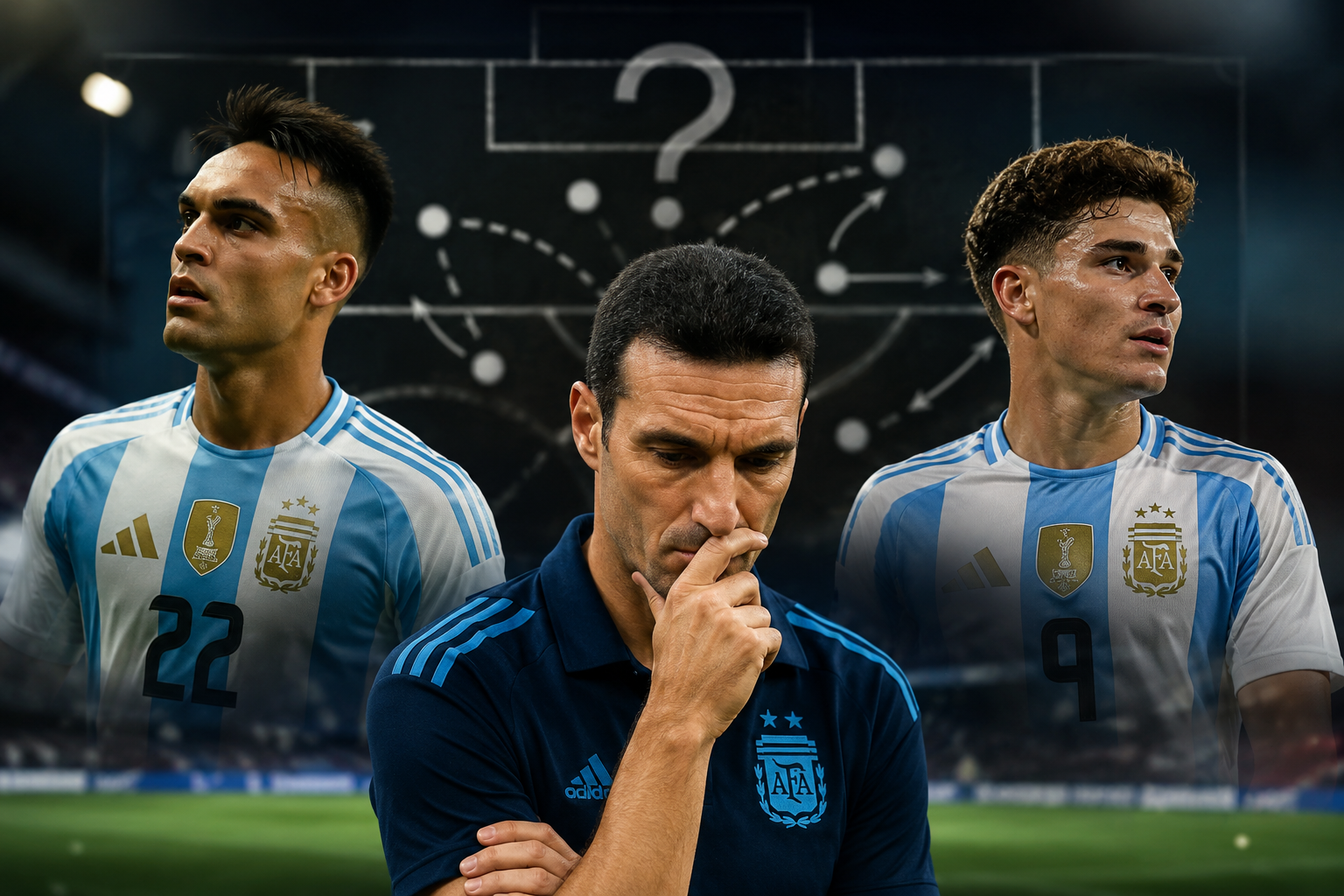
Why not play Julián Álvarez and Lautaro Martínez together? Even against Cape Verde, Lautaro had started to grow into the game before being substituted with the match still tied !?
One question that came to my mind: Does Argentina really have one of the best squads in the world, yet rely on only one substitution pattern? After reviewing Argentina's first four World Cup matches, one tactical pattern caught my attention. Regardless of the scoreline, the opponent, or how the match was unfolding, most of the substitutions were remarkably similar. This raised an important football question for me: Should substitutions follow a pre-planned routine, or should they reflect the unique tactical demands of each match? One of the most noticeable observations was that, in three of Argentina's first four World Cup matches, the substitutions were almost identical. Lautaro Martínez and Thiago Almada were consistently replaced by Julián Álvarez and Nicolás González between the 55th and 65th minute, regardless of whether they were performing well or not. Later, around the 80th–85th minute, the midfield substitutions followed almost the same pattern in two of those matches. The final substitution was usually a direct full-back replacement on either side. The only exception was the match against Jordan, where Argentina had already secured qualification, making squad rotation understandable in order to give valuable minutes to both starters and substitutes. This approach may make sense in comfortable matches that are effectively decided by halftime, where the objective is simply to rotate players on a position-for-position basis. However, it still raises questions, especially considering the quality available on Argentina's bench. Supporters know how much these players can contribute during the second half—not only by adding attacking quality, but also by reducing the team's heavy dependence on Lionel Messi. For example, Nico Paz, who enjoyed an outstanding season with Como, produced impressive statistics and helped the club qualify for the UEFA Champions League for the first time in its history. He offers creativity and attacking solutions from midfield. The same applies to Giovani Lo Celso, who featured regularly for Real Betis this season. His creativity, excellent left foot, and attacking vision provide another dimension. His stunning free-kick goal against Jordan may well become one of the finest goals of this World Cup. I also cannot overlook Giuliano Simeone, who proved to be an important attacking option for Atlético Madrid in several key La Liga and UEFA Champions League matches. That is exactly why I found this substitution pattern surprising. What I found even more difficult to understand was Lionel Scaloni's decision to repeat the same substitutions against Cape Verde despite the completely different match situation. When he made his usual double substitution—bringing on Julián Álvarez and Nicolás González while taking off Lautaro Martínez and Thiago Almada—the score was 1–1. As the reigning World Cup champions, Argentina's objective should naturally be to win the match by increasing their attacking power. The obvious solution would have been to keep Lautaro on the pitch alongside Julián Álvarez rather than replacing one striker with the other. Even more surprisingly, only seconds before being substituted, Lautaro created a clear-cut chance for Lionel Messi. However, Cape Verde's goalkeeper produced another outstanding save and continued his extraordinary performance against Messi throughout the match from every possible angle—including open play and set pieces—with the only exception being Messi's brilliant first-half goal. Furthermore, when the score is level, opponents usually retreat deeper and defend with more numbers. In that situation, greater attacking presence inside the penalty area becomes even more important. Argentina had two of the world's best strikers available, yet Scaloni still chose the same routine substitution by replacing Lautaro Martínez with Julián Álvarez. Another point that came to my mind concerns match preparation itself. As a coach, a large part of my tactical plan is always built around the specific opponent—their strengths, how to neutralize them, their weaknesses, and how to exploit them in the best possible way. Therefore, second-half substitutions should primarily depend on what actually happened during the first half. Did the match develop as expected? Did the opponent create different tactical problems? Were there new spaces to exploit? Based on those answers, the coach should decide which substitutes to introduce, when to introduce them, and in which positions—either to solve tactical issues within his own team or to capitalize on weaknesses in the opposition. In my opinion, that is the natural philosophy behind effective in-game management from the touchline. In the end, this is not a criticism of individual players, because Argentina possesses exceptional quality in almost every position. Rather, it is a question about tactical flexibility. World Cups are rarely won simply because a team has the strongest starting eleven. More often, they are won by coaches who can read every match, adapt to changing circumstances, and make substitutions that solve the specific problems presented by that game instead of repeating the same pattern. Perhaps Scaloni sees details that others do not. But from my perspective, every match tells a different story—and every story deserves its own tactical decisions.
Author's Note:
This article was originally written immediately after Argentina's match against Cape Verde and before their Round of 16 match against Egypt. The original version was also published on my LinkedIn at that time. It is republished here with its original tactical analysis and conclusions unchanged.
More from Mohamed Khirallh coming soon.
Visit the profile to follow and get notified when the next piece lands.