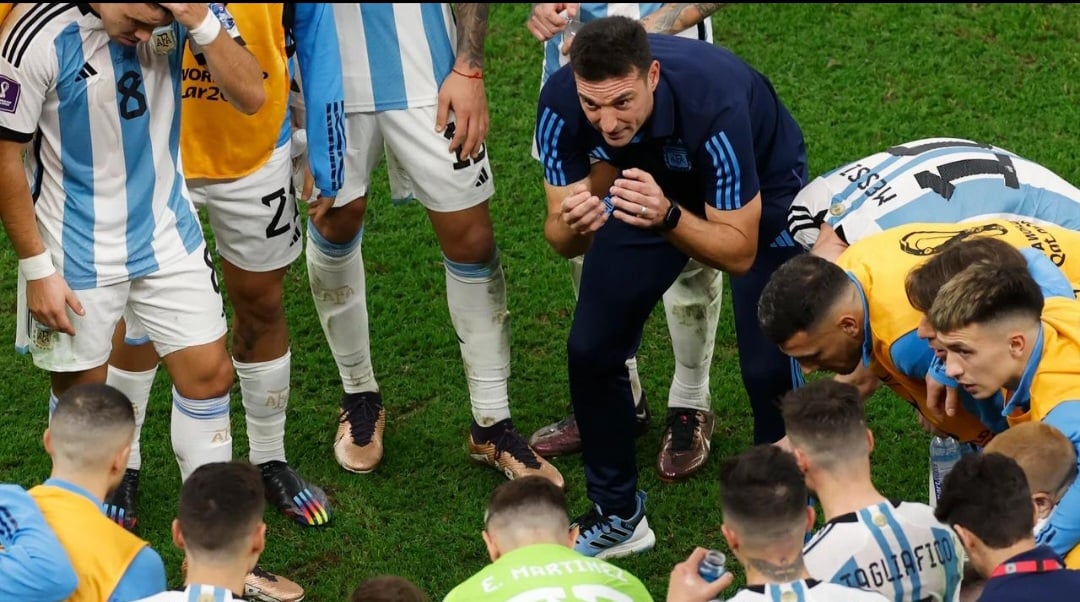
Why Scaloni Was Argentina's Biggest Problem Against Egypt !?
On paper, Argentina were overwhelming favorites against Egypt. Yet football has never been decided by market values, reputations, or star names alone. Sometimes, the biggest challenge is not the opponent—but the decisions made from the touchline. Argentina eventually won, but the match raised an important tactical question: did Lionel Scaloni make the game far more difficult than it needed to be?
This was the kind of match that could easily be titled: "How to Manage a Match the Wrong Way." If you had asked almost anyone in the world before kick-off who would win the match between Egypt and Argentina, the answer would have come without hesitation: Argentina. The only real debate would have been by how many goals. On paper, that prediction seemed perfectly reasonable. Argentina's squad was almost entirely made up of players competing at the highest professional level in Europe, while Egypt relied predominantly on domestic-based players, with only two regular starters playing abroad. The difference was equally evident in market value: Argentina's squad was worth approximately $864 million, compared to around $135 million for Egypt. Add to that the individual quality in almost every position, and the gap appeared enormous. However, football is not played on paper. Once the match began, one interesting detail immediately stood out: both teams started with line-ups they had not previously used during the tournament. Looking deeper into Argentina's selection, Lionel Scaloni appeared to make several tactical adjustments specifically for this match. He started a left-back who had barely featured during the tournament apart from the rotation match against Jordan after qualification had already been secured, seemingly because he considered him more defensively reliable. For the first time—excluding that Jordan match—Thiago Almada did not start, while Leandro Paredes was introduced to strengthen midfield alongside Rodrigo De Paul and Alexis Mac Allister. Julián Álvarez was also preferred to Lautaro Martínez for tactical reasons that Scaloni believed better suited the game plan. Those decisions suggested one thing: Scaloni respected Egypt enough to significantly alter his preferred system. Some may even argue that he respected them more than necessary. From a historical perspective, many would insist that Egypt cannot be compared to Argentina. Moreover, Egypt's route through the tournament did not appear particularly demanding. They drew with Belgium during one of Belgium's weakest performances, defeated New Zealand, drew with Iran thanks largely to an outstanding display from goalkeeper Mostafa Shobier, and eventually overcame Australia after 120 minutes and a penalty shootout. For many analysts, Egypt had not yet faced a genuine elite opponent. That is precisely why it seemed unusual for Argentina's coach to abandon his familiar line-up and begin such an important knockout match with a noticeably more cautious approach. Traditionally, the world's strongest national teams try to impose themselves immediately, using their best attacking players and applying early pressure to finish matches quickly before underdogs gain confidence. Instead, Scaloni's tactical choices produced something very different. Both teams struggled to create numerical superiority in midfield, while Argentina lacked enough attacking solutions to consistently threaten the Egyptian goal. Even Lionel Messi, following his missed penalty, was unable to influence the first half in his usual manner. Meanwhile, Egypt displayed excellent defensive organization and possessed midfielders and attackers capable of retaining possession under pressure—an aspect Argentina surprisingly struggled with throughout the opening forty-five minutes. However, as the world witnessed, the match then took another direction. Following several controversial refereeing decisions, and despite Egypt leading 2–0, Scaloni finally introduced more logical and less predictable tactical changes. Most importantly, he brought on Lautaro Martínez to play alongside Julián Álvarez, while Nicolás González was also introduced as one of the first substitutions. Argentina then increased their attacking pressure, focused repeatedly on delivering crosses from the right flank—an area where Egypt appeared vulnerable—and eventually scored three goals from three crosses to complete a remarkable comeback. It became one of the most difficult victories—if not the most difficult—for this generation of the Argentine national team. Ultimately, coaching decisions can completely change the direction of a match. Sometimes they create unnecessary complications; other times, correcting those decisions changes everything. The events that followed the Argentina–Egypt match, the worldwide debate, the controversy surrounding the refereeing, and the reactions that followed all demonstrate just how influential managerial decisions can be. Now, it will be fascinating to see how far Argentina can go after the difficulties they encountered against a disciplined Egyptian side, especially with a challenging encounter against Switzerland awaiting them.
Football's biggest lessons often come from victories rather than defeats. Argentina secured qualification, but their performance against Egypt demonstrated how tactical decisions can dramatically influence the course of a match. Against stronger opponents, similar mistakes may prove far more costly. Now, it will be fascinating to see how far Argentina can go after the difficulties they encountered against a disciplined Egyptian side, especially with a challenging encounter against Switzerland awaiting them.
More from Mohamed Khirallh coming soon.
Visit the profile to follow and get notified when the next piece lands.