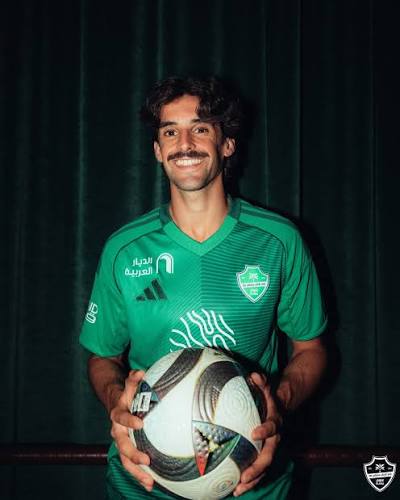
FRANCISCO TRINCAO IS NOT DONE IN EUROPE JUST YET
When Francisco Trincão completed his move to Saudi Pro League giants Al Ahli this summer, the reaction across European football was surprisingly muted. At just 26 years old, the Portuguese winger appeared to be entering the prime years of his career, yet another gifted talent had chosen a lucrative move away from Europe's biggest leagues.
The question isn't whether Trincão deserved the financial reward. He undoubtedly did. The real question is whether he gave up on a prolonged career in Europe too soon.
Trincão's journey has never been straightforward. After emerging from Braga's renowned academy, he quickly established himself as one of Portugal's brightest attacking prospects. His elegant left foot, close control, vision and ability to glide past defenders earned him a €31 million move to Barcelona in 2020, a transfer that seemed to signal the arrival of Europe's next elite winger.
Unfortunately, timing can define careers.
Barcelona were entering one of the most turbulent periods in their modern history. Financial instability, constant managerial changes and the departure of Lionel Messi created an environment where young players struggled to develop consistently at the time. Despite flashes of brilliance (including memorable goals against Real Betis and Alavés)Trincão never received the stability required to fulfil his enormous potential.
His loan spell at Wolverhampton Wanderers only complicated matters further. The Premier League's physical demands and Wolves' conservative attacking style under Bruno Lage never truly suited a player who thrives in possession-based systems. While the underlying numbers failed to impress, his technical quality never disappeared.
Returning to Portugal proved to be the reset his career desperately needed.
Under Ruben Amorim at Sporting CP, Trincão rediscovered both confidence and consistency. Although his first season didn’t necessarily turn heads, Amorim's unwavering faith eventually paid dividends. The winger finished the 2024-25 campaign with nine league goals and a division-leading 14 assists while playing every league match as Sporting secured another Primeira Liga title.
Perhaps more importantly, he evolved.
No longer simply a flashy winger, Trincão became a complete attacking creator. He pressed intelligently, improved his decision-making in the final third and developed into one of Portugal's most productive forwards. His performances in the UEFA Champions League, including a brace that earned Player of the Match honours early in the 2025-26 campaign against Kairat Almaty, demonstrated that he could still influence games on the biggest stage in European club football.
The Saudi Pro League has increasingly attracted players still capable of competing at the highest level, and Trincão joins that growing list. While the move offers financial security and a fresh challenge, it also leaves many wondering what more he could have achieved in Europe's biggest leagues had another elite club taken a chance on him, or he remained with the Lisbon giants.
For clearer context, this isn't a player in decline.
This is a player finally reaching maturity.
At 26, most elite attackers are only beginning to understand the finer details of their game. Players with Trincão's profile- technically gifted, tactically intelligent and creative in tight spaces- often enjoy their best years between the ages of 27 and 31. Unlike explosive wingers who rely solely on pace, his strengths lie in decision-making, close control, vision and the ability to unlock compact defences. Those qualities rarely disappear overnight.
That is why his move to Al Ahli feels premature from a purely footballing perspective.
While many still view the Saudi Pro League as a retirement destination, recent seasons have begun to challenge that perception. The league has become increasingly competitive, attracting players in their prime rather than solely those nearing the end of their careers. Footballers such as Gabri Veiga, Jhon Durán and Moussa Diaby all chose Saudi before turning 30, illustrating how perceptions around the league are changing.
More importantly, spending time in Saudi no longer appears to be a one-way journey. Gabri Veiga returned to European football with Porto after two impressive seasons at Al Ahli, proving that elite clubs remain willing to invest in players from the Saudi Pro League when their quality is evident. Likewise, Jordan Henderson, who returned to Europe and the UEFA Champions League with Ajax after leaving Al-Ettifaq and has recently sealed a transfer to Chelsea, demonstrates that the door back to Europe's top clubs remains open.
For Trincão, that should provide encouragement rather than closure.
If he continues to produce at Al Ahli, there is every reason to believe a path back to Europe’s top leagues will open up. The modern transfer market has become more fluid than ever before. Careers are no longer linear, and footballers are increasingly choosing unconventional pathways before returning to the biggest stages. Saudi Arabia can now represent a detour rather than a destination.
Perhaps history will remember Francisco Trincão as another gifted footballer who left Europe too early.
But those who watched his renaissance at Sporting know a different story. They saw a player who weathered the immense pressure of Barcelona, learned valuable lessons in the Premier League, rebuilt his confidence under Rúben Amorim and emerged as one of Portugal's most intelligent attacking players in recent years.
European football may not have seen the last of Francisco Trincão.
If his career has proved anything, it's that writing him off tends to age badly.
Credits
Words