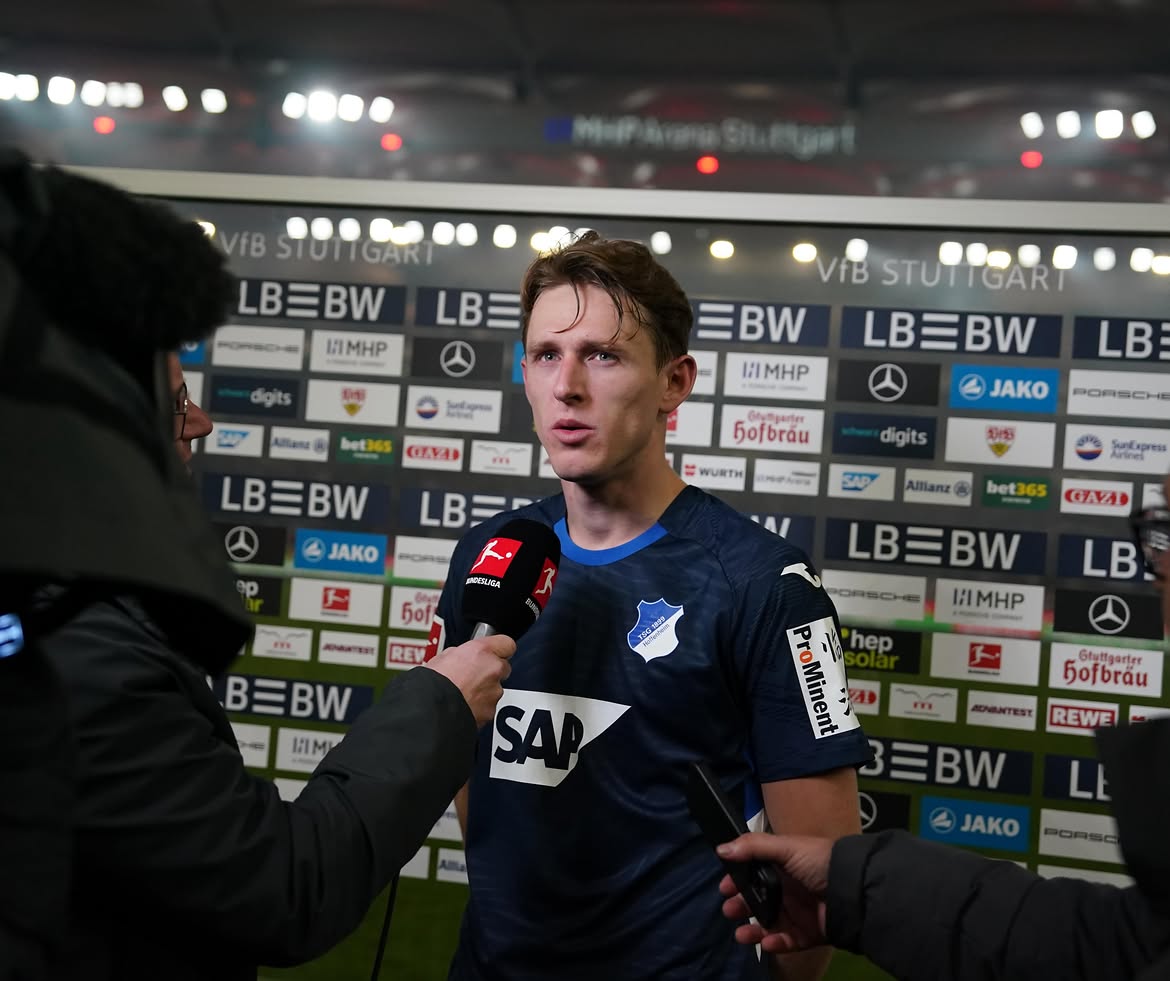
Publication Instagram @wouterburger_
Wouter Burger: the deep-lying midfielder in search of control
The numbers caught my attention, the eye test made me stay. A deep dive into why Wouter Burger has become one of the most intriguing midfield profiles I've come across recently.
Tactical Profile
I developed a bit of an obsession with Wouter Burger while searching for midfielders who could complement Moisés Caicedo at Chelsea.
The numbers initially pointed me in his direction. A 25-year-old midfielder standing at 1.91m, with strong defensive numbers, an excellent aerial profile and a passing repertoire that goes well beyond simple ball circulation, is naturally going to attract attention. But numbers can only take you so far.
So I went looking for the games.
I watched every Hoffenheim pre-season match I could find featuring Burger, partly because I wanted to understand the player better, but mostly because I wanted to know whether my initial perception from the data would survive the eye test.
It did.
Burger is not particularly exciting in the conventional sense. He is not going to receive the ball and immediately beat three players. He is not a midfielder whose game is built around constant carrying or spectacular individual actions.
What makes him interesting is almost the opposite.
He seems to understand where the next pass needs to go.
At 1.91m, Burger brings obvious physical presence, but the most interesting part of his profile is how that physicality coexists with an ability to work with the ball. He can defend, compete aerially, occupy space and still be the player looking to break a line from deep.
That combination is what defines him.
Distribution
Burger's passing profile immediately jumps out.
He averaged 8.17 progressive passes per 90 compared to a league average of 5.74, while also attempting 5.30 long passes per 90 against 3.06 for the average Bundesliga midfielder. His volume of passes is not particularly extreme — 45.69 per 90 compared to 42.61 — but the type of passes he attempts is important.
He is not simply recycling possession.
Burger actively looks to move the opposition, constantly moving around the pitch looking to create passing lanes, whether for himself or for his teammates by drawing in defenders.
The most interesting numbers are perhaps his vertical and line-breaking passes. He averaged 1.11 through passes per 90, more than double the league average of 0.45, while producing 3.04 passes into the penalty area per 90 compared to 1.67.
His xA/90 was 0.17 against 0.07 for the average player in his position.
That tells you something about his mentality with the ball.
Burger is comfortable playing forward.
And this is where the eye test becomes important. There is a tendency to look at a 1.91m midfielder with good defensive numbers and immediately classify him as a ball-winner. I don't think that fully captures what Burger is.
He can win the ball, yes, but he also wants to do something with it.
His first instinct after recovering possession is often to look forward rather than simply secure the ball. He can hit longer diagonals, find vertical options between lines and attempt passes that accelerate an attack rather than merely maintain it.
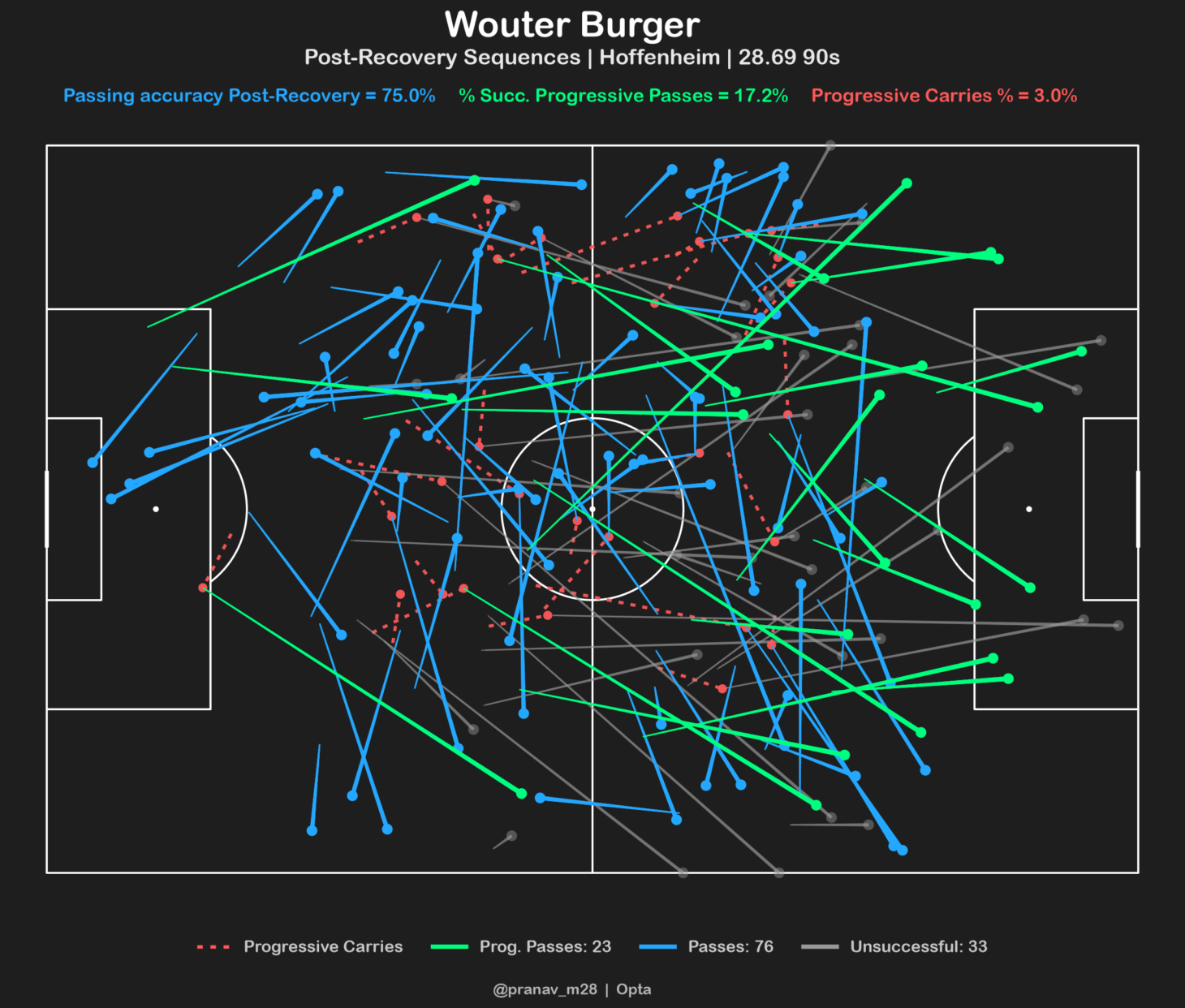
That doesn't mean every pass is perfectly executed. His 81.3% passing accuracy is actually below the 84.4% league average.
But that is partly the point.
Some of the passes he attempts carry considerably more risk than the average midfielder's. If you are consistently looking for the difficult forward pass, your completion rate is naturally going to take a hit.
I'd rather have a midfielder who occasionally gives the ball away trying to break a line than one who protects his passing percentage by refusing to attempt the pass in the first place.
Deep-lying creation
The "deep-lying creator" label from his profile traits might actually be the most useful way to understand Burger.
His creative numbers are unusually strong for someone with such a defensive presence.
He recorded 0.20 assists per 90 against a league average of 0.06, 0.20 smart passes against 0.11 and 0.13 second assists against 0.05.
The important part isn't necessarily the raw assist number. It is where the creation comes from.
Burger can influence attacks before they reach the final third.
He does not need to be the player receiving the ball inside the box to have created the situation that leads there. His value can come two or three actions earlier: receiving deep, recognizing a forward run, finding the vertical pass and allowing the next player to attack an unsettled defence.
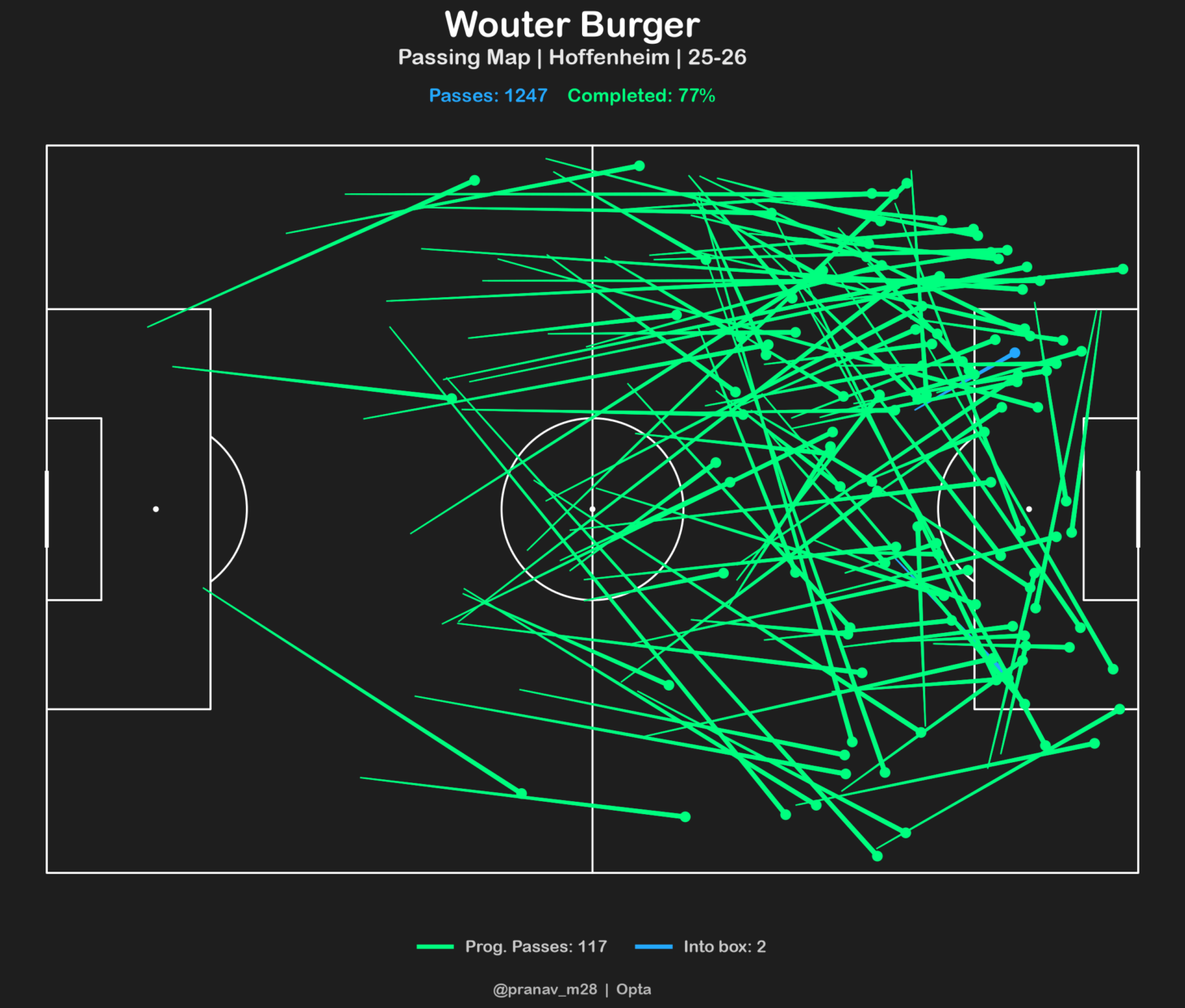
That is why I think calling him simply a defensive midfielder undersells him.
He has enough passing range and imagination to function as a genuine progression mechanism from deeper areas.
Defensive value
The other half of the equation is what initially makes Burger so attractive.
His defensive numbers are strong across several categories.
Burger averaged 6.49 interceptions per 90 compared to 4.59 for the Bundesliga average, 5.70 defensive duels compared to 4.86 and 8.47 successful defensive actions compared to 6.87.
He also averaged 1.01 sliding tackles per 90, more than double the league average of 0.45.
There is a clear appetite for defensive involvement.
But again, I wouldn't describe him as a pure destroyer.
Burger's defensive value comes partly from his ability to occupy space and anticipate where the ball is going. His size gives him an obvious advantage in certain situations, but the more interesting quality is how often he seems to be in the right area to interfere with the next action.
He is not just reacting — he is positioning.
Aerial game
The aerial numbers are perhaps the easiest part of his profile to identify.
Burger won 51.3% of his aerial duels compared to 43.2% for the league average and contested 5.06 aerial duels per 90, more than twice the positional average of 2.53. At 1.91m, this is not surprising.
What is more interesting is how useful that physical profile could become tactically. A midfielder who can compete consistently in the air gives you another way of defending direct play, especially when the team is defending higher up the pitch and needs to deal with balls played over the first line. It also gives you an additional reference point when possession is lost. Burger doesn't need to win every aerial duel. His presence alone changes the calculation for the opposition.
This becomes even more interesting when brought back to Chelsea specifically. The current midfield is not exactly short on quality, but it is short on height. Caicedo is 1.78m, Dario Essugo 1.78m, Enzo Fernández 1.77m, Valentín Barco 1.72m, Roméo Lavia, 1.81m, and Jordan Henderson, at 1.83m, is the tallest of the group. Burger would add an entirely different physical reference at his height.
Chelsea's defensive structure under Xabi Alonso relies more on a mid-block than an aggressively high defensive line, which makes the midfield's ability to deal with direct play and second balls particularly important. The centre-backs can contest many of those situations, but adding more height to midfield would give Chelsea another layer of protection and make the team more robust when defending transitions without compromising its ability to control possession.
That is where Burger becomes particularly interesting to me. His height is not simply an individual physical attribute; it could fill a physical gap within Chelsea's midfield profile. The question is less whether Chelsea need a tall(er) midfielder and more whether they can find value in having a player who changes the physical dynamics of the sector without compromising its technical level.
Carrying
This is probably where I would place the biggest caveat. Burger is not a particularly high-volume carrier.
He averaged just 0.81 progressive runs per 90 compared to 1.02 for the league average, while his dribble volume was only 0.34 per 90 against 0.98.
That is a significant difference.
Not every midfielder needs to be a carrier, particularly when the team already has players who can break pressure in that way. Caicedo and especially Lavia are much more comfortable escaping pressure through their carrying. I don’t really want to keep returning to Chelsea specifics, but given the context in which I first observed Burger, it is almost impossible not to do so. He can complement that rather than replicate it, using his passing range to progress possession while others provide the ball-carrying.
There is a tendency in modern midfield scouting to value players who can do everything. Pass, carry, defend, create, press, arrive in the box.
Burger doesn't need to be that player. His game is built on clarity rather than chaos.
Receive. Scan. Pass.
Receive. Scan. Pass.
It sounds simple, but the quality of the decision in those moments is what makes a midfielder useful. And the numbers suggest that this simplicity should not be confused with passivity. According to Opta/WhoScored gathered by Playerprint (developed by @pranav_m28), Burger ranks in the 91st percentile for the share of his passes that are progressive, in the 86th for passes into the box per 90, and in the 85th for tempo-setting passes when compared to other midfielders in the Top 5 European leagues (T5).
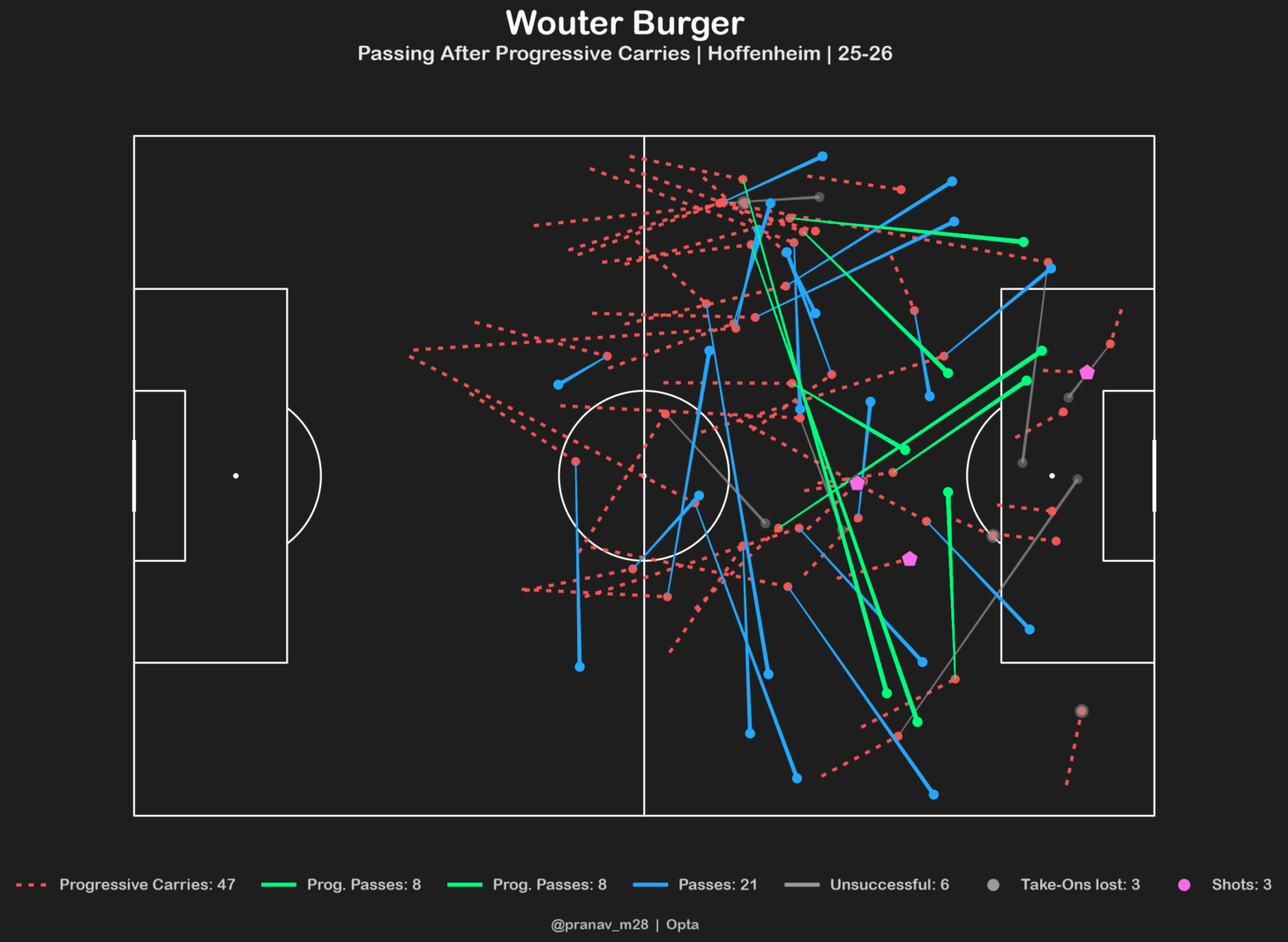
He is not constantly trying to force progression through carries or spectacular passes. Instead, he tends to move the ball forward through his distribution, recognizing when a simple pass can advance the attack and when the tempo can be raised. There is a certain efficiency to it: he doesn't need to dominate every phase of possession to influence how the team progresses.
Final Third
Burger's attacking output is perhaps the most underrated part of his profile.
Four goals and six assists in 30 games is not spectacular on its own, but his underlying numbers are encouraging. He produced 1.11 shots per 90, 0.14 xG per 90 and 0.13 goals per 90, all above the positional averages.
His 39.4% shots-on-target rate also stands out compared to 26.8% for the league average.
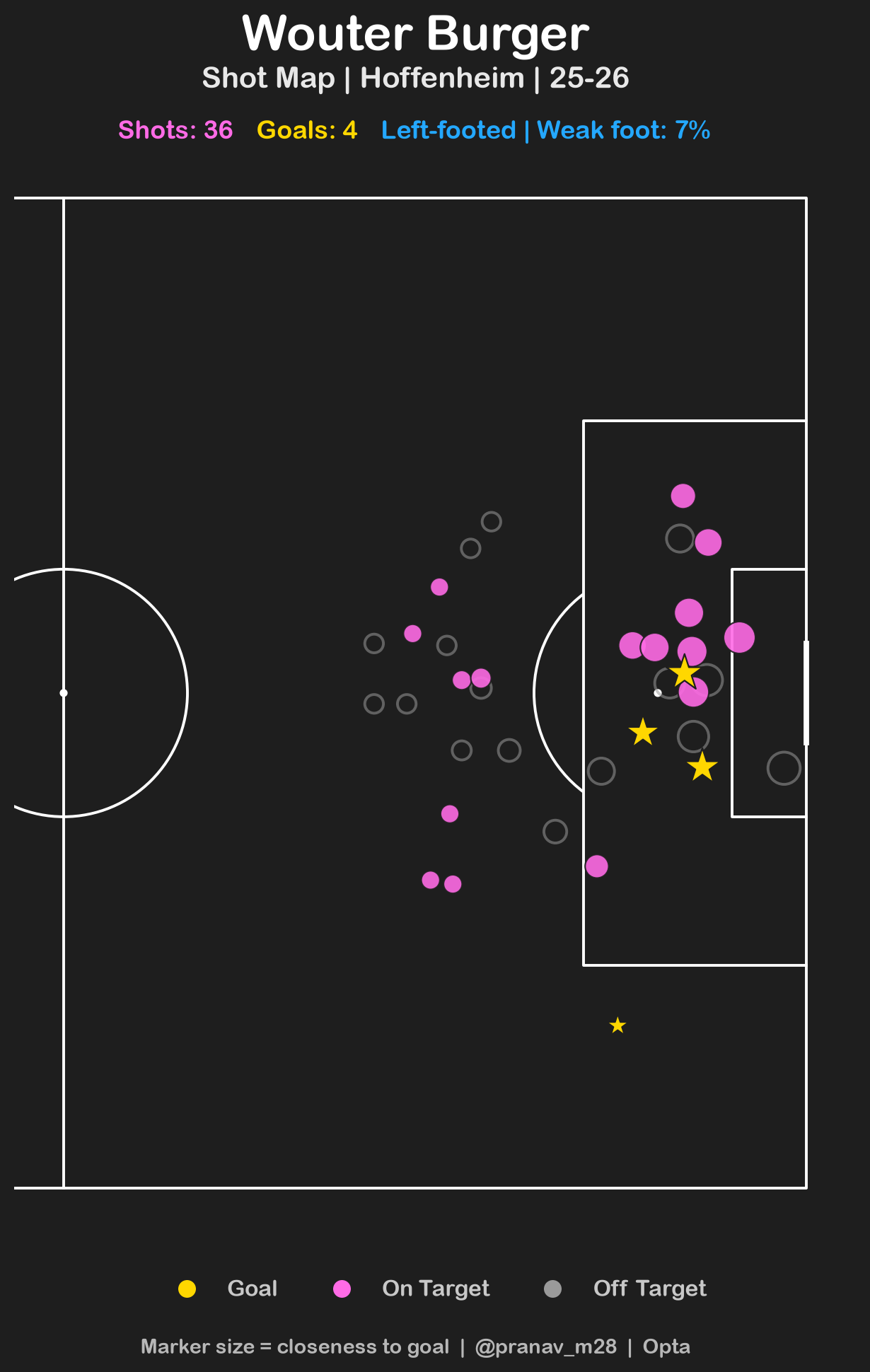
More importantly, his passing profile suggests that his contribution to the final third does not need to come through high shot volume.
He can create.
He can arrive.
He can play the pass before the assist.
And because he operates from deeper areas, those actions can be difficult for opponents to track.
There is another element here that is easy to overlook: set pieces. Burger is naturally a useful target in the box, but his value goes beyond simply attacking aerial balls. His delivery also gives him another avenue to influence the final third without needing to be involved in sustained attacking sequences.
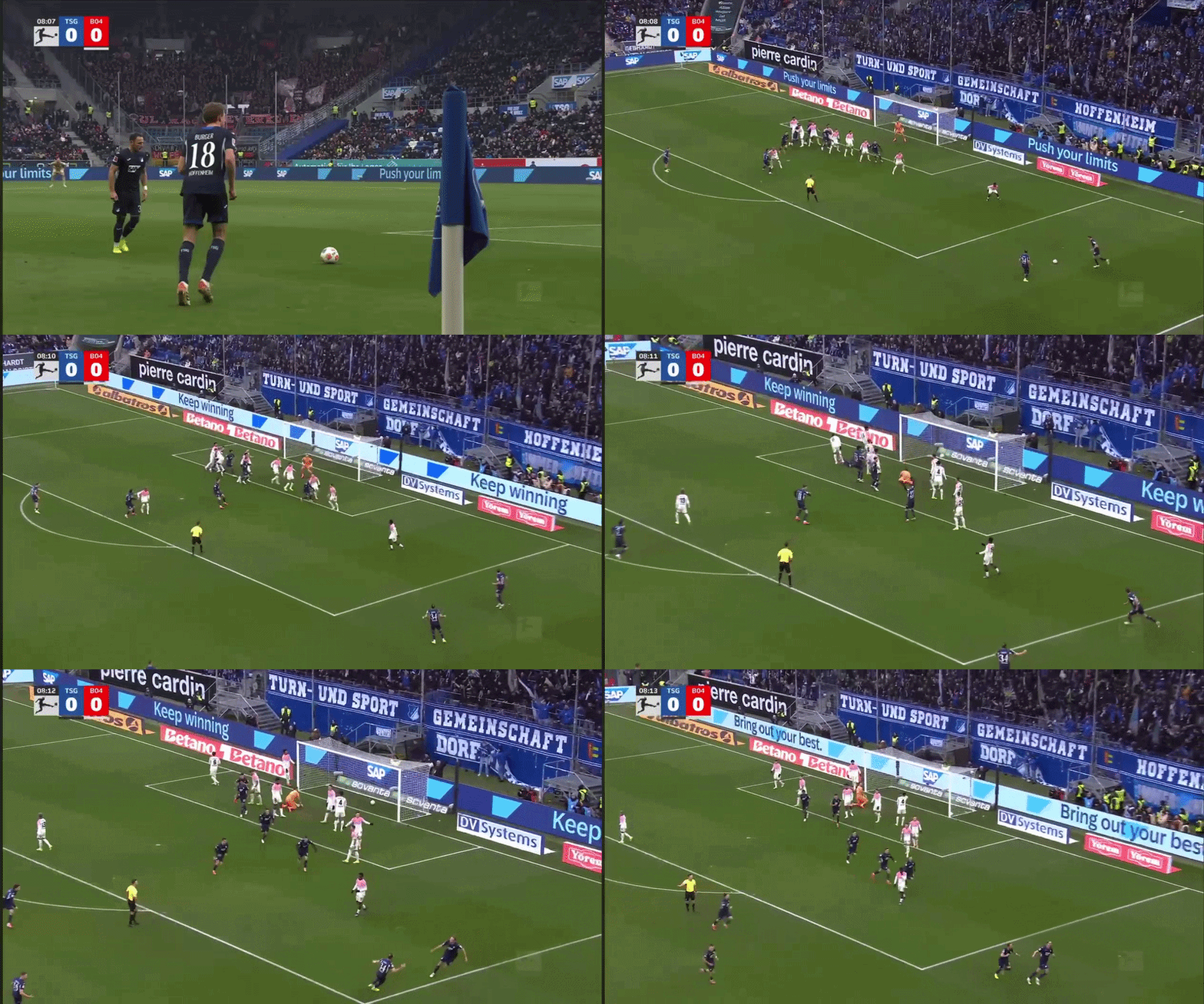
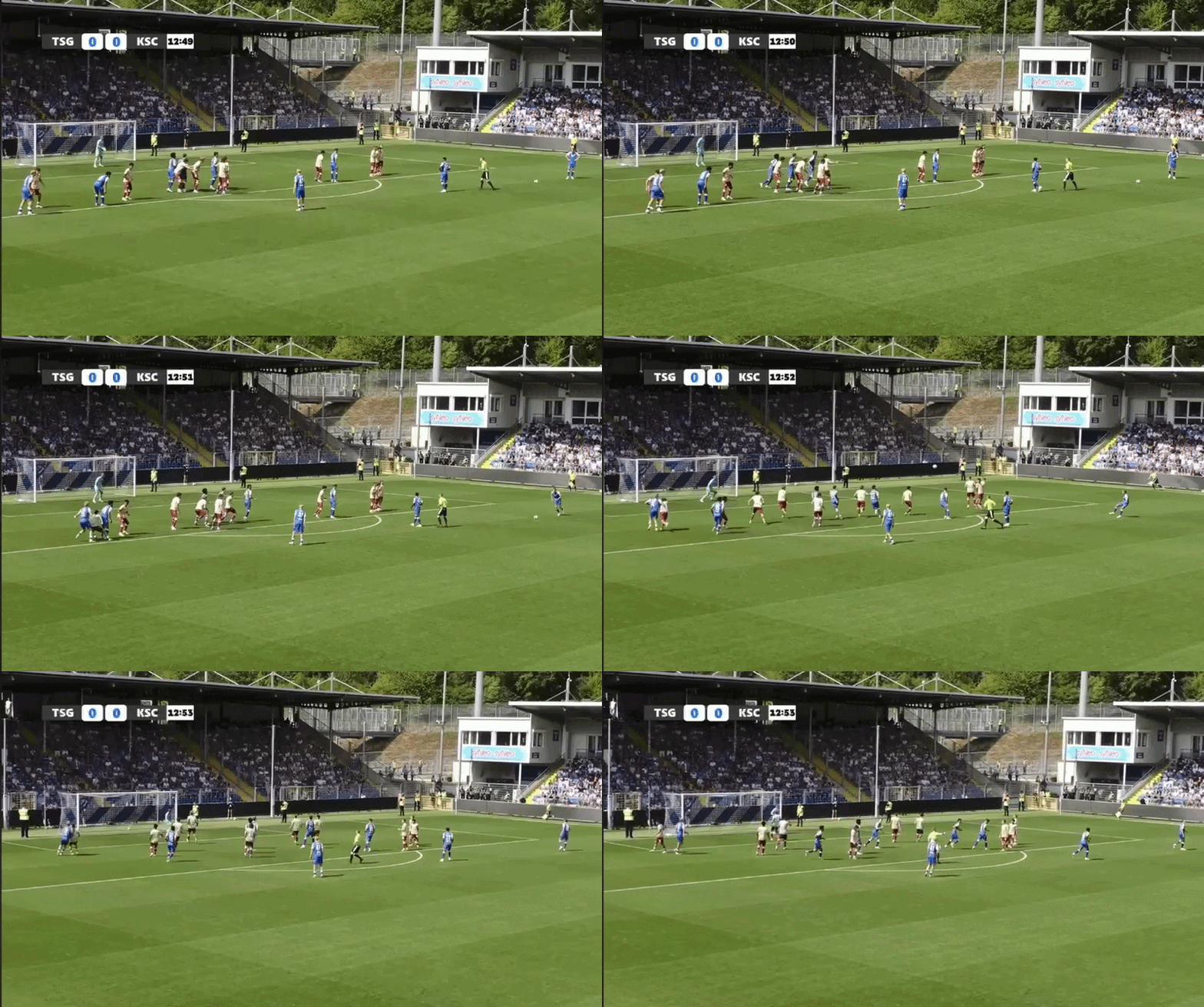
That is the interesting thing about Burger: he doesn't need to become a conventional attacking midfielder to contribute offensively. His value comes from connecting phases, arriving at the right moments and offering another weapon when the game is stopped.
The player in context
This is where Burger becomes more than just a statistical profile.
What stands out most is the consistency in how he influences the game in possession. Across different actions and situations, there is a clear pattern: he is not just involved in build-up phases, he is actively shaping what comes next.
Burger is a creator.
More specifically, he is a creator who does his best work from deeper areas of the pitch. His passing isn't simply about keeping the ball moving or connecting one phase to the next. He actively looks to create an advantage with it — whether that means splitting a line, finding a runner, playing into the box or attempting the difficult pass that turns possession into an attack.
There is a certain irony to looking at a 1.91m midfielder with good defensive numbers and assuming his primary value is what he does without the ball. In reality, some of his most interesting qualities emerge when he has it.
Burger is willing to take risks with his passing because he is looking for rewards.
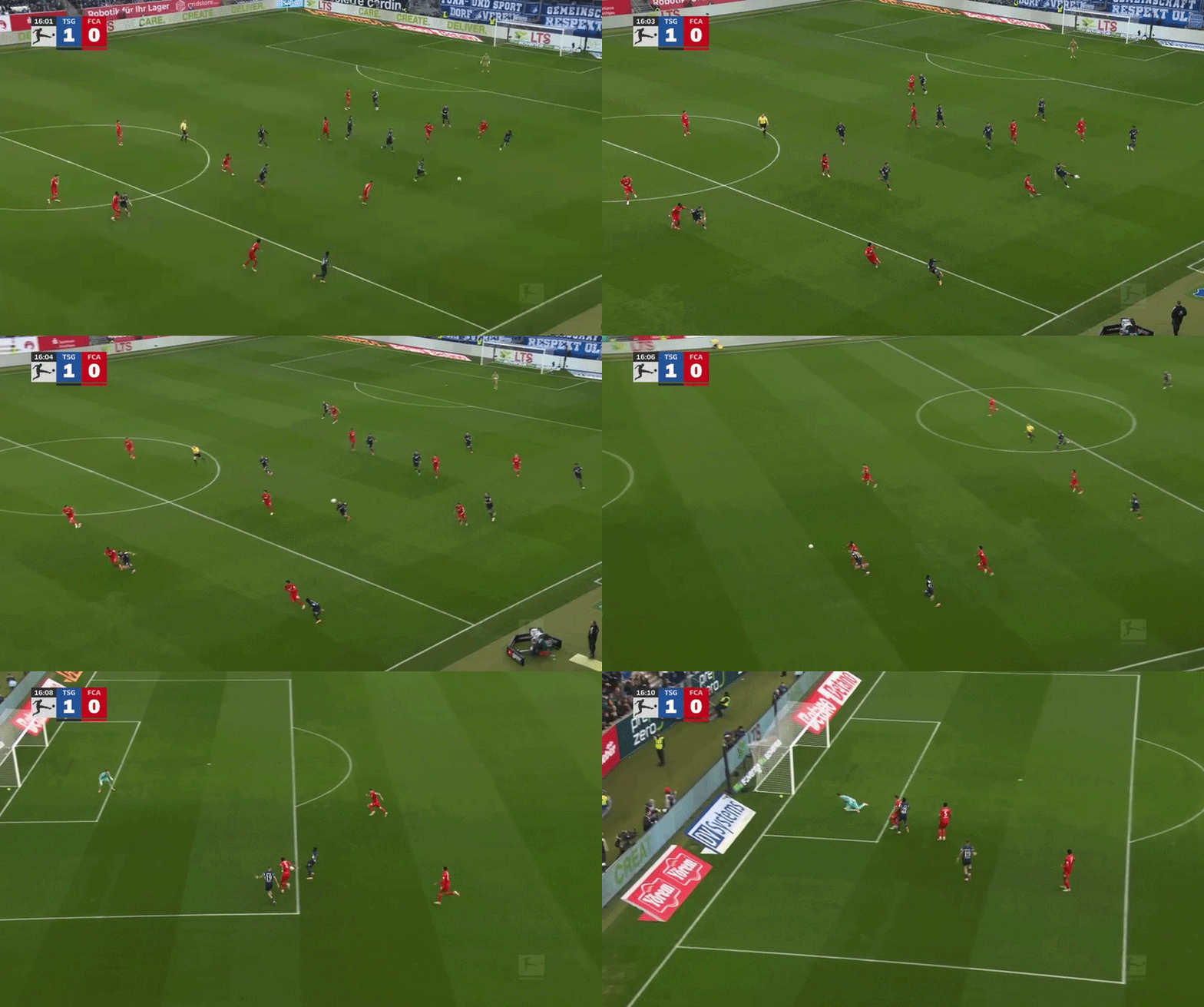
The through balls, passes into the penalty area, progressive actions and consistent involvement in the final third are not isolated moments. They are different expressions of the same underlying tendency: he wants to create from deep.
He is therefore better understood as a deep creator than simply a midfielder who happens to be good at progressing the ball.
And this is where the idea of him as a connector needs some qualification. Yes, Burger links phases of play. But he doesn't just link them — he tries to change them.
He receives deep and looks forward. He sees the run and attempts the pass. He can bypass a line rather than circulate around it. He can be the player responsible for turning a defensive recovery into a chance before the opposition has had time to reset.
That makes him a particularly interesting profile: a midfielder with the physical and defensive tools to operate deep, but with the creative instincts of someone who wants to influence what happens further up the pitch.
He doesn't simply keep the game moving.
He tries to make something happen.
The limitations
There are obvious limitations, but they are perhaps more nuanced than the carrying numbers and the eye test (at times) initially suggest.
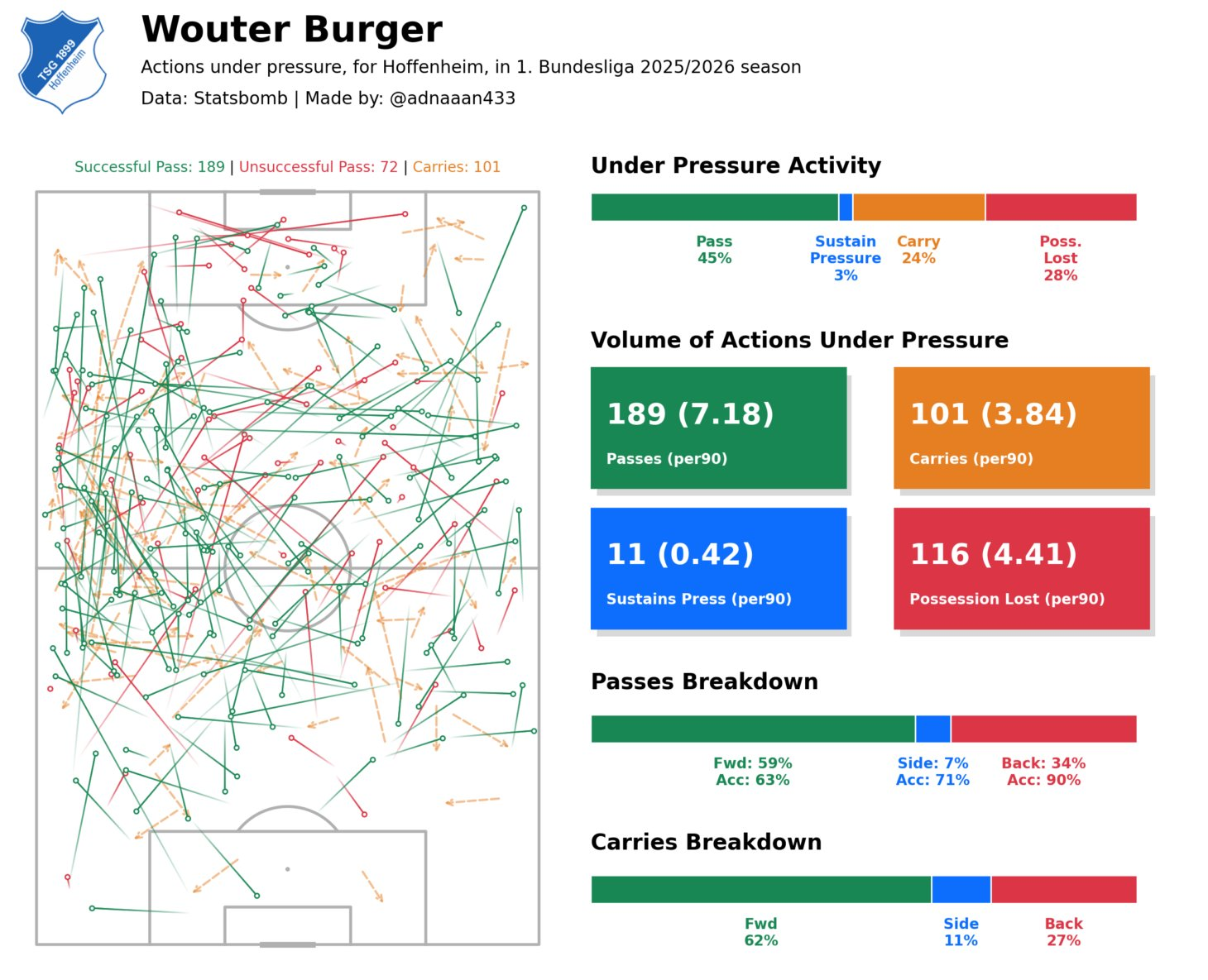
Burger is not a natural ball carrier. His dribble volume is low, and his 0.81 progressive runs per 90 sit below the league average of 1.02. When he receives the ball under pressure, his instinct is rarely to manipulate his way through the press with his feet.
The hold-up data from Playerprint makes that even clearer.
His average hold lasts 6.48 seconds, placing him in the 59th percentile, suggesting he is comfortable holding possession long enough to assess his options. But his retention rate in the middle third sits at 77.8%, only the 30th percentile, while his press-evasion figure is at the 63rd percentile (0.02).
That distinction matters.
Burger can buy himself time even though isn't particularly good at escaping pressure. And that fits the player I saw.
He doesn't typically solve pressure by turning away from it, taking on the opponent or carrying through the next line. His solution is usually to receive, scan and find the pass.
That isn't necessarily a flaw. In fact, it can be a strength when the structure around him gives him reliable passing options.
His progressive release rate of 7.58% sits in the 69th percentile, while 28.8% of his holds end in a progressive carry, only the 45th percentile. Neither number suggests that he is an exceptional pressure-beater, but they do reinforce something important about his profile: his progression is primarily about what he sees and plays, rather than what he does with his feet.
The 0.00% dangerous-loss rate is encouraging too. Despite the risks he takes with his passing, there is little evidence here of him regularly turning possession into genuinely dangerous turnovers.
There is, however, still a question around the quality of his execution under pressure.
His 77.1% passing accuracy is poor when compared to the T5 average. Some of that is clearly explained by the ambition of his passing — he attempts considerably more progressive and line-breaking passes. and crosses, than the average midfielder — but ambition obviously does not eliminate the risk. There will be moments where the difficult pass simply isn't on.
That is the question I would want answered over a larger sample, particularly against elite pressing sides.
Can Burger consistently recognize the progressive option when the opposition removes his first choice?
Can he receive under pressure and use his body and positioning to create just enough time for the pass?
And, perhaps most importantly, what happens when that pass isn't available and he has to escape the pressure himself?
For me, that is the clearest limitation in his profile.
Burger can create from deep. He can progress the ball. He can find passes that many midfielders of his physical profile simply don't attempt.
But if the opposition takes those passes away, he doesn't have the carrying or press-evasion ability to consistently manufacture a solution himself.
His answer is usually to hold, scan and pass... but if the structure around him can give him those options, that may be enough.
Conclusion
My interest in Wouter Burger started with a spreadsheet.
It continued because the player made sense on paper.
And after watching his pre-season games, I think the eye test has only made the profile more interesting.
He is a 1.91m midfielder who can compete physically, defend space, win aerial duels, recover the ball and contribute consistently to defensive actions. But he is also a progressive passer who is comfortable looking beyond the obvious option, attempting vertical passes and creating from deeper positions.
That combination is not particularly common.
And, returning to Chelsea's perspective, perhaps the easiest way to understand what makes Burger interesting for the Blues is to look at the midfielders already there.
Caicedo is the controller of space and the great problem-solver. His mobility, defensive range and ability to recover possession allow him to cover enormous amounts of ground, while his carrying gives him a way of escaping pressure that Burger simply doesn't possess (yet).
Enzo offers something different. He is a progressive passer and creator who can dictate games from deep, and in many ways his creative instincts are similar to Burger’s in terms of wanting to play forward and influence attacks early.
Lavia brings another variation: control, security and defensive presence, with the ability to dictate tempo when given the ball. Essugo is more naturally disruptive, giving you physicality, ball-winning and recovery without the same creative emphasis.
Barco, meanwhile, is perhaps the most obvious example of a midfielder who can progress the ball through technical quality and carrying. He can manipulate space with the ball at his feet and offer creativity, but his profile is fundamentally different from Burger's.
And then there is Henderson, who is a pure stabiliser: structure, tempo control, and off-ball discipline. He offers experience and game management, functioning as a way to close games down rather than open them up.
Burger doesn't really duplicate any of them.
He has some of Enzo's creative instincts, but his game is more vertical and risk-oriented from deeper positions. He has some of the physical and defensive qualities that make Essugo or Lavia useful, but with a considerably stronger creative profile. And while he can progress the ball, he does it primarily through passing rather than the carrying that makes Caicedo and Barco so special.
That is what makes him intriguing to me and led me to write this article.
Burger isn't a flashy midfielder. He won't dominate games through carries or individual dribbles. His influence is quieter, but, sometimes the most useful midfielders are the ones who make the game easier for everyone around them.
And that is the final impression he leaves.
He is not trying to be everything, but is rather trying to make everything else work better.
Credits
Words