Canva
UEFA Coefficients Preview: 2026/27 Season
A look at the coefficient battles for the 2026/27 UEFA club competition season.
A new season is just around the corner, meaning there is a lot to follow in the UEFA club competitions.
The 2026/27 campaign features 236 clubs playing across three competitions - the UEFA Champions League, the UEFA Europa League, and the UEFA Conference League. All 237 sides involved will have one goal: to lift one of the trophies come the end of the season.
They will not only be playing for glory, as there is something else also on the line. Each win, each draw, each progression to a later round in Europe wins their country coefficient points. And that is pivotal in deciding how many spots a country has in each competition, and what starting point.
The five-year UEFA country coefficient ranking, as well as the seasonal ranking, play a pivotal role in this respect. It is certainly something worth following, as many nations end up jockeying for certain positions in the rankings. Every result matters in the continental scene, something we have seen all too much over the last few years.
So, ahead of the new season, here is a preview of all coefficient battles we can expect to see over the next 11 months. For this article, the current access list is used as UEFA has yet to publish the one for the next cycle.
Battle for 50th: Nine Nations Hope to Avoid Bottom Five
We start at the foot of the five-year rankings, where there is a large group of countries sitting in, or dangerously close to, the bottom five.
Lithuania, Gibraltar, Montenegro, Northern Ireland, and Luxembourg are safe for now, but Andorra, Georgia, Estonia, and Wales all have work to do. The first qualifying round in particular will be quite decisive in finding out who will end up joining San Marino in the bottom five come season's end.
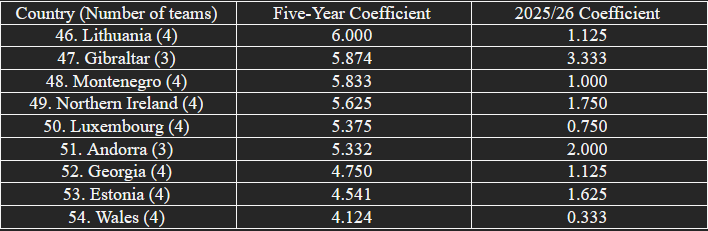
The fascinating part here is the fact that all nine countries have at least one direct clash in the first qualifying rounds of the Champions League and Conference League. In the case of Andorra and Estonia, all of their teams have direct clashes at this stage. That adds a further intrigue to the opening round of qualification.
But, how will this race be decided? A decade ago, the aim would just simply be to have the teams go as far as possible in qualifying. However, since the addition of the UECL, that has now changed, as a semi-realistic hope of playing in the league phase becomes available.
As such, the most important part here in successfully avoiding the bottom five is to have the domestic champion qualify for the league phase. From there, earning at least one win, or two draws, is an added bonus. Anything more than that would be beyond impressive. That, combined with winning direct duels in the qualifiers will be pivotal, as those wins become even more decisive.
But it is not only what the domestic champion does. Of course, they have a considerable advantage over the remaining teams, who have to get through four rounds of UECL qualifying with no room for error. However, the other two or three teams who enter at this stage have a part to play too. Ideally, at least one more side should be targeting the third qualifying round. That awards six games, and a more than decent shot at some key coefficient points. In total, having 12-18 games total would be a key number.
Regarding how many coefficient points will likely be required, that depends on the country in question. For the likes of Lithuania, Gibraltar, and Montenegro, less is needed, likely around 1.250 points to be safe without doubt. Going further down, that changes. Georgia, Estonia, and Wales have less than 5.000 points in their five-year ranking to start, meaning they will likely need at least 2.500 points to stand a chance.
Who are favourites in this battle for 50th? Looking at who are most likely to have a team in the UECL league phase, Northern Ireland should feel quite confident. Lithuania has little to do get over the line, so they should not run into too many problems. Andorra and Estonia both have a massive opportunity, as do Gibraltar and Georgia. Those four nations are involved in direct meetings in the UCL first qualifying round. Expect the winners of those ties to put their nation in a strong position.
Wales has a ton of work to do, and there is little to suggest they will be able to dig themselves out of this deep hole. Given Montenegro and Luxembourg's tough draws in the UCL, they will be under pressure. It will then become a question of what their UECL teams can do, going back to my point on direct clashes. There are seven ties in the first round that are direct battles, so if either are going to succeed, this will likely play a role.
Battle for 33rd, 38th: Tough Chase for Some, Tight Race for Others
Moving towards the middle of the rankings, the race for places in the top 33/top 38 will involve around 10 countries once again. Here is where expectations are higher than what one would see in the race for 50th.
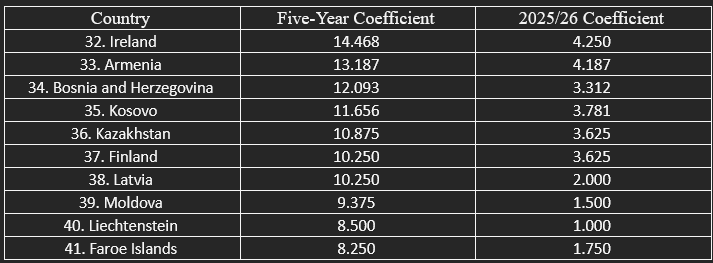
Going into the first week of qualification, the Republic of Ireland and Armenia are the last two nations holding onto top 33 places, which award UEL places for domestic cup winners. Bosnia and Herzegovina, Kosovo, and Kazakhstan are the three just below, who should not have to worry about falling out of the top 38.
Teams ranked 34th to 38th see their domestic cup winners start in the second qualifying round of the UECL, rather than the first. Finland and Latvia make up the final places in the top 38, though Moldova, Liechtenstein, and Faroe Islands are in the hunt.
To be successful this season, countries involved in this race will need their domestic champion to qualify for the league phase, namely the Conference League. From there, knockout round football will also likely be required, evidenced by some performances over the last few seasons.
On top of that, one of the other three teams will need to go as far as the playoff round minimum to really give their nation a shot, while another should be pushing for the third qualifying round. In total, between 20 and 24 games among the four sides are necessary. For Liechtenstein, who only sends one team a season, getting to the playoff round would likely seal the deal for them.
For the season coefficient, Ireland can get away with 2.500 points due to their head start. Armenia and Bosnia will want at least 3.000 points, nearing that 3.500 mark. Kosovo will require at least 3.500, while Kazakhstan will need a total closer to 4.500 if they are to have any hope, though at least 2.500 should be enough for them to avoid dropping out of the top 38.
For the other countries involved in the top 38 battle, Finland and Latvia – level on points to begin the campaign – should be striving for about 2.500 points. Moldova needs at least 3.000 points to stand a shot, while Liechtenstein and Faroe Islands must push for 4.000 points.
What can we expect in this race this term? Given Ireland’s advantage, they should be able to hold onto 33rd, though they will certainly have a tough time repeating last season’s success. Armenia and Bosnia will likely be the two to really fight for that other top 33 spot, with both supplying UECL league phase representatives regularly over the last few years. It will be a tough ask on Kosovo and Kazakhstan, although they both did quite well in 2025/26.
As for 38th, Finland and Latvia start with a 0.875-point lead, not a massive one. The former did quite well last term, something that cannot be said for the latter. It is not a big enough lead, and more will be necessary for this season, especially from Latvia. Moldova, Liechtenstein, and Faroe Islands all struggled last summer, with much more expected from the trio.
Battle for 22nd, 29th: Huge Group, Much on the Line
We move to the middle of the pack, for the battle for top 22 and top 29. There have been some interesting races here over the last couple of years, and we could see another one unfold in 2026/27, especially for 22nd.
Several of the countries involved would usually be in the race for a top 15 place, but instead, the gap between 15th and the rest is unusually large. So, now there is a large group of countries looking to compete to either stay, or enter, the top 22.
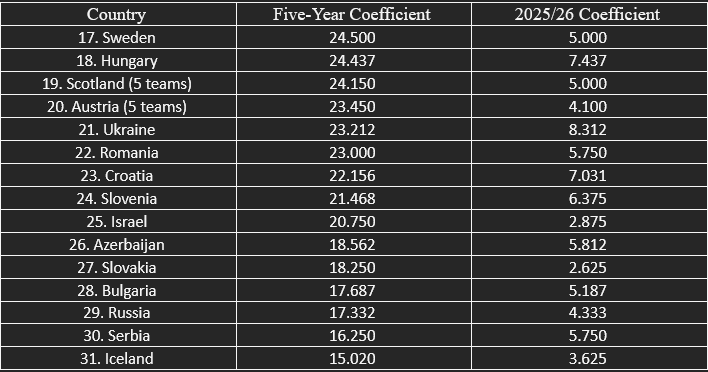
Sweden, Hungary, Scotland, Austria, Ukraine, and Romania are the six currently holding a top 22 place, which allows the domestic champion to enter the second round of UCL qualifying. Croatia, Slovenia, and Israel are in contention to catch the group of countries above them.
For 29th, which allows the lowest ranked domestic team to enter UECL Q2, Azerbaijan, Slovakia, and Bulgaria will be looking over their shoulders for the season, as Serbia and Iceland will try to pass them. It must be noted that with Russia’s continued ban from continental play, they are expected to be assigned 4.333 points once again, which will bring their five-year total to 21.665 points, which will likely be enough for a top 29 place.
As we continue to move up the rankings, the requirements and expectations change considerably. For top 22 to be achieved, at least two teams will need to qualify for a league phase, ideally with the domestic champion playing in the UEL proper. Moreover, knockout football will be expected from at least one of the two. It is a similar theme for the race for 29th, though having both teams play in the UECL would be fine.
Among the other two sides (three for Scotland and Austria), going deep in the qualifiers is quite pivotal. Of course, getting a third league phase team would set up a country for success, but it is not an absolute must. By season’s end, countries hoping to finish in the top 22 should be striving for at least 36 games in Europe. As for 29th spot, that number should be about 32.
Looking at what is needed from a coefficient total, expect another broad range of points. A five-year total of 29.000 points is likely the goal in the race for 22nd, meaning for most involved a figure of around 5.000 to 5.500 points. For the trio on the outside looking in, that number jumps up to 6.000 to 7.000 points. In respect to 29th spot, a total of about 22.000 points should be the minimum, so a seasonal total of between 4.000 and 7.000, depending on where a country starts, should do the trick.
The real question for both battles here is: is there a country currently sitting outside of 22nd/29th that stands a good shot at displacing one of the nations above them? For 22nd place, Croatia stands the best chance, given their contingent of teams. Israel is not out of the question either, though they need a massive improvement on the last two years. Serbia is the country to look out for in the battle for 29th, as much will depend on what Partizan Belgrade does.
On the other hand, the likes of Sweden and Ukraine could struggle massively, presenting that opportunity for the chasing pack. Bulgaria could be in the same boat if Ludogorets falters in UECL qualifying, opening the door for Serbia to be in the top 29 come season's end.
Battle for 14th: Trio Involved in Potential Thriller
What is usually a battle for top 15, where five European spots (two in the UCL) are on the line, that does not look likely this year. Instead, there is a race for 14th spot between three nations that have already all but secured 15th spot. The countries who finish in 13th and 14th will be rewarded with a UCL playoff round spot for their domestic champion in the 2028/29 season.
This should be an exciting race this season between Denmark, Norway, and Cyprus, with the trio having recently climbed back into the top 15 after struggling in the 20s for a few years. Two of the three are coming off excellent 2025/26 seasons, with Norway looking to build on the success of Bodø/Glimt.

Success for the three countries involved in the race for 14th looks like getting at least two sides in the knockout round, pushing for round of 16 in the UEL. For the league phase, ideally three teams (four for Norway) would give a solid advantage, though two (three in Norway’s case) is the bare minimum.
This is the group where having a side enter the UCL league phase would be beneficial, given the bonus points available. For number of games, the teams should combine for about 44 matches minimum, though hitting that 50 mark should be the goal.
When looking at the five-year coefficient, finishing above 40.000 points should be the goal. That puts a bit more pressure on Cyprus, who will likely require more than 10.000 points – a total they have hit in each of the last two seasons. For Denmark and Norway, 9.000 points on the season could very well be enough to see them hold onto a top 14 place. The pair have only managed to hit that mark once in the last four years though, which is why this race is even more intriguing.
Norway has a huge advantage here, in that they are already guaranteed three teams in the league phase – two in the Europa League and one in the Conference League. In fact, their domestic champion enters the UCL playoff round, two games away from the league phase. In comparison, neither Denmark nor Cyprus have a guaranteed league phase team yet.
However, the great equalizer is looking at the UEL and UECL contingent for the duo. In both of their cases, two of the three representatives have a coefficient high enough to get favourable draws throughout qualifying. In this case, there is a higher chance of Denmark and/or Cyprus ending up with three league phase teams, than Norway having four. This battle looks very tight as a result, and it will be difficult to call who will end up finishing in the top 14.
Battle for Top 10: Quartet Set for Tough Fight
The last five-year coefficient battle is expected to be for the places in the top 10. Ninth is also important, with all four countries involved having a realistic shot. Ninth place earns three guaranteed league phase berths, while 10th is the last spot where the domestic champion is assured league phase football.
Türkiye, Czechia, Poland, and Greece are the quartet competing for these spots, and if things end up like last term, we are in for perhaps the most fascinating battle of the bunch here.

What is the point of success in this race? For starters, at least four league phase spots are required. Any less and the nation(s) in question will be at a disadvantage. Getting all five teams past qualifiers would be a massive boost, and could be decisive. Beyond that, three teams in the knockout phase should be the minimum, ideally with one making the quarterfinals of the UEL or UECL.
Also, a place in the UCL knockout rounds should also be a goal for these countries, given their high ranking. Only Türkiye and Czechia are already guaranteed a league phase spot in the competition, with Poland and Greece having their champions start in qualifying. All four nations also have their runner ups involved in UCL qualification, and they too could also play a significant role.
In total, countries involved in this race should be looking at about 60 matches in total this term, averaging 12 per team. Looking at seasonal coefficient, a minimum of 10.000 points is a non-starter. To catch Türkiye, the trio below them will have to strive for 15.000 minimum, with Greece needing closer to 17.500. However, if the aim is just top 10, a coefficient closer to 15.000 should be the goal.
Team-for-team, Greece is in the strongest position of the bunch. Their two teams starting in the second qualifying round are seeded throughout qualification, meaning they should really have all of their sides in the league phase. Türkiye’s contingent is also quite strong, and should strive for five league phase places.
Czechia and especially Poland could struggle from that perspective, though if they can pick up four league phase spots – Czechia already has three while Poland has none – they will be in the hunt.
European Performance Spots: Big Five Set For Another Big Battle
We are moving on from the five-year coefficient to our last UEFA coefficient battle, which is the seasonal ranking. The top two finishers at the end of the season will earn an extra Champions League berth, which are known as European Performance Spots.
Unlike the five-year ranking, it is not an absolute given who will be involved. However, the expectation is that the top ranked nations, namely the ‘Big 5’ leagues, will be the main perpetrators once more.
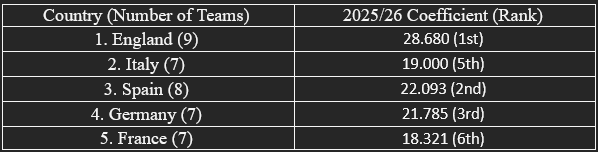
Italy, Germany, and France have seven teams each, while Spain will have eight and England nine once more. It is the same count as last term, leaving things at the status quo. These are the five countries most likely to battle it out for the two EPSs.
To earn an EPS, there is very little room for error. For starters, all teams need to qualify for the league phase. This is where the quintet have the advantage, as only one team is not yet secured football in the fall. They must successfully negotiate a two-legged UECL playoff round tie first.
Next, as many teams as possible need to be in the knockout rounds. To be in contention, countries should avoid losing more than one team during the league phase. After that, it is a matter of who goes the farthest, especially in the UCL, where more points are available. Remember, for each round achieved from the round of 16 on, it is 1.500 bonus points in the UCL, 1.000 in the UEL, and 0.500 in the UECL.
Direct duels are of increased importance, given how regularly sides of these countries face off. From the last two campaigns, at least 20.000 points are needed. That should be the same here, with an average of 14 matches per side being required to get over the line. Looking at it from that perspective, the countries with seven teams will be looking at almost 100 games in total. Spain should be reaching about 105 matches, while for England, that total is more than 110.
But who else has a shot at the top two? Here are five more countries who have the best chance of playing a role of a top two berth.
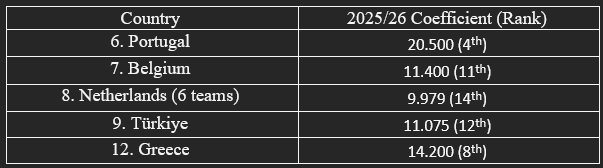
Portugal, Belgium, Netherlands, Türkiye, and Greece are the most likely to have all their teams in a league phase. The Portuguese, in particular, will be one to watch. They were in contention for much of the 2025/26 campaign, finishing fourth. They could be in for another top season, and should have all of their sides involved in a league phase.
Belgium and Netherlands disappointed in different ways last term, and more will be expected from both. It will be a tough ask in any case, but if they can get everyone in the league phase, they could challenge. As previously mentioned, Türkiye and Greece have a strong group in Europe this term, so they could play a part as well.
Credits
Words