
Inside America's Fast-Growing Betting Market: What Every Bettor Needs to Know
US sports betting hit $165B in wagers last year. Here's the real data on the boom, the odds stacked against you, and what every bettor should know before placing a bet.
Eight years ago, sports betting was legal in just one state. Today it's legal in 38, and Americans are betting like it's a national pastime. Statista reports that U.S. sports-betting revenue climbed from roughly $400 million in 2018 to more than $13 billion in 2024. By 2026, the figure had surpassed $16.96 billion.
What’s driving the surge? Some analysts point to the World Cup, others to the rise of MLS, David Beckham’s marketing charm, or simply the American appetite for sport and competition.
Whatever the cause, America’s punters’ market has evolved into a $165 billion-a-year machine, and it’s still accelerating.
U.S. Bettors: Breakdown Reports
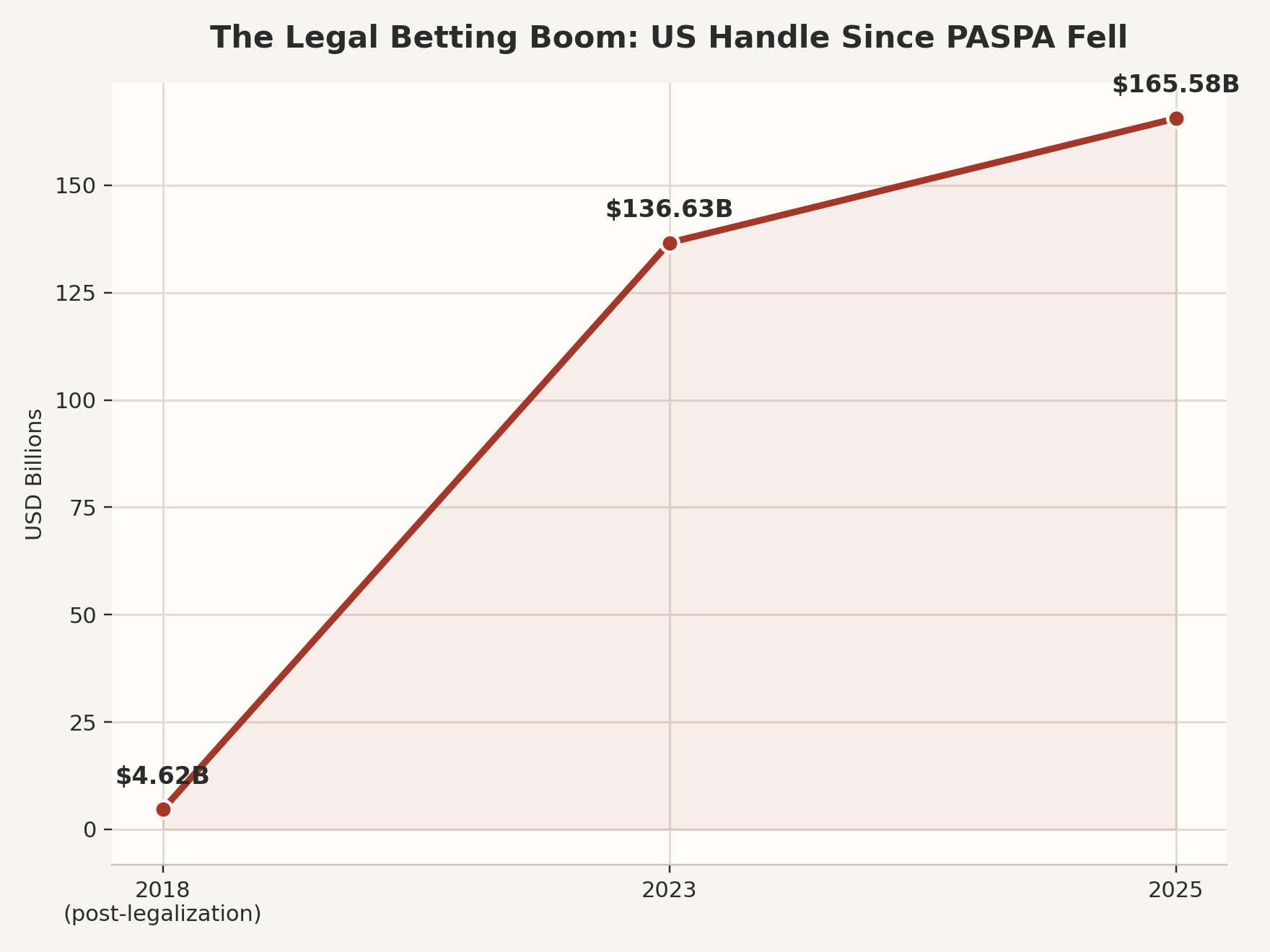
Before 2018, legal sports betting in America barely existed outside Nevada. The Professional and Amateur Sports Protection Act (PASPA) had effectively barred it nationwide since 1992, even as an estimated $150 billion a year flowed through illegal and offshore books. That ended when the Supreme Court's Murphy v. NCAA ruling struck down PASPA in May 2018. Growth since has been explosive: the handle jumped from $4.62 billion pre-legalization to $136.63 billion by 2023, and sports betting is now legal in 38 states plus D.C.
Rules are set state-by-state (age limits, bet-type restrictions, tribal vs. commercial licensing), but that system is now under siege from prediction markets like Kalshi and Polymarket, which claim CFTC oversight lets them skip state licenses and taxes entirely, despite sports making up 72%+ of their volume. Roughly 20 states are suing these platforms, 44 attorneys general have opposed the CFTC's rules, and one state suit against Kalshi seeks $36 billion in penalties. The conflict is headed for the Supreme Court.
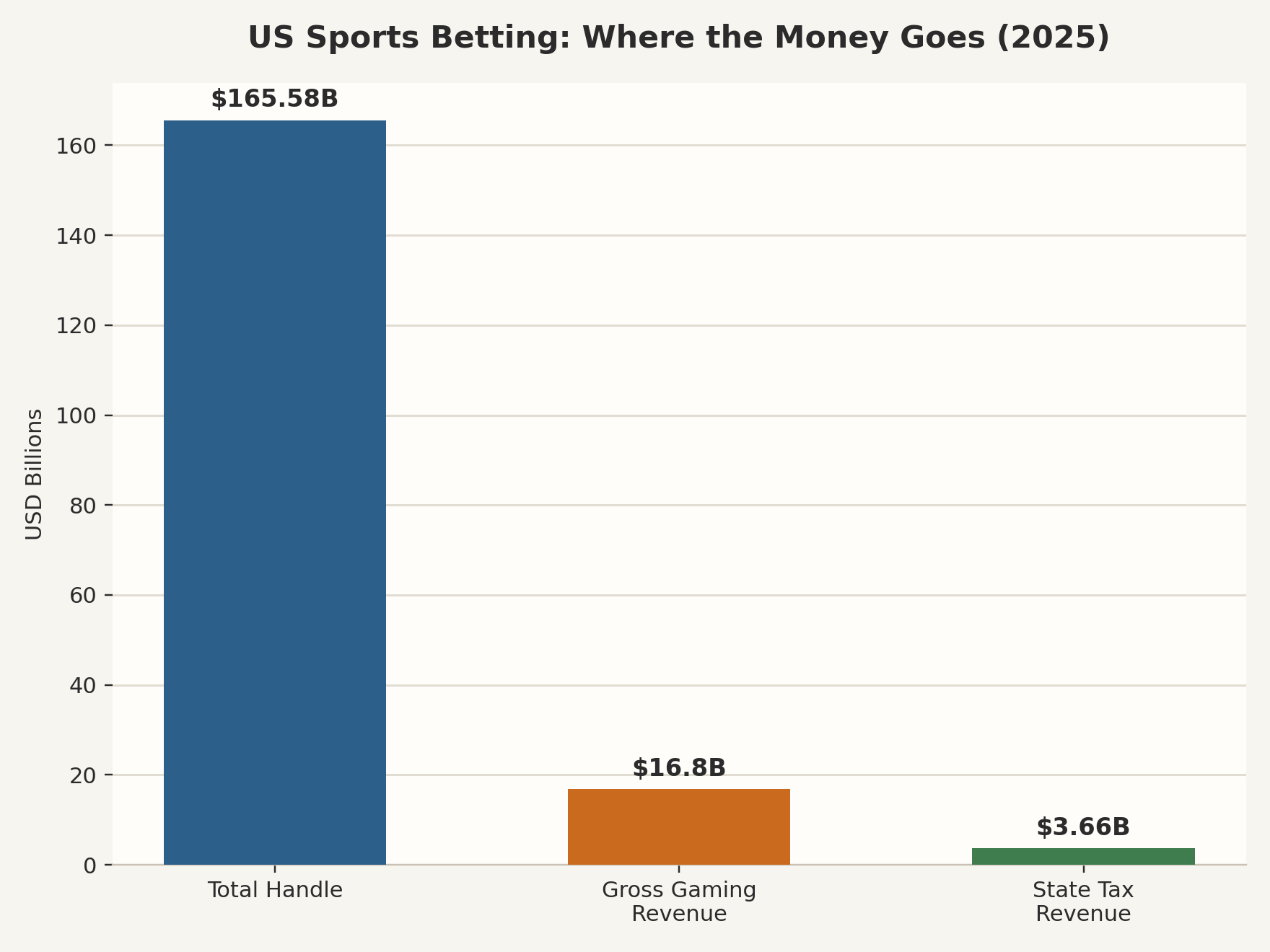
In 2025, US sportsbooks processed $165.58 billion in handle, kept $16.80 billion in revenue, and paid $3.66 billion in state taxes, while the AGA says states have lost $570 million+ in tax revenue to untaxed prediction-market betting.
Betting: Drivers and Indicators
The betting boom is feeding into an enormous American sports economy. McKinsey estimates that the U.S. sports economy was worth $160 billion in 2024 and could exceed $300 billion by 2035, representing roughly 6% annual growth. The firm's analysis highlights rising fan engagement across the NFL, NBA, MLB, NHL, and MLS, precisely the sports attracting huge volumes of wagers.
Coincidence? Hardly. Here's what's actually driving it:
1. The World Cup after-effect
The 2026 FIFA World Cup, hosted across the US, Mexico, and Canada, left American sportsbooks in record territory. US operators processed an estimated $2.82–4.3 billion in handle across the tournament, roughly nine times the $490 million wagered during Qatar 2022. Fans weren't just cheering alone but were positioning themselves to profit from the passion, and sportsbooks saw record first-time depositors as a result.
2. Pro betting TV commercials and ads
Sportsbooks turned advertising into their biggest weapon. FanDuel and DraftKings each spent over $1.2 billion on marketing in 2025, roughly a fifth of their total revenue, saturating game broadcasts with odds, promos, and "bet now" prompts. National TV ad spend for the category jumped 40% to $270 million in 2026 alone, and a Washington Post review of 50 broadcasts found sportsbook branding appearing in nearly half the games analyzed. The pitch has moved beyond TV, too: DraftKings alone reportedly outspent every alcohol brand combined on podcast advertising in 2025. The message is everywhere fans already are, timed to hit right when they're most locked into the game, turning every commercial break into another nudge to place a bet.
3. Rise of gambling sponsors
Leagues stopped treating sportsbooks as outsiders and made them official business partners. The NFL just renewed multi-year deals with DraftKings, FanDuel, and Fanatics ahead of the 2026 season; the previous five-year DraftKings/FanDuel/Caesars package alone was worth just under $1 billion, giving operators NFL branding rights, real-time Next Gen Stats data, and integrations baked directly into league broadcasts and digital platforms. Other leagues are chasing the same money: the NHL signed marketing deals with both Kalshi and Polymarket in October 2025, and MLS made Polymarket its official exclusive prediction-market partner in January 2026.
4. Massive investment in MLS
MLS hasn't been shy about spending big to buy relevance, and it's paying off. The arrival of superstars like Lionel Messi, Luis Suárez, and Son Heung-min has sent team valuations soaring. Inter Miami alone is now valued at $1.45 billion, up 22% in a single year, and dragged casual fans into the stadium and onto betting apps. MLS betting volume jumped 33% in a single season as Inter Miami went from the 15th most-bet-on club in the league to the most-bet-on club almost overnight, proof that star power translates directly into betting handle, not just ticket sales.
5. A younger, more diverse fanbase is spending more
McKinsey's research points to demographic shifts, especially fast-growing Latino fan engagement, as a major driver behind the sports economy's climb toward $300 billion by 2035. Latino fans already make up 19% of that $160 billion ecosystem and are projected to hit 25% by 2035, contributing roughly a third of all future growth, while spending 15% more than non-Latino fans across media subscriptions, tickets, and merchandise. That audience skews young, mobile-first, and digitally native; the exact profile sportsbooks are built to convert, since betting apps live on the same phones this demographic already uses for streaming and social media.
| Year | No. of U.S. States Where Betting is Legal | Amount Processed by US Sportsbooks |
|---|---|---|
| 1992 | 0 | - |
| 2018 | 30 | $4.62 billion |
| 2026 | 39 | $165.58 billion |
Tips and Key Strategies
Successful sports betting isn't about chasing quick wins; it's a disciplined approach built on consistent, strategic wagering over an extended period. Unlike other forms of gambling, a winning bettor is driven by research, planning, and smart money management rather than gut feeling. Building a strategy that actually holds up long-term means understanding and applying a handful of key components. Below, we break down the essentials every smart bettor should follow.
1. The Kelly criterion
The Kelly Criterion is a mathematical formula used to determine the optimal size of a bet based on the probability of winning and the odds on offer. It helps bettors maximize returns while minimizing the risk of going broke by calculating an ideal stake size from the gap between your estimated odds and the bookmaker's odds.
The formula works by taking your estimated probability of winning, subtracting the probability of losing, dividing by the decimal odds minus one, and applying that fraction to your bankroll. For example, if you believe a team has a 50% chance of winning at odds of 2.0, the Kelly formula tells you exactly how much of your bankroll to put down. A positive result signals a value bet; a negative one tells you to walk away or consider the opposite outcome.
Used correctly, the Kelly Criterion keeps bet sizes proportional to your actual confidence rather than to impulse, and it can be dialed back with Fractional Kelly, a more conservative version that reduces variance and helps preserve your bankroll over time. Applied consistently, this approach turns betting from a guessing game into a repeatable system built around value, discipline, and long-term survival rather than one-off wins.
2. Utilising Bookie promos and offers
Betting promotions can be a means major bookmakers use to attract new customers, but they can be an opportunity for punters too. Free bets, cashback, enhanced odds, and deposit bonuses can give bettors additional value and, when used responsibly, help them make their bankroll go further. Comparing offers across multiple bookmakers can also help bettors find better promotions rather than relying on a single sportsbook.
Some promotions can be particularly attractive to new bettors. No-deposit free bets, for example, allow eligible users to place certain bets without making an initial deposit, while cashback offers can return a percentage of qualifying losses. Enhanced odds can also increase potential payouts on selected markets. However, these offers often come with conditions such as minimum odds, qualifying bets, wagering requirements, maximum stakes, or expiry dates.
The key is to look beyond the headline promotion and understand its actual value. Always read the terms and conditions before accepting an offer, as restrictions can significantly affect how much you can gain from it. Used strategically, bookmaker promotions can complement a football betting strategy, but the best approach is to compare offers, understand the rules, and focus on genuine value rather than chasing every bonus.
3. Bayesian statistics approach
Bayesian statistics has become an increasingly useful approach to sports betting because it allows probabilities to evolve as new information becomes available. Unlike traditional methods that may rely heavily on fixed historical data, Bayesian analysis starts with an initial assumption, or prior probability, and then adjusts it as fresh evidence emerges. In sports betting, where injuries, team form, lineups, weather, and in-game events can quickly change the outlook of a match, this flexibility can be particularly valuable.
The basic framework is straightforward: bettors begin with prior knowledge, incorporate new evidence, and calculate an updated posterior probability. For example, a bettor may initially estimate a team's chances of winning based on its historical performance and current form. If the team's star player is ruled out shortly before kickoff, that new information can be incorporated into the model, producing a revised probability that better reflects the current situation.
This makes Bayesian analysis especially relevant to in-play betting, where circumstances and bookmaker odds can change within seconds. As goals, injuries, red cards, possession, and other events unfold, probabilities can be continuously reassessed. The approach does not guarantee profitable bets, but it provides a structured way to update expectations and make decisions based on the latest available evidence rather than relying solely on an initial prediction.
4. Betting on Over/Under goals
Over/under goals betting is one of the most popular football betting markets, particularly during live matches. The idea is simple: bettors predict whether the total number of goals scored will be above or below a bookmaker’s line, such as 2.5 goals. To make more informed decisions, analysing a team’s recent scoring and conceding record, ideally alongside a larger sample of matches, can reveal useful patterns. Expected goals (xG) can add another layer by measuring the quality of scoring chances created and conceded rather than focusing solely on the final score.
Finding value requires more than simply choosing the most likely outcome. Bettors should compare the probability suggested by their analysis with the bookmaker’s odds and consider whether the price accurately reflects the risk. Higher lines, such as over/under 4.5 goals, can offer bigger odds but are generally harder to predict because they require an unusually high or low-scoring match. Combining historical data with team form, match statistics, and live developments can provide a stronger basis for evaluating these markets.
Match conditions can also have a significant influence on goal expectations. Weather, tactics, injuries, substitutions, the scoreline, and the pace of play can all change the likelihood of further goals. Historical head-to-head results may provide additional context, although they should not be treated as a standalone predictor. For in-play bettors, combining live match information with statistical models and current market prices can help create a more informed approach to over/under betting.
5. The Value betting concept
Value betting is a straightforward yet powerful strategy focused on identifying odds that exceed the actual likelihood of an event occurring. It lets bettors capitalize on the gap between bookmaker odds and real-world probability. The core idea is simple: if you believe the true probability of an event is higher than what the odds imply, you've found a value bet.
Mastering it requires a genuine understanding of both the sport and the betting market. Analyzing team form, player injuries, and historical performance is essential groundwork, and calculating the true probability of an outcome, then comparing it to the odds on offer, tells you whether a bet actually holds value. For instance, if a bookmaker offers odds of 3.0 on a team to win, but your own analysis puts the true probability at 40%, the bet is valuable because the expected value is positive.
Value betting is especially accessible for beginners since it usually involves single outcomes rather than complex accumulators, and sticking to single bets sharpens your sense of value and leads to more informed decisions over time. It's no surprise that many successful punters treat value betting as a cornerstone of their strategy, since it consistently surfaces genuine winning opportunities rather than lucky ones.
Editor's Final Remarks
The market isn't slowing down, and neither is the sophistication of the apps chasing your attention. Statista puts the US at the top of the global leaderboard, projecting $21.96 billion in sports betting revenue for 2026, with over 80% of all legal wagers now placed on a phone rather than at a window. New York, Illinois, New Jersey, Ohio, and Pennsylvania lead as the five biggest state markets, a clear sign of just how much room is still open for more Americans to jump in.
But here's the catch nobody puts on the billboard: research published in Comprehensive Psychiatry found that sports bettors can carry elevated risks tied to gambling engagement. The study, which examined 2,806 U.S. adults alongside an oversample of 1,557 sports-wagering adults, found that risk was closely tied to the breadth and intensity of someone's gambling behavior.
More recent research makes the picture even clearer. Fulford's 2026 study found that 33.8% of sports gamblers fell into a high-intensity category, defined by betting at least weekly, typically wagering more than $50, or losing $100 or more in a single day. Meanwhile, 60% reported their typical wager was $20 or less, showing how casual, small-stakes betting can coexist in the same market as far riskier behavior. The numbers don't lie: the boom is real, but so is the fine print. Every bettor has to weigh the two before placing that next wager.