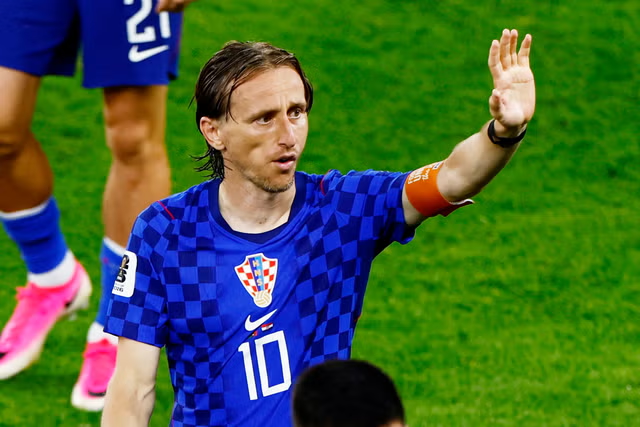
Luka Modrić and the Impossible Debate: Why He Has One of Football's Strongest Claims to Be a Top Three Midfielder
Football supporters love one question more than almost any other: who is the greatest?
It is a debate that has no definitive answer, yet one that continues to define generations of the sport. The difficulty lies in the fact that football is both objective and subjective. Statistics tell part of the story, while the eye test often tells another. Trophies matter, but so too does the context in which they were won. Longevity deserves recognition, yet a player's peak can sometimes outweigh the length of their career. That is why ranking footballers requires more than simply counting medals or compiling highlight reels. A meaningful discussion should instead begin with a consistent framework.
My own framework consists of goals and assists where appropriate, individual honours, trophies, influence on winning, longevity, consistency, relevant performance metrics and, perhaps most importantly, what the player actually looked like on the pitch. Football remains a game watched by human eyes before it is analysed by data. There is, however, another metric that deserves far greater attention than it currently receives: the difficulty coefficient.
Not all achievements carry the same weight. Winning the Premier League with one of England's richest clubs is undoubtedly impressive, but guiding a club with fewer resources to the same achievement is arguably even greater. Likewise, winning international tournaments with one of football's traditional superpowers should not be evaluated identically to transforming a nation with a vastly smaller player pool into genuine contenders. Football does not exist in a vacuum. Financial power, squad depth, infrastructure and population size all influence success, meaning context should always accompany achievement when assessing greatness.
It is this principle more than any other that elevates Luka Modrić's career into football's highest conversation.
At club level, Modrić has spent the majority of his prime at Real Madrid, the biggest club in world football and one of the most successful sporting institutions ever assembled. Success is expected there, and winning trophies is part of the club's identity. While that should never diminish Modrić's extraordinary contribution, it does mean that some of his greatest achievements are found elsewhere.
International football provides the strongest evidence for his case.
Croatia is a remarkable football nation, producing elite footballers despite a population of fewer than four million people. Even so, reaching the 2018 FIFA World Cup final remains one of the greatest overachievements in modern international football. Modrić was unquestionably the heartbeat of that side. He dictated the tempo, escaped pressure with astonishing composure, progressed possession through midfield and repeatedly produced when the pressure was greatest. Croatia defeated nations with significantly larger populations and deeper talent pools before eventually reaching the final, with Modrić deservedly receiving the Golden Ball as the tournament's outstanding player.
Four years later, many expected Croatia's golden generation to fade. Instead, Modrić once again led his country to the semi-finals of the 2022 World Cup before securing a third-place finish. Sandwiched between those tournaments were competitive European Championship campaigns that reinforced Croatia's position among Europe's elite despite operating with a fraction of the resources available to many of their rivals. When discussing football greatness, these contextual achievements deserve significantly greater recognition than they often receive. Taking Croatia to consecutive deep World Cup runs is not directly comparable to achieving similar success with one of football's traditional global powers. Difficulty, overachievement and context should all influence how careers are evaluated.
None of this is intended to diminish Modrić's extraordinary club career. On the contrary, it strengthens it. His trophy collection is among the finest ever assembled by a midfielder, yet numbers alone cannot explain why he remained indispensable for so long. Across multiple managers, tactical systems and generations of teammates, Modrić continually adapted while remaining one of Real Madrid's most trusted and influential players. Very few midfielders have demonstrated such longevity while maintaining world-class standards well into their late thirties.
Perhaps the defining moment of his individual career arrived in 2018 when he won the Ballon d'Or. For a decade, the award had effectively become the private property of Lionel Messi and Cristiano Ronaldo. Breaking that dominance required an exceptional year for both club and country, and Modrić achieved precisely that. It was recognition not only of his technical brilliance but also of his influence over the biggest matches in world football.
Yet statistics and awards still fail to capture everything that made Modrić exceptional. His greatness becomes most apparent through the eye test. He rarely appeared rushed, even when surrounded by opponents. Pressing him often seemed futile because his awareness of space and timing allowed him to escape situations that appeared impossible. His first touch routinely created passing angles invisible to everyone else, while his passing combined progression with security in a way very few midfielders have ever managed. He could accelerate attacks, slow the tempo, recycle possession or unlock defensive structures depending entirely on what the game required at that exact moment.
Modern football increasingly values players capable of controlling chaos, and few have ever done so more consistently than Modrić. He combined technical excellence with relentless work rate, defensive intelligence and tactical discipline. He could recover possession, evade pressure, dictate the rhythm of a match and still provide moments of creativity without sacrificing the balance of his team. That completeness is perhaps his defining characteristic. He was never simply a passer, a dribbler or a playmaker. He was all of them simultaneously.
Football history has produced extraordinary midfielders. Xavi redefined positional football through control and precision. Andrés Iniesta possessed an unmatched ability to deliver in football's biggest moments. Zinedine Zidane combined elegance with authority, Andrea Pirlo orchestrated matches through vision and intelligence, while Lothar Matthäus offered an extraordinary blend of athleticism, leadership and versatility. Comparing players across generations will always remain subjective because football itself constantly evolves.
However, if greatness is judged through a balanced framework that values individual quality, statistical contribution, longevity, trophies, influence, context, overachievement and what the player consistently demonstrated on the pitch, Luka Modrić possesses one of the strongest cases any midfielder has ever assembled. The statistics support him, the honours support him, the longevity supports him and, perhaps most convincingly of all, the football itself supports him. For players of the post-2008 era, Modrić belongs comfortably among the greatest midfielders the game has seen, and when that same framework is applied across football history, his place in an all-time top three becomes an argument built not on nostalgia or emotion, but on evidence.
More from Mohamed Weheliye coming soon.
Visit the profile to follow and get notified when the next piece lands.