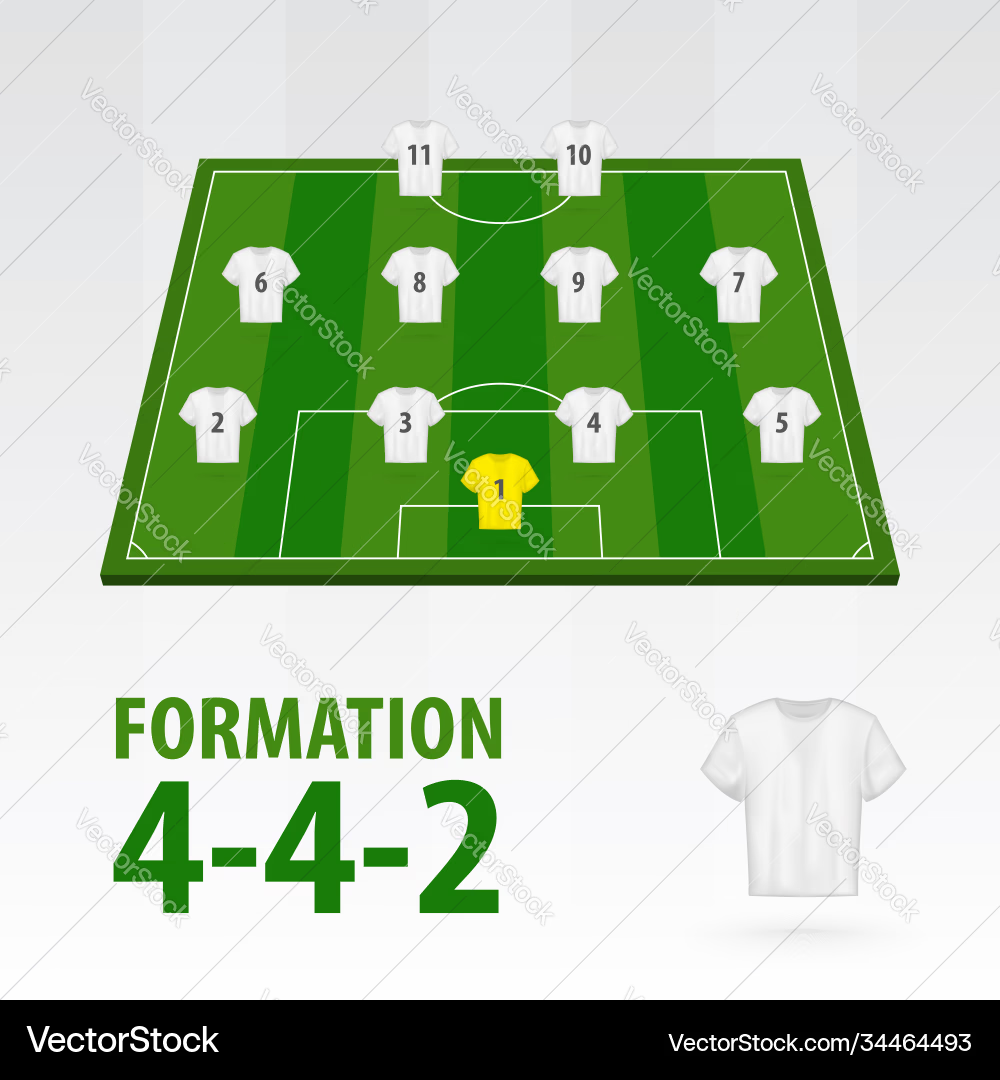
The Death of 4-4-2 Was Greatly Exaggerated
"Football doesn't discard systems. It discards managers who fail to adapt them."
For years, the 4-4-2 has carried an unfair reputation. Mention it in modern tactical discussions and the response is almost predictable: outdated, rigid, defensive and lacking technical sophistication. In an era obsessed with inverted full-backs, box midfields and asymmetrical pressing structures, the humble 4-4-2 has become football's forgotten formation.
Yet history tells a very different story.
One of the greatest teams English football has ever seen—the Arsenal Invincibles—won the Premier League unbeaten using a variation of the 4-4-2. Arsène Wenger's side wasn't tactically primitive. It was tactically intelligent.
The formation itself wasn't the weapon.
The players' interpretation of it was.
That distinction has become lost in modern football.
The Biggest Misconception
Too many people view formations as static diagrams.
A 4-4-2 on a tactics board appears predictable: two banks of four, two strikers and little creativity.
Football isn't played on whiteboards.
It is played in transitions.
The best teams rarely resemble their starting formation once the game begins. A modern 4-4-2 can become a 2-4-4 in sustained possession, a 3-2-5 through intelligent full-back movement or, most naturally, a devastating 4-2-4 when attacking.
That transformation is exactly why writing the system off is a mistake.
The Forgotten Attacking Potential
One criticism levelled at the 4-4-2 is that it sacrifices numbers in midfield.
That criticism ignores what happens when wide midfielders attack aggressively.
Instead of remaining deep, they push alongside the two forwards, instantly creating a front four capable of stretching defensive lines both horizontally and vertically.
Suddenly, the shape evolves into:
- Four defenders
- Two controlling midfielders
- Four attackers
A 4-2-4.
This creates constant dilemmas for opponents. Do full-backs stay narrow and leave the wide players isolated? Or do they engage, opening central channels for the strikers?
Either decision creates space somewhere else.
Rather than limiting attacking options, the modern interpretation of the 4-4-2 can maximise them.
Where Is the Number 10?
Another criticism often directed at the 4-4-2 is that it leaves no room for a traditional number 10. In an era where creativity is often associated with a player operating between the lines, many assume the system sacrifices invention for structure.
In reality, it simply redistributes creativity.
Rather than relying on a single central playmaker, a modern 4-4-2 can empower its wide players to become the team's creators. Instead of hugging the touchline for 90 minutes, they are free to drift inside, combine between the lines and attack the half-spaces, effectively becoming dual number 10s in possession.
Some of football's most gifted wide players have thrived when given that licence. Players such as Eden Hazard and Neymar were never simply wingers; they operated as playmakers starting from the flank. In today's Premier League, Morgan Rogers and Eberechi Eze possess many of those same qualities: comfortable receiving in tight spaces, carrying the ball through central areas and creating chances while nominally beginning from a wide position.
The position on the team sheet matters far less than the spaces a player is encouraged to occupy.
A well-coached 4-4-2 doesn't eliminate creativity.
It simply allows it to emerge from different areas of the pitch.
Why More Teams Should Embrace It
Football has become obsessed with technical superiority.
Managers often attempt to dominate possession regardless of whether their squad possesses the technical quality to execute complex positional play.
For many clubs, particularly those outside the elite, this becomes self-defeating.
Not every squad is built to play intricate positional football.
Not every team has midfielders capable of receiving under intense pressure.
Not every defender is comfortable building through multiple pressing traps.
A well-coached 4-4-2 simplifies decision-making without sacrificing competitiveness. It provides natural defensive compactness, clear pressing triggers, defined responsibilities, reliable width, two central targets and fast transitions.
Most importantly, it allows teams with less technical ability to compete through organisation, athleticism and intelligent movement rather than forcing them into systems beyond their strengths.
There is no shame in tactical simplicity.
Sometimes simplicity is efficiency.
Arsenal's Missed Opportunity?
While tactical hindsight is always easier, Arsenal may have benefited from revisiting aspects of the 4-4-2 during periods last season.
Imagine the personnel.
Out of possession, Bukayo Saka and Leandro Trossard drop into wide midfield positions, maintaining compactness alongside Declan Rice and Martín Zubimendi. The team defends in two disciplined banks with clear defensive responsibilities across the pitch.
In possession, however, the picture changes entirely.
Saka pushes high.
Trossard joins the attack from the opposite flank.
Viktor Gyökeres occupies the centre-backs.
Kai Havertz attacks the spaces around him.
Instantly, Arsenal possess an aggressive front four:
- Saka
- Gyökeres
- Havertz
- Trossard
Behind them, Rice and Zubimendi provide security, control transitions and recycle possession.
Rather than restricting Arsenal's attacking play, the structure could actually create greater occupation of the final third while maintaining defensive balance once possession is lost.
It isn't about abandoning Arteta's positional principles.
It's about recognising that formations are flexible frameworks, not tactical prisons.
The Formation Deserves Respect
The problem has never been the 4-4-2.
The problem is believing any formation should remain unchanged for 90 minutes.
Football has evolved beyond fixed shapes.
Managers now coach phases:
- Attack
- Rest defence
- Build-up
- Pressing
- Counter-pressing
- Defensive organisation
A modern 4-4-2 should evolve with each of those moments.
When it does, it becomes remarkably adaptable.
Perhaps that is why dismissing it as "old-fashioned" feels increasingly lazy.
The formation that once dominated English football hasn't become obsolete.
It has simply fallen out of fashion.
Fashion changes.
Good tactical principles endure.
Maybe it's time football stopped treating the 4-4-2 as a relic of the past and started recognising it for what it can still be: one of the game's most versatile and misunderstood systems.
The 4-4-2 doesn't deserve nostalgia.
It deserves reconsideration.