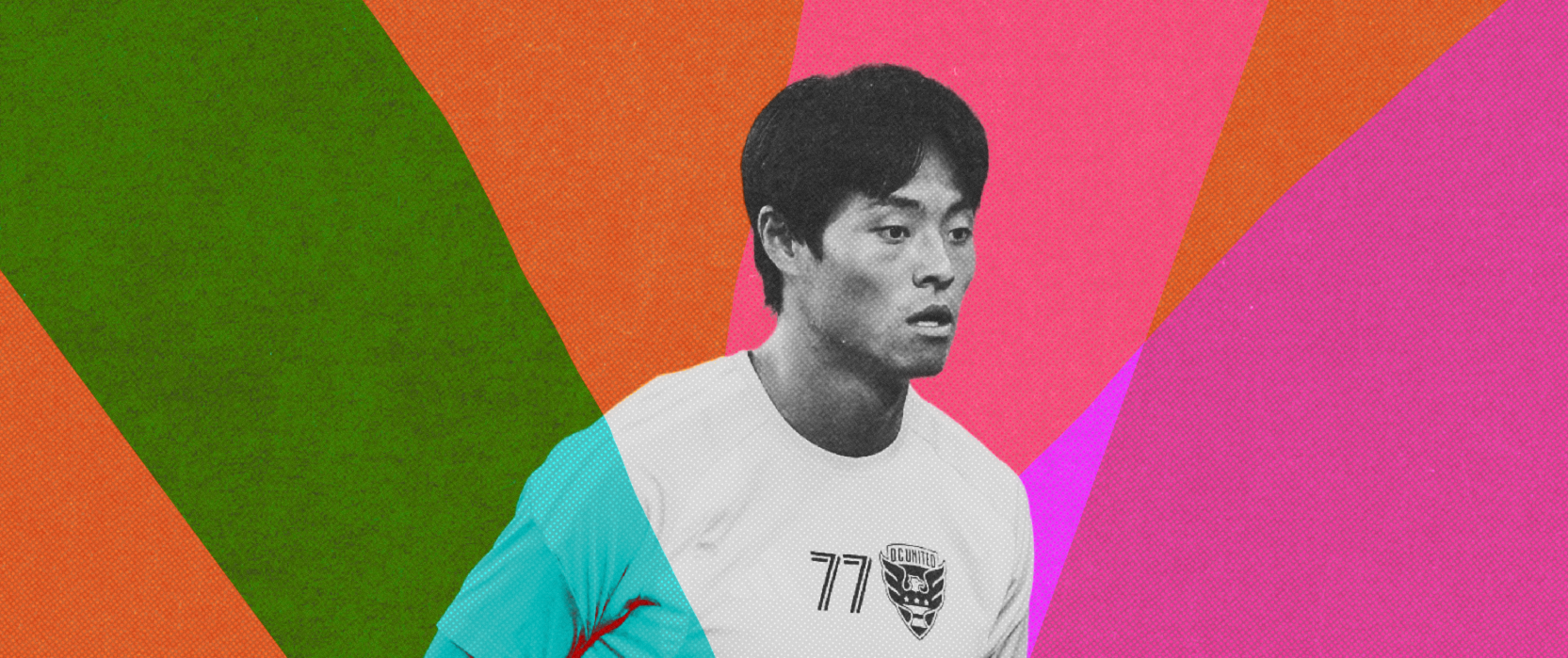
Beyond Positions and Borders: How Hosei Kijima Is Forging His Own Path in MLS
Hosei Kijima was just 12 years old when he left Japan for the United States. Inspired by the success of Japanese tennis icon Kei Nishikori, who honed his skills at IMG Academy, Kijima traded his international school in Yokohama for the renowned sports academy in Bradenton, Florida.
It was a decision that would change the course of his life, but his American adventure got off to a rocky start. Struggling to adjust to his new surroundings, Kijima received 27 detentions during his first year for skipping classes and training sessions. His parents even flew from Japan to Florida in an attempt to get him back on track. Eventually, their message got through.
Kijima transformed himself from a wayward youngster into a dedicated student of the game, waking up as early as 3 a.m. to hone his technical abilities and studying the tactical philosophies of managers like Roberto De Zerbi, Fernando Diniz, Marcelo Bielsa, and Ange Postecoglou. Having spent years analyzing some of soccer's most innovative minds, he hopes to one day follow in their footsteps and embark on a coaching career of his own.
Fernando Diniz: The Godfather of Relationism
His determination eventually earned him a scholarship to Wake Forest University, where he registered nine goals and 10 assists in 63 appearances and captained the Demon Deacons. His performances caught the attention of St. Louis CITY SC, who selected him with the 17th overall pick in the 2024 MLS SuperDraft.
Kijima wasted little time making his mark, scoring the winning goal on his professional debut against Houston Dynamo. He finished his rookie campaign with two goals and an assist in 21 MLS appearances before being selected by San Diego FC in the 2024 MLS Expansion Draft, but he was immediately traded to D.C. United for $400,000 in general allocation money.
After establishing himself as a regular starter under Troy Lesesne in 2025, Kijima found opportunities harder to come by following the midseason appointment of Swiss manager René Weiler. He finished the campaign with two goals in 31 appearances as D.C. United finished bottom of the Supporters' Shield standings. Nevertheless, the managerial change offered Kijima an opportunity to refine his game and develop a more attack-minded approach.
"He's helped me to think less in terms of overthinking and play more with my instinct, and also having my first thought be the goal," Kijima says of Weiler. "Maybe a few years ago, I would have tried to keep possession, maybe go backwards or horizontal. He's given me the freedom to try and take risks and play the best game I can."
https://x.com/dcunited/status/1898558435093889424?a=8tY-WdX_q6r9u6O6fko&s=20
Having made just 13 appearances in 2026, Kijima's season came to a premature end after he sustained a foot injury during D.C.'s 4-0 defeat to Inter Miami. He subsequently underwent surgery to repair his fifth metatarsal, leaving him to watch from the sidelines as his teammates attempted to salvage their playoff hopes.
After defeating New York Red Bulls despite playing with 10 men, D.C. suffered three consecutive defeats, leaving them 13th in the Eastern Conference and six points behind the Red Bulls, who occupied the final wild card position.
For Kijima, however, setbacks are nothing new. Whether it's adapting to a new country, learning an unfamiliar position or fighting his way back into the starting lineup, his career has been defined by a willingness to embrace challenges.
"I think it's resilience," Kijima said when asked what sets him apart from his competition. "Being able to come back from injuries or times where you're not being favored is so important. Being able to step up in games when the coach, the team, when all the club needs you, is so important. I always try to focus on that."
https://x.com/MLS/status/1760137857883091121?a=RsQOV0q5yh3FEXBa5gw&s=20
That resilience has been accompanied by an unusually flexible understanding of the game. Having featured in virtually every position since his academy days, Kijima has developed a philosophy that prioritizes tactical intelligence and adaptability over specialization.
"I'm a footballer. I'm not one position or the other," he said. "Positions are really just made up: there are 11 players on the field and a soccer ball. How you interpret that is different from each person. A left winger can be a 9, a left winger can be a left back at times. I think it's so important to be a good football player as a whole."
It's a philosophy that extends beyond the soccer field. Having spent half his life in the United States, Kijima has learned to embrace unfamiliar environments and adapt to different cultures, experiences that have helped shape both his personality and his approach to the game.
"The world's not gonna adjust for you. The environment around you is not going to change for you. So you have to tweak a few things here and there: the way you see things, the way you act, the decisions you make."
Now 24, Kijima is still searching for ways to improve, both as a player and as a person. One of his biggest priorities is developing greater emotional composure, drawing inspiration from basketball legend Kobe Bryant and applying those lessons to his performances on the field.
https://x.com/MLS/status/1737247011492217240?a=7L0SrYw4QnNjlRZmXRM&s=20
His journey has also given him a unique perspective on the differences between Japanese and American soccer. While he believes Japan's emphasis on technical development from an early age has played a crucial role in the country's progress, he also sees considerable value in the increasingly competitive and tactically sophisticated environment of Major League Soccer.
Kijima remains optimistic about the future of Japanese soccer, believing the national team is moving in the right direction and could eventually challenge for the sport's biggest prize.
"It's not just the Japanese national team; there are other factors that come into it. So it's not that simple, but I think we're definitely heading towards the right direction," he said. "We're on an upward trend in terms of winning games and finding the right players. Maybe next World Cup, we can definitely push the limit and make it further into the tournament, maybe even win."
From Yokohama to Florida, North Carolina, Missouri and Washington, D.C., Kijima's journey has taken him across the United States and exposed him to different cultures, coaching philosophies and styles of play. But even after more than a decade away from Japan, he remains connected to his homeland and determined to represent Japanese soccer on the international stage.
Breaking The Lines spoke to Kijima about his journey from Japan to Major League Soccer, his development under René Weiler, the evolution of Japanese soccer, his life in the United States, and his ambitions for the future.
https://x.com/MLS/status/1737238412975812867?a=FKIkWHqbbrxRMIV2ods&s=20
You've played virtually every position on the field. How has that versatility shaped your understanding of the game?
There's not really a trajectory because, starting at IMG, they basically played me everywhere. My Argentine coach, Oscar Pisano, knew that it was always beneficial to not only learn different positions, but to do what René actually does now: switch us into a different position to learn what that other position requires and look at how your teammates should move.
I think that's so important. If they shift me from left winger to right back, then I now know what the right back goes through with or without the ball or on set pieces. I know what the right back needs to do, and I can actually change my decision-making based on that.
Having just turned 24, do you feel like you're approaching your peak as a player?
No, not at all. I think I have much more to go. One thing that comes to mind is that I've played so many different positions. This might actually be the first time that I'm playing one single position.
There's the potential that there might be another position where I can develop and maybe perform really well. I think I've done okay as a left winger right now, but who knows what the future holds?
Would you prefer to settle into one position on a weekly basis, or do you enjoy that versatility?
No, not necessarily. That's not a desire of mine. I think it's important to understand that different positions require different things, and having that knowledge allows you to make better decisions. I don't necessarily feel the need to settle into one specific role.
What do you think Japanese fans might be surprised to learn about the quality of Major League Soccer?
I just think that MLS is a lot higher level than people think. With players coming from Europe, Japan, of course, Asia, and all over the world, it's not just a physical battle anymore. There's technique involved, there's tactics involved, there's IQ involved. I think it's slowly increasing and growing toward becoming a top league in the world.
What does Japanese soccer do particularly well when it comes to youth development, and what could it learn from the United States?
The first thing that comes to mind is that one of the pioneers of technical training in Japan was actually an American, and his name is Tom Byer. He's a good friend of mine. We always hang out when I go back. He proposed the idea that the golden age of soccer was much younger than what people might say, of 10 to 12 years. It's actually more like somewhere around 2 to 5 years.
It's about developing motor skills, developing functions, the way you think, the way you act, signals from the brain, things like that. I don't get into too much detail, but I think there's a connection there. Japanese technical training is very famous, and obviously props to Tom Byer for bringing all that. I really think it's efficient starting at a really young age, always controlling the ball, looking at the ball, manipulating the ball, important things like that.
I think as you grow, you don't only learn the sport of soccer, but also how to be more efficient in learning new skills and communication, and so many other things.
https://x.com/Twenty9United/status/1822814604461777264?a=AlMdBKOsTX8kpk4_OzY&s=20
Having spent half your life in the United States, what aspects of American culture have you absorbed?
A lot of different things, maybe things I don't even realize. I'm trying to think about it. I think about how important having a car is; maybe not as much cultural, but in Japan, you don't need a car.
I've learned to drive more often. In Tokyo, you just ride the subway; you can walk wherever. One of the big differences is that everything is on a much bigger scale here, and Japan is a lot more narrow and compact, I guess you could say.
Apart from the convenience of public transportation, what do you miss most about Japan?
I'd say the food. I miss a lot of the food, but there are plenty of great Japanese restaurants around the DMV area, so that helps a lot.
You've lived in Florida, North Carolina, Missouri, and now Virginia. How does life in the Washington, D.C., area compare to those other places?
I think it's cool to be in three different states- well, two states and one district, right? It's very diverse. You get to meet lots of different types of people with different jobs, especially.
The soccer culture is there. There are thousands and thousands of kids who play soccer. I drive by and they're playing soccer near the park, or wherever I'm passing through. It makes me so happy to see that soccer is becoming popular throughout the DMV.
https://x.com/dcunited/status/1919474679083106337?a=WCiKHCQIHdu_xR8yQx4&s=20
D.C. United have faced a difficult battle to return to the playoffs. How optimistic are you about the team's chances?
I don't think too much about that. My job is to perform as well as I can each game and each training session, and that's all I worry about.
We're looking to make the playoffs, and we're just here to try our best. I think we're at a point where everybody is ready to go, and we need everybody on the team and the staff to try to make the playoffs.
You've competed with players like Nathan Ordaz and Jackson Hopkins for playing time. What gives you the confidence that you can establish yourself as a regular starter?
I think it's about being ready whenever an opportunity comes. You have to keep working, even when you're not getting the minutes you want, and make sure you can contribute when the team needs you.
https://x.com/KijimaHosei/status/2004097528216883507?a=S6dLi7qLx704xmpSmlk&s=20
You left Japan at 12 to challenge yourself in an unfamiliar environment. How has that experience shaped you, and what are you still trying to improve about yourself?
I think it definitely helped. Going back to your first question, it's so important to be able to adapt to different environments.
Something I'm searching for now, actually working on now, is to be more composed. Growing up, I feel like I lived in a household where there was always panic over the smallest thing.
An example could be if you spill a drink on the dining table. My mom and dad would start screaming, going crazy at home. But now I've learned to compose myself, and it's just liquid that's been spilled.
I try to translate that onto the field, where no matter what happens, you stay steady, similar to Kobe Bryant.
D.C. United have shown signs of greater cohesion this season, and I've seen you and your new Japanese teammates Kimito Nono and Keisuke Kurokawa having a great time together. How important has the relationship between the players been to that improvement?
Yeah, I definitely say so. But it's not just us three. It's the whole team, the whole group embracing each other. I think it's very important.
Do you sense that D.C. United could build momentum during the final stretch of the season and make a late push for the playoffs?
Definitely. I feel like we have a few good performances coming up, and that might just help us make the playoffs, maybe not.
But again, we're worried about each performance, every day, every session, and every game. That's all we can worry about, right? We can't look back or look forward too much.
What gives you confidence in D.C. United's long-term direction, and what message would you like to send to the supporters?
I would say it can't be a dramatic change that maybe the fans expect. It's very, very difficult and very rare, but I think René Weiler and the owners, all of them, have done a great job of shaping and creating an environment for us to perform our best.
We've gotten a lot of unexpected points, maybe points that the fans think are unexpected. I'd say we've done pretty well in terms of performance and getting results.
From me and from the team, all we feel is gratitude for the fans who show up at every home and away game. It's so hard. They're working, they have families, they have kids, and they still show up to support us in these games. We wouldn't be here without them.
That's the message. We, as players, do our best to perform our best, and thank you for the support.
Finally, what message would you like to send to your supporters back in Japan?
Thank you for your support. I don't know if I have too many fans in Japan, but I really appreciate the support.
I do it for the fans, and I try to play my best. Please continue to support us, continue to support Japanese players and D.C. United. We really appreciate it.