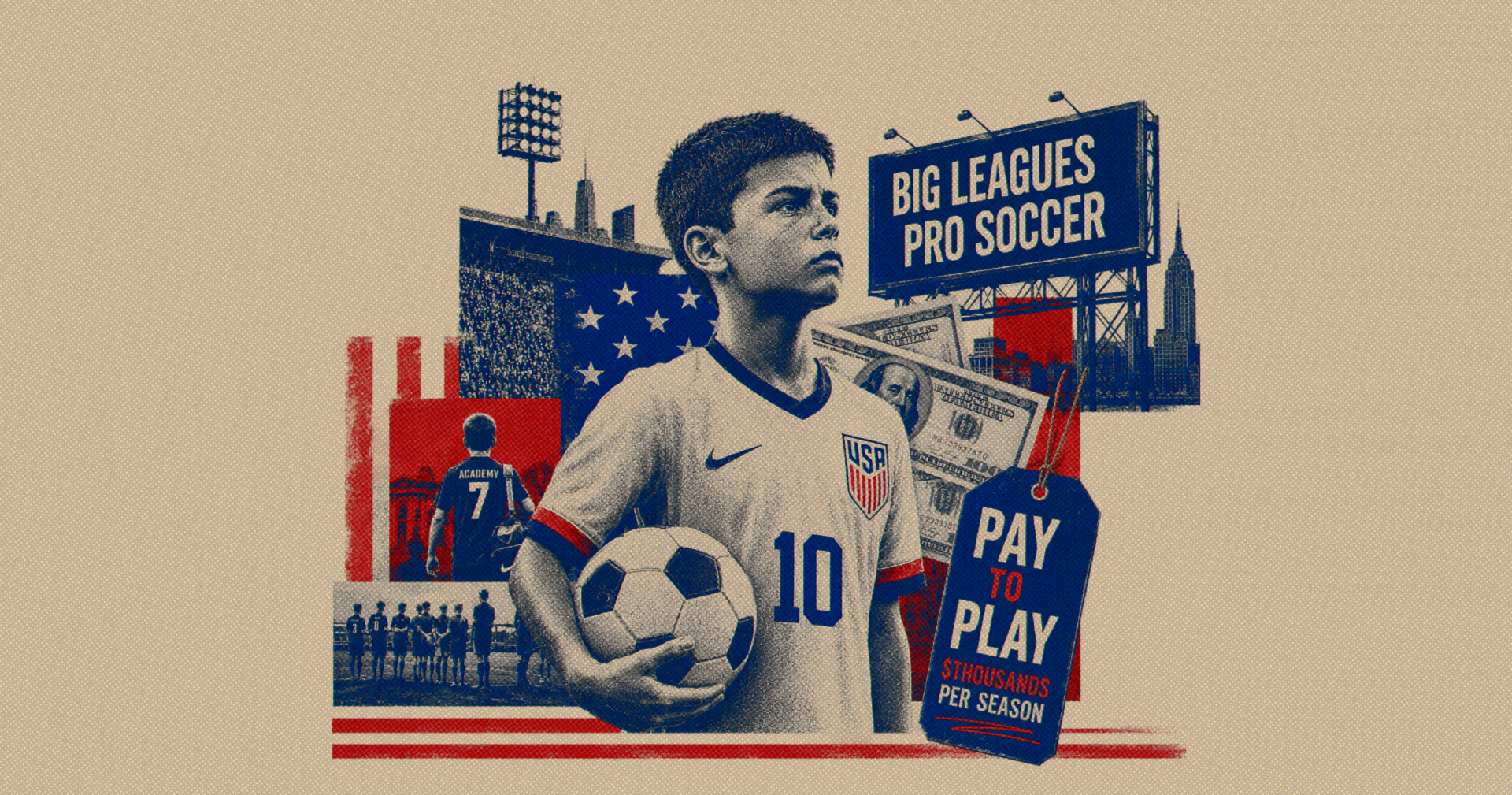
Why It's Time for US Soccer to Completely Eliminate Pay-to-Play
The 2026 FIFA World Cup was supposed to be an inflection point for the US Men's National Team. It was supposed to be, at the very least, their first run to the World Cup quarterfinal in a quarter-century. Instead, it was more of the same old script, with the USMNT beating Paraguay, Australia, and Bosnia & Herzegovina before losing to a Belgium side that had appeared to have been sleepwalking through the competition. Ultimately, it was a massive disappointment for a side expected to be one of the competition's dark horses.
Now, the USMNT have extended manager Mauricio Pochettino's contract as they gear up towards 2030, which will likely be the last World Cup for the 'Golden Generation' of Christian Pulisic, Weston McKennie, Folarin Balogun, and Tyler Adams. However, one thing's for sure: the USA will never fully reach its footballing potential until they get rid of their pay-to-play model. Today, we're taking a look at the insidious financial model that is limiting US Soccer's progress, and the organizations who are fighting against it.
https://x.com/USMNT/status/2084263348816814353?s=20
From swimming to basketball, from gymnastics to track & field, from hockey to American football, it's hard to find a sport that the United States hasn't dominated in. But as opposed to their women's program, their men's soccer program has consistently fallen short in the world's biggest competition. After losing 6-1 to Argentina in the semifinal of the inaugural edition, the USA lost in the opening round of the 1934 World Cup, before exiting the group stage in 1950.
It would take four decades for the USMNT to return, during which time youth soccer exploded onto the scene. Through the 1960s and early 1970s, organized youth soccer was primarily recreational, driven by grassroots non-profits like the American Youth Soccer Organization and US Youth Soccer, with volunteer parents coaching teams and charging nominal fees to cover basic equipment and insurance.
But as the '70s drew to a close, and as soccer started to skyrocket in popularity across American suburbs, the gap widened between casual recreation and competitive play, and independent "travel" and "select" clubs started to pop up across the USA. These clubs began hiring paid professional coaches, booking private facilities, and entering regional weekend tournaments, and they offered ambitious soccer families a chance to shine their skills not on a municipal or school field, but on a manicured, five-star pitch.
After the collapse of the original North American Soccer League in 1984, the U.S. lacked a stable professional league to fund free youth academies, enabling private clubs to step in as the sole pathway for elite development, thus passing all operational and coaching costs directly onto parents. After the USA hosted the 1994 World Cup, and with Title IX giving collegiate women's soccer a massive boost, more parents began viewing competitive club soccer as a financial investment toward college athletic scholarships.
https://x.com/AP_Sports/status/1539926239170928640?s=20
These parents decided to bite the bullet and fund their children's soccer journey, ranging from expensive college showcase events, regional travel leagues, and specialized year-round training. The launch of centralized competitive structures like the U.S. Soccer Development Academy in 2007, the Elite Clubs National League in 2009, and later MLS NEXT in 2020 institutionalized national travel schedules, and unlike MLS teams like FC Dallas and D.C. United, which eliminated tuition fees for their primary academy teams, the majority of elite U.S. youth soccer remains heavily reliant on player tuition to fund club operations, facilities, and travel expenses.
The pay-to-play model has forced American parents into a financial ultimatum: pay thousands of dollars in club, travel, and coaching fees or watch their children fall behind in soccer. It's no surprise that, unlike other American sports icons like LeBron James (NBA), Lamar Jackson (NFL), and Andrew McCutchen (MLB), there aren't quite as many stories of American soccer players escaping poverty and reaching the zenith of the game. Those that have, like Clint Dempsey, have relied heavily on financial support from their clubs and other benefactors.
One man who is striving to provide poverty-stricken children with a soccer pathway is Luca Marton, the Los Angeles Managing Director of Street Soccer USA. "We're not a youth academy: we're very much an alternative to the pay-to-play system. I'm not looking for the next superstar. My lens is very much from a quantity, not a quality of skill perspective. Of course, the quality of our instruction is paramount all the time, but I don't care how good you get at the game, and I hope that my coaches don't either. If you get great at the game, that's amazing, but the idea is increasing access to as many kids as possible."
"I'd rather have 200 girls playing in the projects for the first time ever than 20 potential academy stars coming through the ranks that could be the next U.S. men's national team stars. I used to have this kind of thing where a player would get really great, and I'd say, 'I want to hold on to them, but then I started to realize that's just my ego...I would do much better by this individual by leveraging my contacts and my network by getting their fees waived, getting them transportation, and getting them into a more appropriate environment for them to hone their skills. If I was going to go in one direction, I have to go fully in that direction."
"If I've got 40 kids coming out to the Imperial Courts Housing Projects in Watts on a Tuesday night, and 35 of them are straight-up foundational new players, and 5 of them are ballers, I'm not going to use one of my four coaches to go focus on those 5 players, even though they have the ability. I need those coaches to be focusing on the greater good, as opposed to those 5 players reaching that next level of excellence in terms of skill and talent."
https://x.com/StreetSoccerUSA/status/1966154767383609371?s=20
"In those cases, I'll get fees waived, I'll raise money, and I'll move them into the proper places that will kind of really catalyze their growth. But that's the biggest differentiator: we are a social services organization at heart, and we have the ability to train and to take on highly skilled players and bring them into competitive realms when we have the capacity, but it's not our main focus."
When Marton moved from New York City to Los Angeles, he found a community that was inhospitable to burgeoning soccer stars. Unlike New York, which has widespread public transportation, children in LA have to either find someone to drive them or walk across decrepit sidewalks that are unprotected from reckless drivers. And in some cases, these sidewalks have been deadly battlegrounds between notorious street gangs like the Crips and Bloods.
"We're in the Imperial Courts Housing Development Projects, Nickerson Gardens Housing Development Projects, Jordan Downs, and Gonzaga Village...they are each about a half a mile away from each other, but due to a difficult infrastructure of Los Angeles, they're just not physically able to walk from place to place without being in danger."
"The sidewalks are kind of crummy, and cars go quickly, but there's also a long history of social tension between the developments that still lives on today. If I tell a kid from Nickerson that I want them to come over and play at Jordan, their aunties, their uncles, or mom, dad, grandma, grandpa, will say 'You don't go over to Nixon, because that's where the bounty hunter bloods are at...there's a lot of gang warfare that goes along with these stories."
"A lot of the last generation experienced a lot of violence and bloodshed, and they haven't forgotten it. You lose a family member of yours, or a loved one, and then the world changes a little bit, but you still remember that and pass it on."
"It's not as dangerous as it once was, but that lore of the family's experiences and trauma still lives on strongly enough that it's not possible to have one big Watts community club and have everybody come to it. I had to go into Imperial Courts and get a space use agreement with the Government Housing Authority, who told me that I had to find and meet the local OG in each project for this thing to work."
https://www.instagram.com/reel/DZvCi_fvYlM/?utm_source=ig_web_copy_link&igsh=MzRlODBiNWFlZA==
Marton then joined Street Soccer USA, a non-profit organization that promotes the growth and development of a national network of grassroots soccer programs, boasting over 4,000 unique participants per year across its 18 different locations.
From there, he spoke with the local ‘OG,’ or Original Gangster, in various housing projects like Watts and Imperial Courts, where he received the green light to go ahead with his project and establish dual mini-pitch FIFA-grade turf walled pitches and administer free futsal events and tournaments like the Street Soccer LA Cup.
"My real goal is to get as many kids playing for free, getting fields unlocked, getting high-quality spaces provided, getting the same equitable opportunities that for the last 50-100 years, kids in Beverly Hills and Santa Monica might have gotten, but that they've never received."
"I hope that everybody really stops feeling competitive and fighting for the scraps that the Nikes and the big brands of the world give out, and they start feeling more collaborative, because the competition that exists right now is actually hindering the progress of the quality of play and instruction that's coming up through urban areas."
Despite the efforts of Marton and other organizations, the majority of middle-income families across the USA are unable to spend thousands—sometimes up to $25,000 a year—on a single child's sport, leading them to choose between sports fees and basic household bills. Unable to qualify for financial aid, these families are also unable to absorb year-round travel, hotel, and registration costs, prompting their children to be squeezed out of the talent pipeline early on.
https://x.com/UnfilteredSoccr/status/2079275750218256706?s=20
This pales in comparison to other countries in the world, where professional clubs operate youth academies at zero cost to the players or their families, funding them as capital investments. Their return on investment comes either from promoting academy graduates to the first team or selling them to other clubs for transfer fees. The US' system, meanwhile, forces families to absorb every single cost from coaching salaries, field rentals, league registration, and extensive tournament travel.
FIFA regulations have necessitated that when a professional player is transferred, a percentage of the transfer fee is distributed back to every youth club that helped develop that player between the ages of 12 and 23, giving grassroots clubs a financial incentive to scout and develop talent regardless of background.
For decades, US youth clubs rarely received training compensation due to legal interpretations around employment law and NCAA eligibility rules, meaning that youth clubs had no financial choice but to charge families upfront to keep their doors open.
These clubs aren't always prioritizing honing the tactical, technical and mental skills needed to flourish at the professional level: instead, they're trying to placate their paying customers with an immediate return, be that trophies, ranking points, and showcase tournament wins.
This has incentivized coaches to prioritize physically early-maturing players over late-blooming, technically gifted players, and it's one of the many reasons why Brando Babini decided to launch Youth 4 Youth FC, the premier player-led development program & agency creating pathways to college & professional soccer through training, mentorship, and recruiting.
After experiencing firsthand how the U.S. youth soccer system locks out talented players through pay-to-play barriers, Babini, 21, founded Youth 4 Youth FC at 16 years of age. Their network spans 50+ clubs & colleges, helping to pair children with active collegiate and professional soccer players. It has grown into one of the fastest-rising player-led soccer development networks in the country, featuring 650 elite players across 8 states, hosting the largest free college soccer showcase in U.S. history, and generating 51 college offers for players at zero cost.
https://www.instagram.com/reel/DbYrefGx6D_/?utm_source=ig_web_copy_link&igsh=MzRlODBiNWFlZA==
"I think the US has an important decision to make as a federation and as a country: where the investment goes post-World Cup. This will generate $13 billion of economic activity, at least $100 million for the Federation...where does that money go? Does it go to building more CapEx-heavy projects like stadiums and teams and leagues and stuff like that or to reinvesting in the youth and thinking about what's the long-term vision for the sport in the US?"
"It's in the best commercial interest to begin investing in talent, helping pro clubs outside of the MLS build out strong, free academies, because that will ultimately make the US more money in the future. Transfer revenues are really where the most money is made in football. The financial and cultural opportunity is here now. What happens after that defines what the future of American soccer looks like."
"Are we investing in the right things? Are we building the right culture? We need to teach these players what it means to compete with grit, and translating that idea top down from federation level to club level and getting the right people in the right seats will help us do that."
Whilst professional clubs across the world typically deploy extensive, localized scouting networks into open public parks, local schools, and pickup games to find raw talent across all socioeconomic backgrounds, US scouting traditionally occurs within the pay-to-play ecosystem itself, be that expensive regional showcases or paywalled league platforms.
And although MLS and select USL clubs now operate fully or heavily subsidized academies to align with global standards, these academies only cover a small fraction of the massive US geography, meaning that pay-to-play remains the grassroots pipeline across the country.
https://x.com/DuelNats/status/2082963362548265234?s=20
The USA have played in nine of the last 10 World Cups, exiting the group stage in 1990, 1998, and 2006, and making it to the quarterfinal in 2002. On every other occasion, however, they've been eliminated in the Round of 16. There's a reason why: unlike every other team that reached the quarterfinals in 2026, the USA isn't producing the best players from the entire national talent pool, but a drastically smaller pool of players who can afford these exorbitant costs.
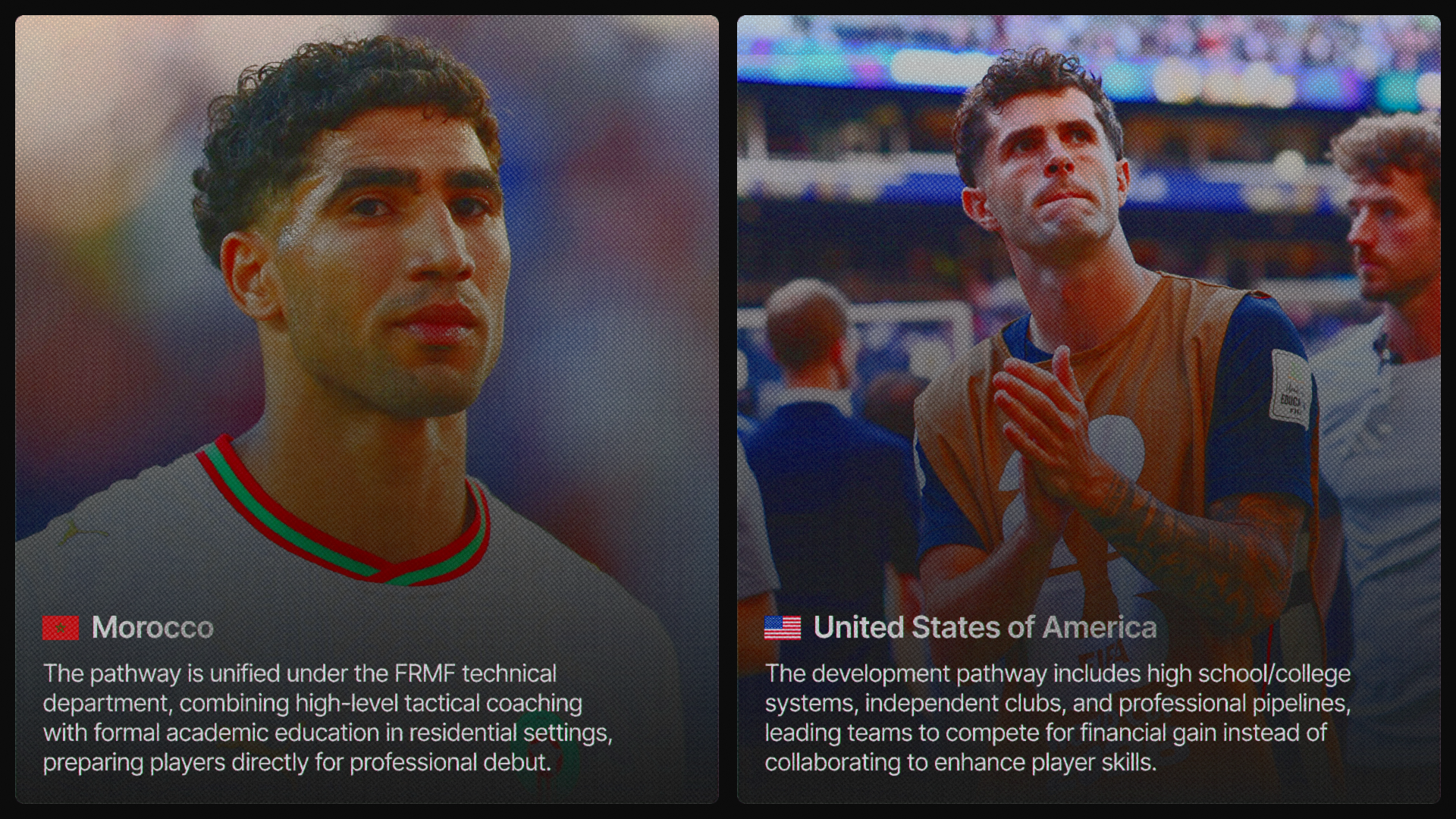
While the U.S. relies on a commercialized, consumer-funded framework, Morocco uses a centralized, state- and club-subsidized development system centered on meritocracy and elite infrastructure. The Royal Moroccan Football Federation, backed heavily by national initiatives, subsidizes high-level youth development and gives elite talent free training, schooling, housing, and equipment.
And unlike the US, which has prioritized children in rich areas like Texas, Southern California and Florida, Morocco has relied on organic street and grassroots soccer and scout networks to identify promising youngsters throughout the nation.
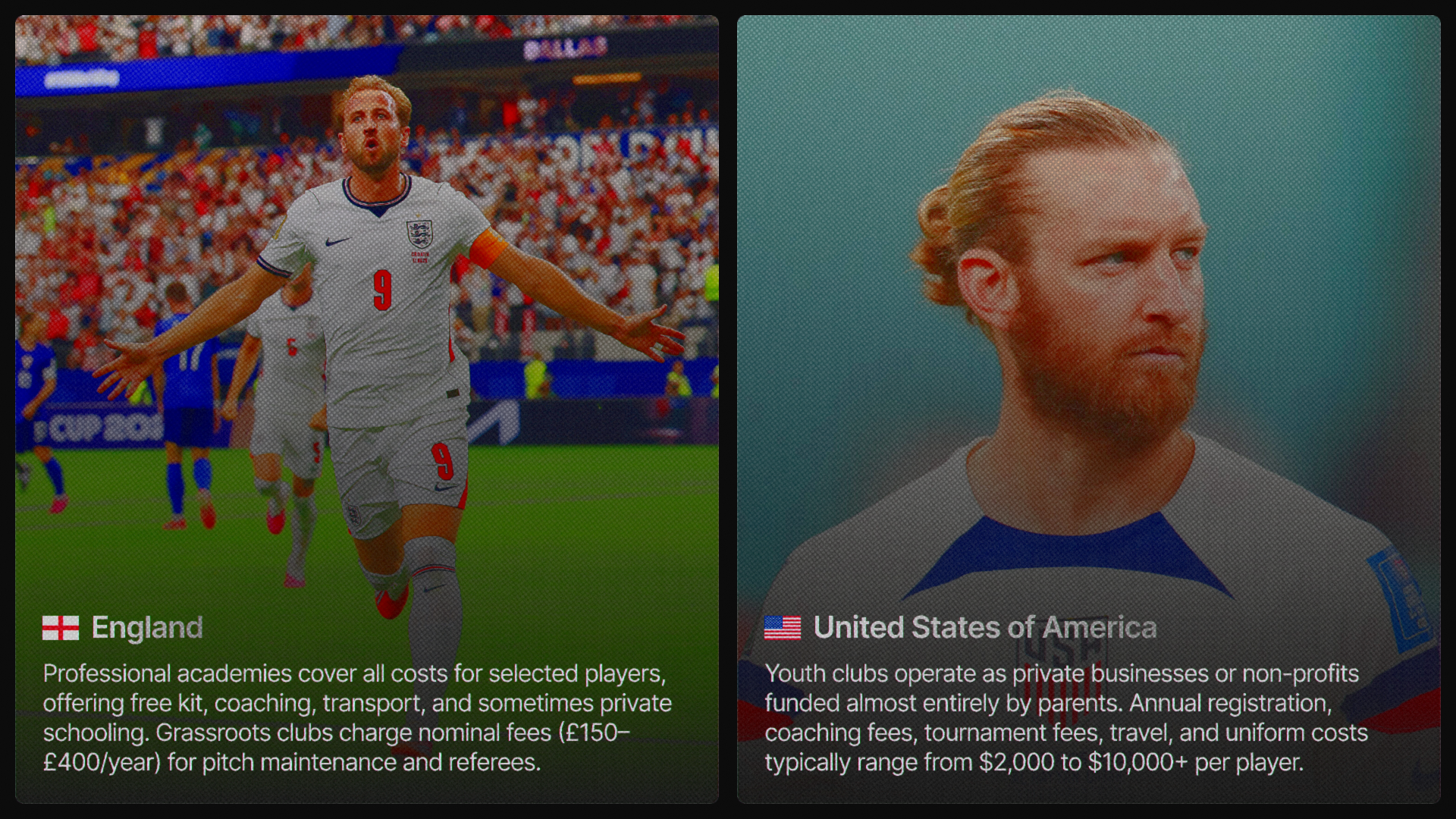
England’s pathway is built as a vertically integrated, club-funded pyramid designed to produce professional talent, whilst the US system has functioned as a privatized, service-based industry designed around participation and college pathways.
Top professional clubs across the top four tiers run academies fully subsidized by the clubs. With 92 fully professional clubs in the top four divisions alone—plus hundreds of semi-professional clubs—packed into a geographic area smaller than the state of Alabama, it's practically impossible for any talented player to fall through the cracks.
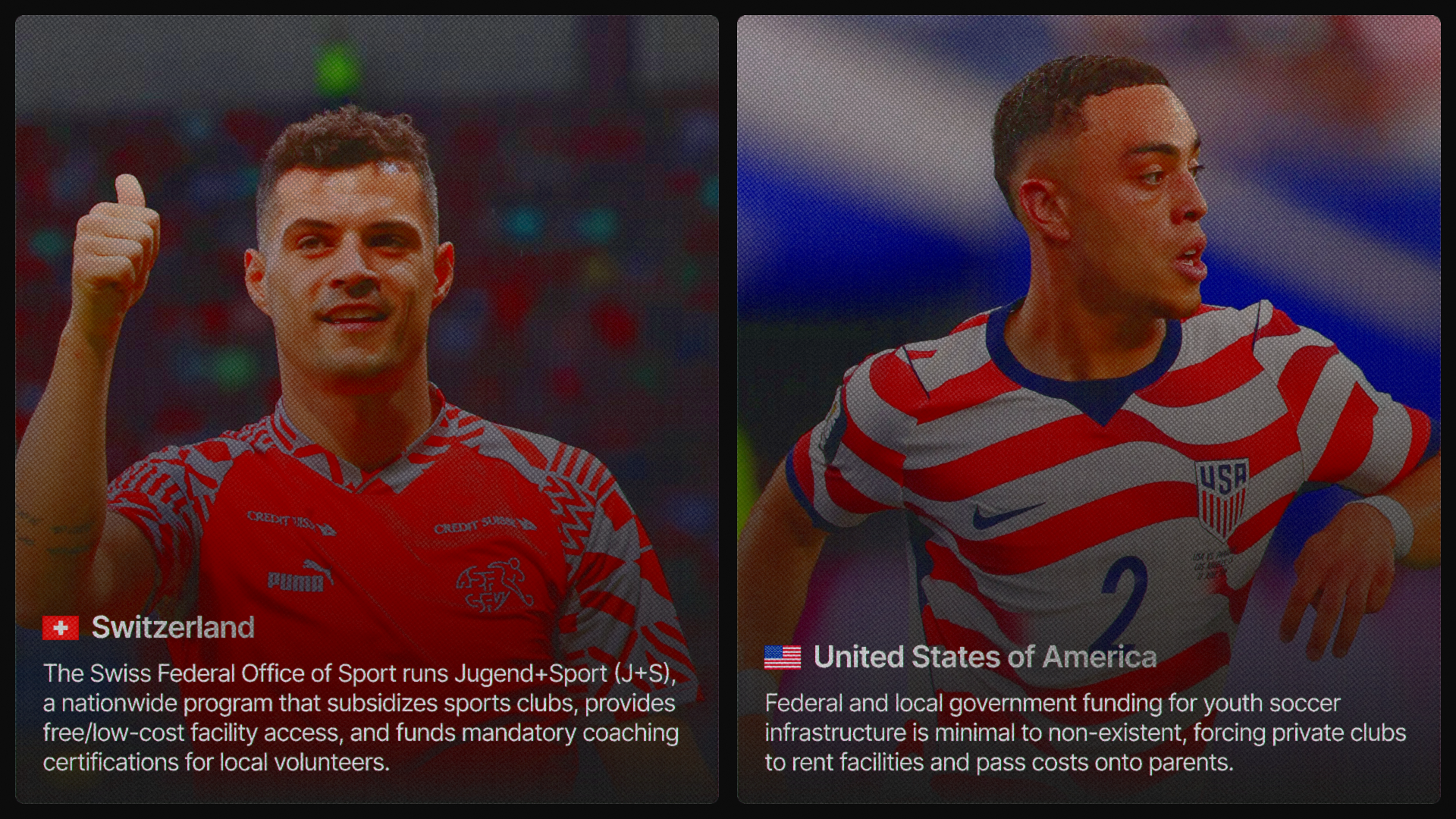
Switzerland combines municipal infrastructure, federal sports subsidies, and professional club investment to keep barrier-to-entry minimal. Youth sports are heavily anchored by the federal Youth+Sport (J+S) program, with the federal government and cantons subsidizing local sports clubs (Vereine) and coaching education.
Local municipalities own and maintain training grounds, drastically lowering overhead for grassroots teams. And whilst vast swaths of the US are dependent on non-MLS US academies, every town has a local Verein where children can join for nominal annual dues.
Argentine clubs like River Plate and Boca Juniors run youth academies as capital investments, covering room, board, schooling, and high-level training for elite prospects, and understanding that all it takes is one lucrative transfer to fund the entire academy for a year.
Talent identification starts in local neighborhood institutions (clubes de barrio) and informal pick-up games (potreros), with extensive scouting networks visiting every corner of the country, ensuring that socio-economic status never prevents a talented child from entering a top club's pipeline.
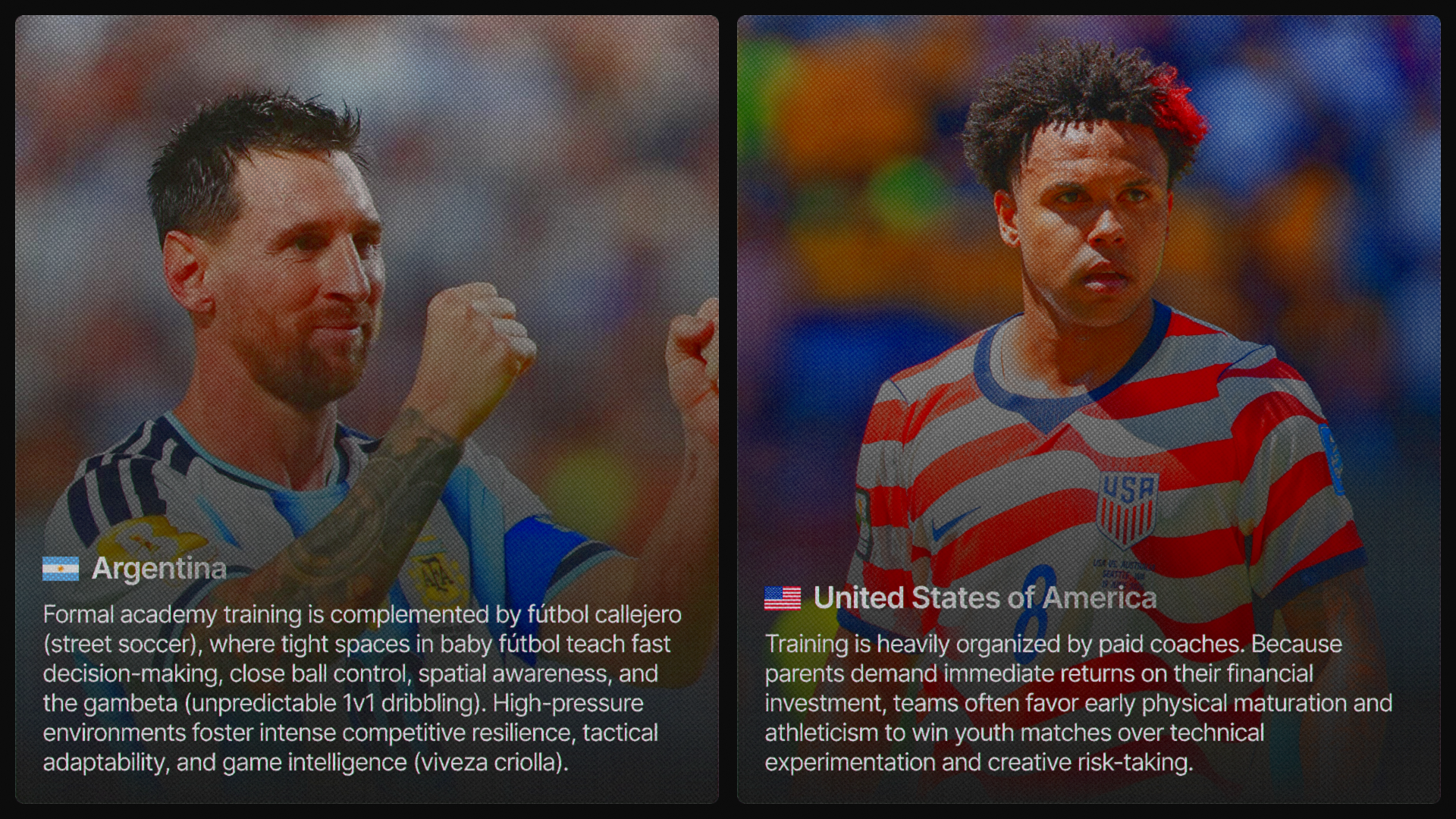
Belgium’s model has operated as a unified national vision over the past two decades, including making entry-level coaching licenses free, whereas the US system is fragmented across competing private leagues and organizations.
Furthermore, Belgium has integrated elite training directly into the public education system, giving elite high school players four mornings per week to train with federation coaches before continuing their academics in state-backed Topsport schools, before training with their clubs in the evening, whereas US players must balance high school/club splits or travel demands.
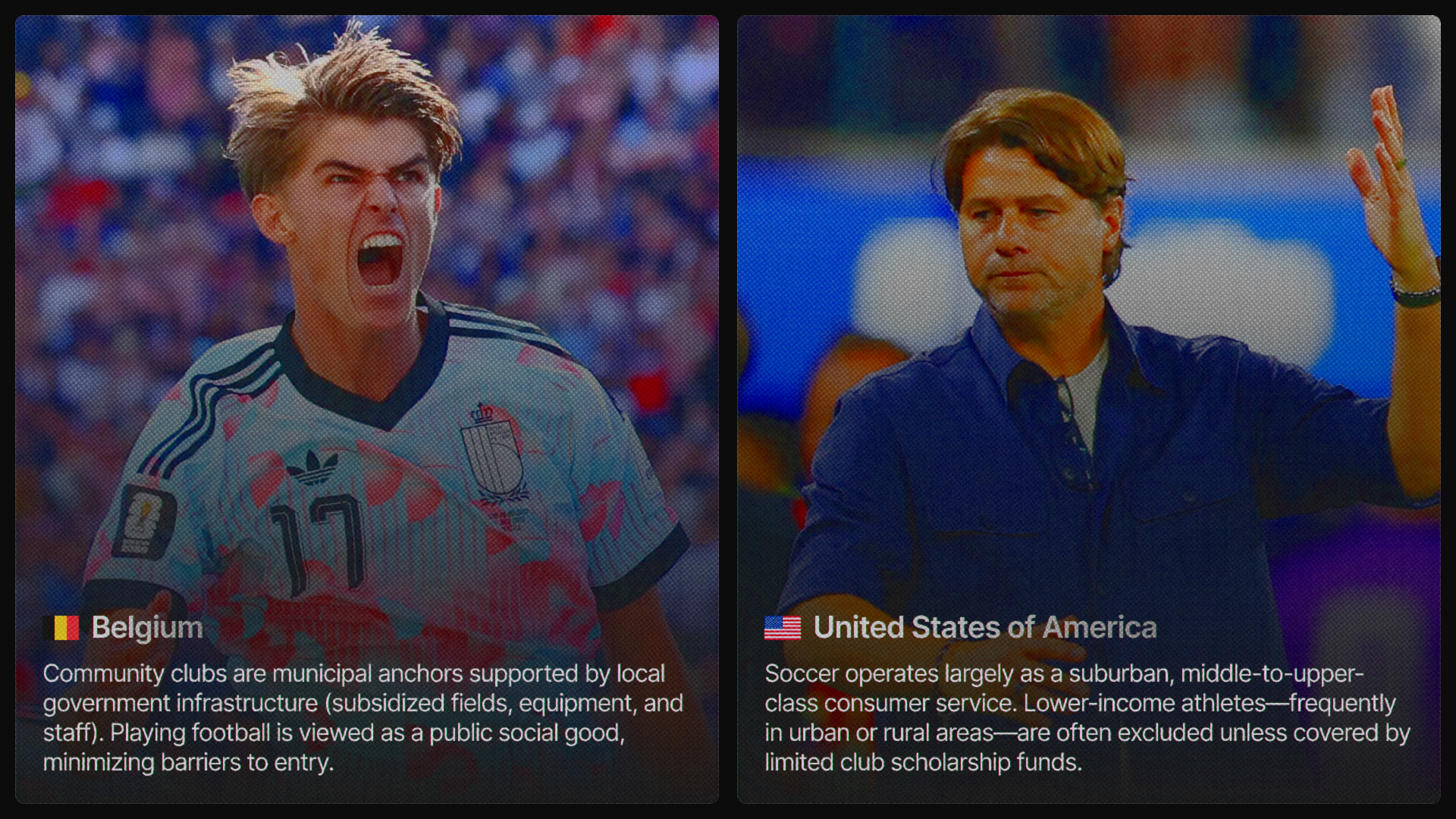
Unlike in the USA, where the main priority is to win youth tournaments and grab the attention of college scouts, French clubs prioritize developing young talents and selling them for hefty fees. Grassroots clubs are heavily subsidized by local government bodies and the French Football Federation (FFF), making participation virtually free or nominal ($100–$300/year).
Publicly supported national centers like Clairefontaine take the best 13-to-15-year-olds for weekday elite training while they attend public school, returning to local clubs on weekends. At 15, the best talents move into professional club residential academies full-time at zero cost to families.
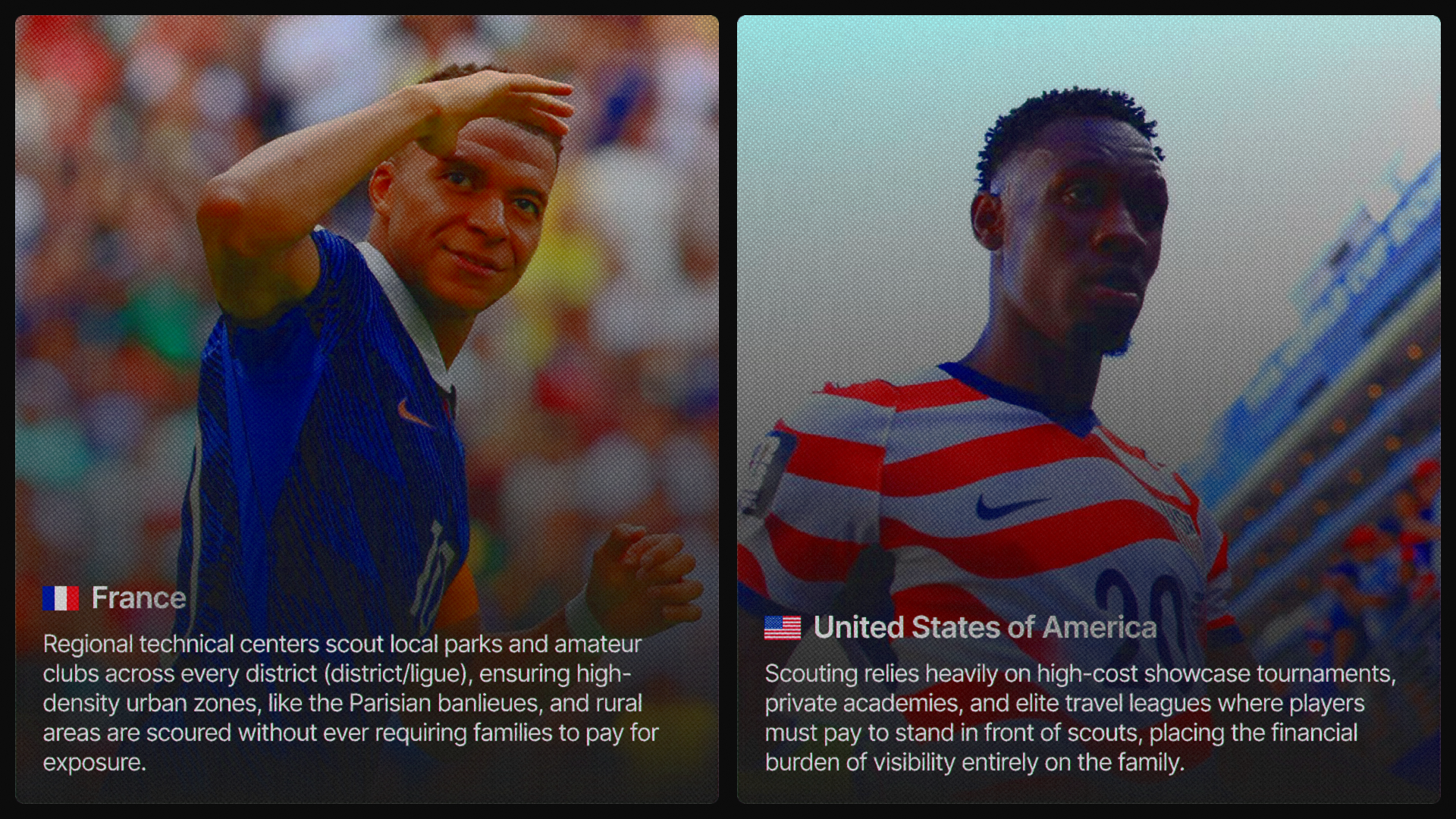
It's the same story in Spain, where professional clubs and heavily subsidized local community club absorb the costs of lodging, education, and elite training, knowing that FIFA's Training Compensation and Solidarity Mechanism allocates a portion of transfer fees back to every grassroots club that helped train the player between ages 12 and 23.
This hasn't been the case in the U.S. due to legal constraints and historical friction between U.S. Soccer, MLS, and youth clubs regarding child labor laws and antitrust regulations, meaning that grassroots clubs typically miss out on solidarity payments. Moreover, Spain's high density and a unified pyramid mean scouts reach nearly every corner of the country, preventing kids from having to pay for showcase tournaments or long-distance travel.
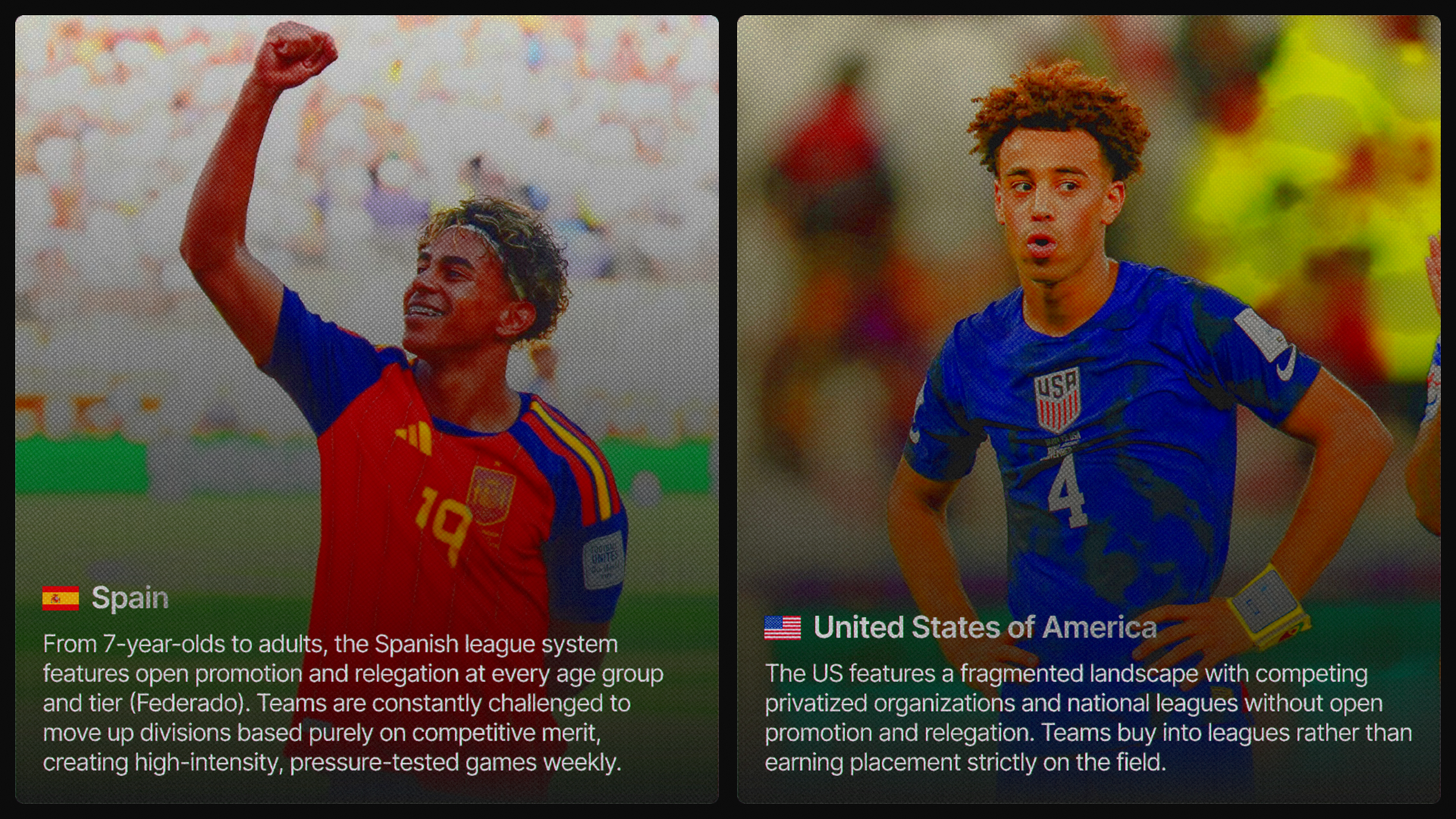
Last but not least, Norway have returned to a major tournament after 26 years thanks to a structural overhaul that prioritized broad accessibility, infrastructure, and child rights over early hyper-competitiveness. Rather than relying on elite private academies, Norway democratized the sport nationwide through several key pillars like Children's Rights in Sport, which, up until age 13, plays games without published league tables, official rankings, or high-stakes tournament trophies.
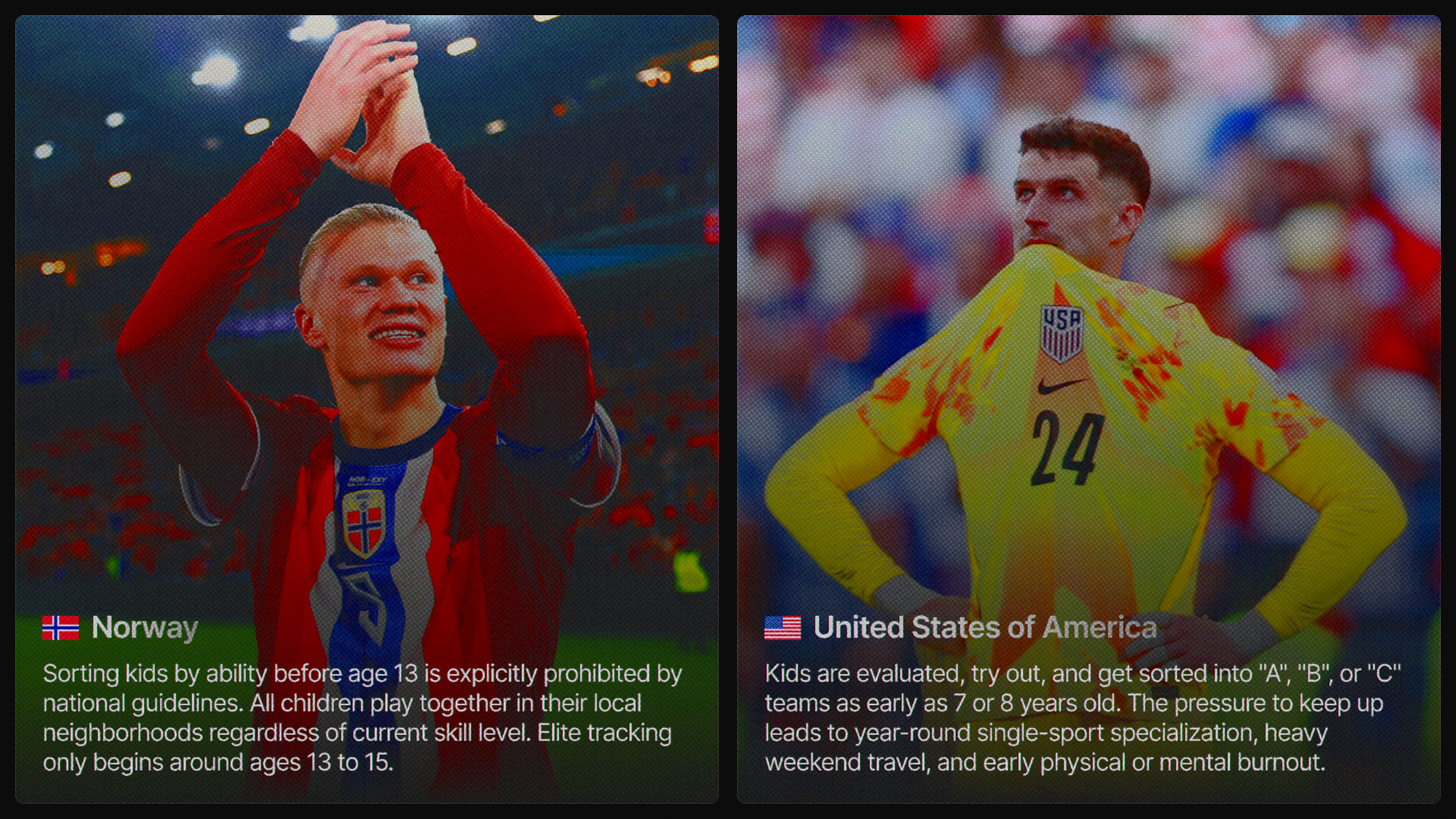
Participation fees are kept low, funded in part by national sports lotteries, explicitly countering pay-to-play barriers, and the Norwegian federation (NFF) and local government have invested in artificial pitches to counteract their sub-zero winters. And instead of centralizing coaching expertise in capital academies, the NFF established local coach educators in every district, giving parent-volunteers direct, on-site mentoring from NFF developers encouraging technical risk-taking over rigid tactical systems.
If the US wants to finally wake up and become a soccer heavyweight at the men's level, it has no other choice but to get rid of its pay-to-play model and ensure that every single one of the 70 million+ children living in America can afford a top-class soccer education. It's time to get with the program and build a model that gives every kid a chance to succeed in youth soccer, not just the ones who can afford it.