
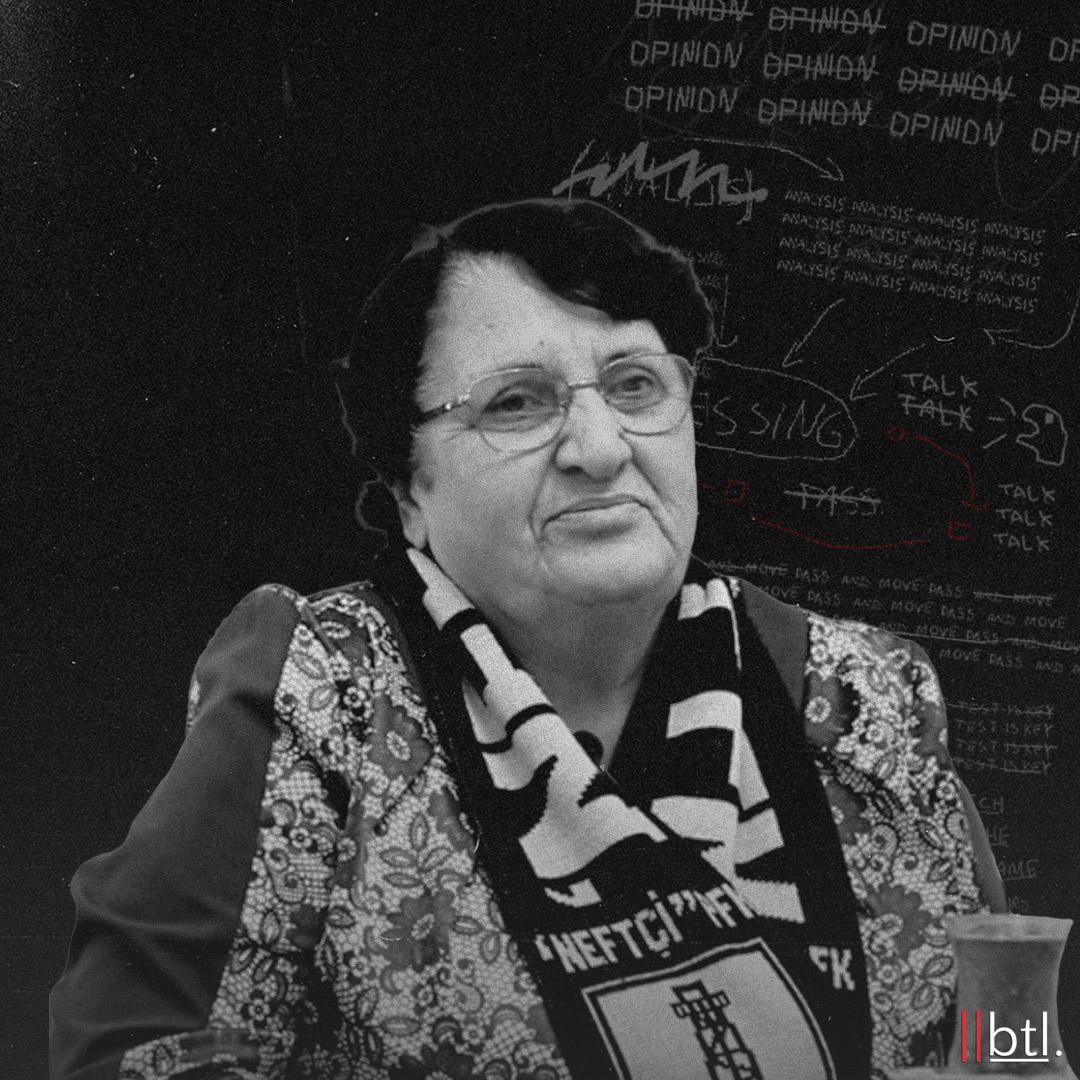
Afiga Mammadova: 62 Years of Loyalty, One Club for Life
When Afiga Mammadova walks into a football stadium in Baku, she does so with the calm assurance of someone who has seen almost everything the game can offer. The black-and-white Neftchi scarf around her neck is not a fashion choice or a nod to nostalgia. It is a statement of fact. At 69, she has supported Neftchi for 62 years.
In an era when football loyalty is often fragile and conditional, Afiga’s devotion feels almost radical. She has followed the club through Soviet-era highs, post-independence uncertainty, modern-day instability and renewed hope. Footballers, coaches and club officials know her by face. She is not famous in the conventional sense, but within Neftchi’s world she is a constant — a reminder of what the club once was and what it still means.
“I didn’t decide to support Neftchi,” she says. “It was already decided for me by my family.”
Football as inheritance
Afiga’s love for football was inherited rather than discovered. Her parents and uncles were devoted Neftchi supporters, and in their home, the club was part of everyday life. In Soviet Baku, football was followed with both intensity and intimacy: matches were listened to on the radio, watched on shared televisions, debated at home and in the streets.
Sasha from Shamkir: The Forgotten King of Azerbaijani Football
Neftchi, in those years, carried a special meaning. It represented the working people of Baku, the oil city, and Azerbaijan’s presence inside the USSR’s football hierarchy. Supporting the club was about identity as much as results. “It wasn’t just football,” she says. “It was pride. It was who we were.”
As a child, Afiga rarely attended matches. Stadiums were overwhelmingly male spaces, and families were cautious. “My uncle took me once or twice,” she recalls. “Then he stopped. He said there were too many men.”
But absence from the stands did not weaken her bond. She memorized players’ names, followed results obsessively, and built an emotional connection that only deepened with time.
Remembering the greats
Ask Afiga about Neftchi’s past, and she answers without hesitation. Sergey Kramarenko. Alakbar Mammadov, remembered not only for Neftchi but for scoring four goals against AC Milan while playing for Dinamo. Vyacheslav Semiglazov. Anatoli Gryazev. Yashar and Adil Babayev. And then there is Anatoli Banishevski.
“Everyone loved Banishevski,” she says. “He was our pride.”
One of her most powerful football memories involves the legendary striker in deeply human circumstances. During a period when Banishevski had been suspended from football, he visited neighbours who were relatives of close friends. On the same day, Neftchi were playing Ararat Yerevan in the Soviet championship. The neighbours’ television was broken, so everyone gathered at Afiga’s house to watch the match.
“Neftchi lost 1–0,” she says. “Banishevski left our house crying. And he made us cry too.”
That defeat triggered anger and despair among supporters. Parts of the stadium were later damaged. Veteran footballer Samad Gurbanov retired soon after, publicly stating that if Neftchi could lose like that, he would never play football again. For Afiga, it was the moment she fully understood how deeply football could wound.
Witness to history
Afiga belongs to a shrinking group of supporters who personally witnessed Neftchi’s greatest Soviet-era achievement: third place in the 1966 USSR Championship. “Yes, we were very happy,” she says. “It was historic.”
Decades later, that moment returned in a deeply personal way. The wife of Mubarez Zeynalov, a member of the 1966 squad, brought the bronze medal to show Afiga and her family. One photograph shows her grandson Murad holding the medal — a powerful image of continuity. “It meant a lot,” she says. “Past and future together.”
Her memories of Soviet football are rich with names and moments that shaped the club. She speaks of Sergey Kramarenko’s consistency, Banishevski’s brilliance, and the Babayev brothers’ enduring influence. These are players who defined eras not just by their skill, but by the pride they instilled in their supporters.
Football, Wine and Mountains: The Inside Story of Georgia’s Extraordinary Rise
A grandson in the shirt
For Afiga, football loyalty has become more than memory; it has become family destiny. Her grandson Murad Mammadov now plays for Neftchi’s first team — the same club she has supported for more than six decades. His love for football appeared almost instinctively.
“He wasn’t even speaking properly,” she says. “He went to a shop with his father and chose a ball. His first word wasn’t ‘mother’ or ‘father.’ It was ‘ball.’”
Murad progressed through Neftchi’s youth academies, supported relentlessly by his family. When his father, an offshore oil worker, was away for long stretches, Afiga took responsibility. “I took him to training, to matches. I watched everything,” she says. Today, Murad is part of the squad. Comparisons to Manchester City’s Phil Foden have appeared on social media, but Afiga keeps her expectations measured.
“I want him to be known for who he is,” she says. “I want people to say: there is a club called Neftchi in Azerbaijan, and Murad plays for them.” Offers from other Azerbaijani clubs have come. Murad declined them. Leaving Neftchi was never an easy thought.
Underdogs No Longer: Qarabağ Have Shown They Are a Force to Be Reckoned With
Staying through the hard years
Neftchi’s recent history has been turbulent. Instability, coaching changes and inconsistent performances have tested supporters’ patience. Many drifted away. Afiga did not. “I’ve been with this club for 62 years,” she says. “I’ve seen good times and bad times. This is not the end.”
She believes the team has shown signs of recovery in recent matches. She speaks positively about former head coach Samir Abasov, recently dismissed, praising his willingness to trust young players. “He gave Murad a chance,” she says. “And Murad used it.”
Afiga continues to attend matches regularly, home and away. She has travelled to Tovuz, Imishli and Gabala to support the team. She avoids discussing Qarabag now after receiving online abuse following earlier interviews, but fondly remembers the fierce derbies against Khazar Lankaran. “Those games were real football,” she says. “Pure emotion.”
The meaning of staying
Football stadiums have changed. Women in the stands are no longer unusual. Afiga has never felt unwelcome. “No one ever said anything bad,” she says. “People understood.”
Yet what sets her apart is not visibility, but endurance. In a sport increasingly defined by short-term thinking, Afiga Mammadova represents the long view — a supporter who stayed when it was easy, and when it was not.
Her presence reflects what Baku Juniors manager Aghasaf Osmanli describes as the true beauty of the game. “What decorates football is the participation of different people,” he says. “I enjoy meeting those who come together under a shared slogan of love and listening to their stories. The presence of women in the stands, in particular, is irreplaceable.”
Enigma, Patience and Faith: How Gurban Gurbanov Revived Qarabağ
Osmanli recalls first meeting Afiga at one of Neftchi’s home matches, both of them wearing the club’s scarf — a small moment that revealed a much deeper story. Her love for football, he notes, has lasted for more than half a century and is inseparable from family. To support her grandson, a member of the team she loves, she is willing to devote any distance, time, money and energy.
Living in the Sahil settlement, Afiga is well known in her community, where neighbours are also familiar with and take an interest in women’s football. She sometimes writes to Osmanli to ask about his team’s work. “At such moments, I feel a sense of responsibility,” he says. “Thank you, Afiga khanim, for your love of football.”
She adjusts her scarf, takes her seat, and waits. She has learned that football, like life, moves in cycles. And that belief — quietly held, patiently lived — is sometimes the strongest form of loyalty there is.
By: Fuad Alakbarov / @DrAlakbarov
Featured Image: @GabFoligno