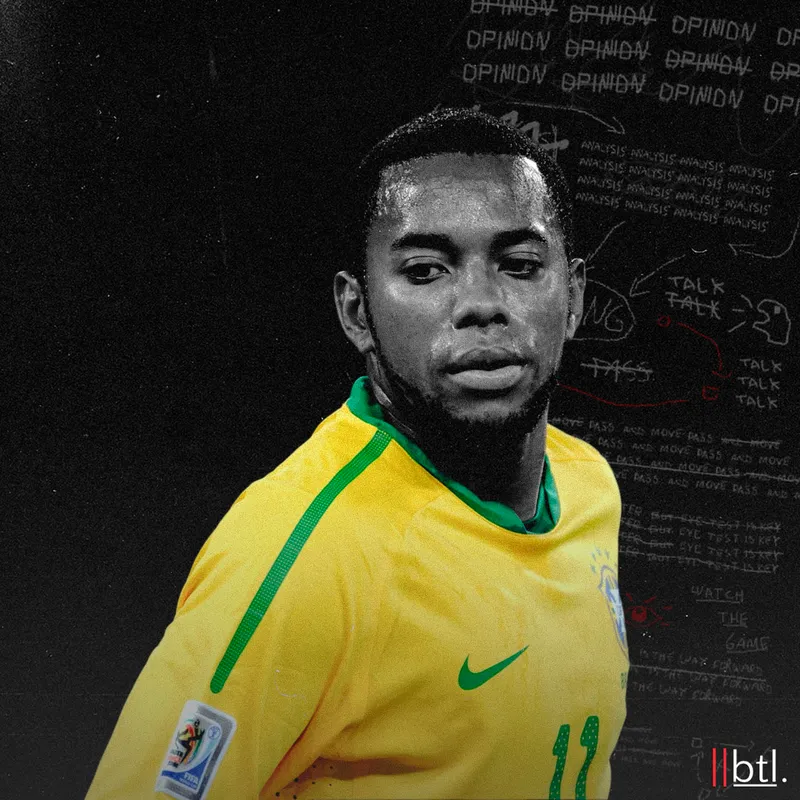
Robinho: The Lost Illusion
“People do not fall in love with reality. They fall in love with illusion.” Football has always been obsessed with wonderkids. The boys who dribble too easily. Who humiliate defenders with a smile on their face. Who seem to carry something…
“People do not fall in love with reality. They fall in love with illusion.”
Football has always been obsessed with wonderkids. The boys who dribble too easily. Who humiliate defenders with a smile on their face. Who seem to carry something supernatural within them. And maybe no one embodied this more in the early 2000s than Robinho. Because he was not simply a Brazilian talent. He was a promise. Pelé’s heir. The next genius. The new king of football. At least, that is what the world wanted to believe.
Santos. The coastline. Hot air. Samba. And a skinny boy treating the ball as if it were nothing more than a toy. His name was Robson de Souza. But everyone called him Robinho. Even as a teenager, there was already mythology surrounding him. At the dawn of the YouTube era, videos of him spread everywhere. Stepovers. Backheels. Unstoppable dribbles. The ball did not roll. It danced. And when Pelé personally introduced him to the world, football had already made up its mind: he would be the next great Brazilian dream.
“Robinho is capable of things other players cannot even imagine,” - Pelé.
/@btl/ronaldinho-a-midsummer-nights-dream
But dreams are dangerous. Because the bigger the illusion, the more painful the awakening becomes. In 2005, he arrived in Madrid. The Bernabéu wanted a new Galáctico. The club was still living in the world of Zinedine Zidane, Ronaldo, David Beckham, and Luís Figo. And Robinho fit perfectly onto the posters. He smiled. He entertained. He dazzled. And during those first months, it felt like he truly could become anything.
Defenders scrambled after him. Fans rose from their seats every time he dribbled. Nike commercials were building a new Brazilian icon around him. But football has a cruel rule: entertainment alone is never enough. Madrid wanted goals. A leader. Consistency. And Robinho continued to live only in flashes.
Sometimes he was a genius. Other times, invisible. One week he danced through defenders. The next, he disappeared from the match completely. It was as though he spent his entire career chasing his own shadow. Because Robinho’s story always revolved around one question: Was he ever really as good as people wanted him to be?
In 2008, a new era began in Manchester. Manchester City’s new Emirati owners wanted a superstar. A face for the project. And Robinho became the first big name. Blue shirts. Camera flashes. Money. Promises. It felt like Hollywood had handed him another leading role. On his debut, he scored a free-kick against Chelsea. The stadium exploded. The Premier League had found its new showman.
/@btl/carlos-tevez-war-and-peace
But the cold English nights were not Brazil. There, a smile was not enough. You had to fight. And Robinho was never a fighter. He wanted to be an artist. A street footballer in a world that was slowly turning into a factory for machines.
“Sometimes I feel people expected more from me than I could actually give.” - Robinho
And then, slowly, everything began to fall apart. Manchester. Milan. A return to Santos. New beginnings. New disappointments. Everywhere he went, there were moments when the old magic suddenly returned. A dribble. A trivela. A smile. And every single time, people wanted to believe in him again. Because the illusion was still alive.
The world refused to accept that Robinho might never have been what they imagined him to be. But the real collapse did not come on the pitch. It came away from it. As the years passed, his name no longer appeared in headlines because of football. The magic was replaced by scandals. Court cases. Accusations. A ruined reputation. And the boy once called the savior of Brazilian football slowly became nothing more than a shadow of his own story.
/@btl/pep-guardiolas-barcelona-a-religion
The stadium lights faded. The crowd moved on. And eventually, the illusion collapsed completely. Because there are players who become legends. And there are others who become reminders. Robinho’s story is not the story of fulfilled greatness. It is the story of wasted possibility. Of a boy the entire world wanted to see as the next Pelé, while perhaps even he himself never truly knew who he really was.
And maybe that is why it all feels so tragic. Because when Robinho played, sometimes it genuinely felt as though football had become a child again. But illusions do not last forever. One day every spotlight fades. The music stops. And in the end, only silence remains. And one question: What if he really had been the chosen one?
Credits
Words
Krisztián Horváth