
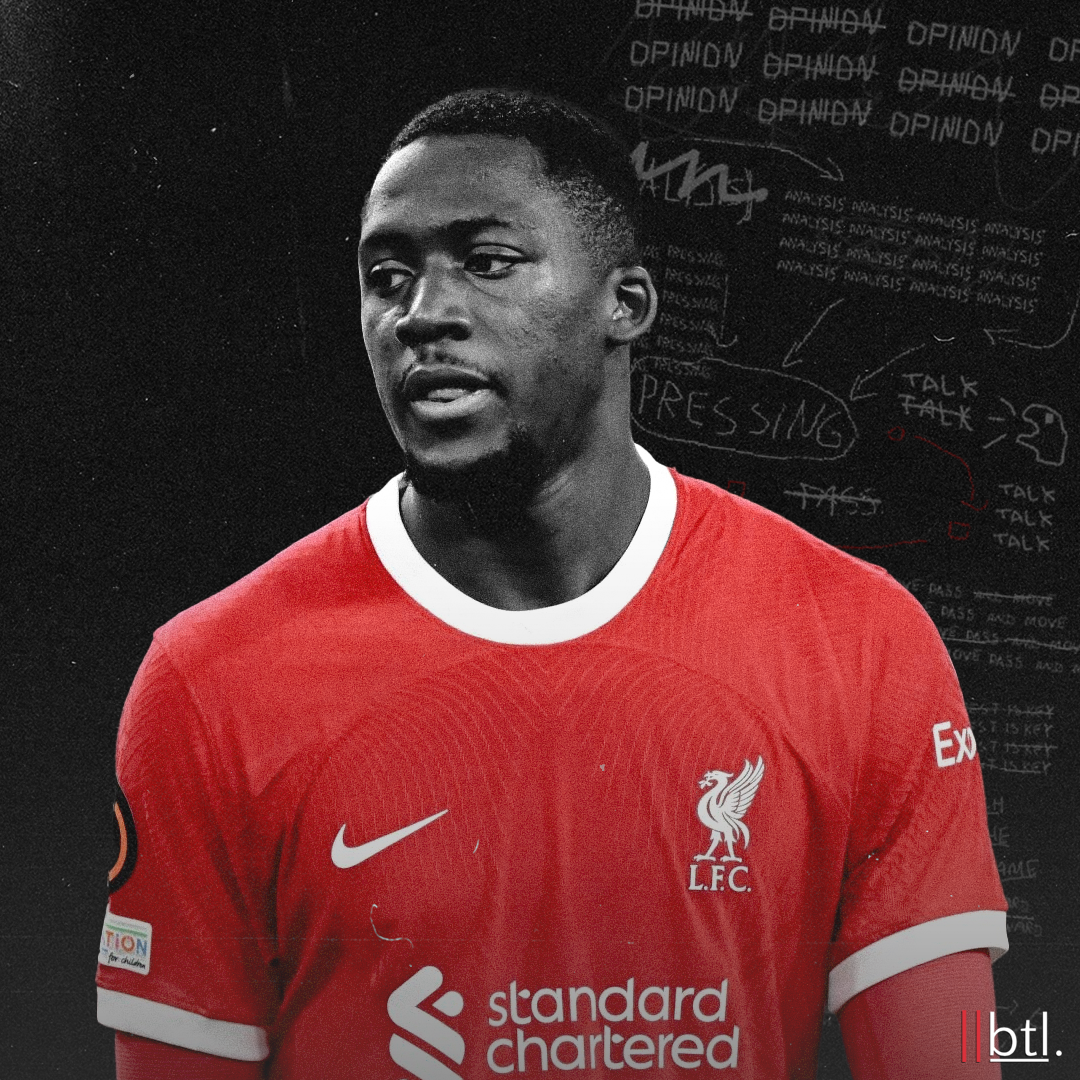
Why Ibrahima Konaté to Real Madrid Makes Sense
At first glance, Ibrahima Konaté may seem like an unusual transfer target for Real Madrid. The French defender is coming off a season that raised legitimate questions. Injuries once again interrupted his rhythm, with thigh and knee problems contributing to an inconsistent 2025-26 campaign. While flashes of his immense talent remained evident, there were also stretches where he struggled to maintain the level expected of one of Europe’s premier center-backs.
Ordinarily, that profile would invite caution. Instead, Real Madrid appears interested. The immediate reaction from some supporters may be confusion. Why pursue a defender coming off an injury-interrupted season? Why add another center-back when the squad already possesses several options at the position? The answer reveals something larger than Konaté himself.
This potential move is not simply about adding another defender. It is about how Real Madrid increasingly operates in the transfer market, how the club views squad construction in the modern game, and why calculated risk has become one of its greatest competitive advantages.
Madrid’s Center-Back Situation Is Less Secure Than It Appears
The first thing to understand is that Madrid’s interest in Konaté says as much about the current state of its defense as it does about the player. On paper, the club appears well-stocked at center-back. In reality, the picture is considerably more complicated.
Antonio Rüdiger remains one of the most important defenders in world football, but he is now 33 years old and reportedly signed only a one-year contract extension. David Alaba has already departed, removing a veteran presence from the squad. Éder Militão continues to possess enormous talent, but multiple major injuries over recent seasons have made durability a fair concern.
Dean Huijsen may be one of Europe’s brightest young defenders, yet even he missed fifteen matches through injury last season. Raúl Asencio entered the campaign with momentum and optimism surrounding his development but struggled to establish himself as a reliable long-term solution.
Viewed individually, none of those situations would necessarily create panic. Viewed collectively, however, they expose a reality Madrid can no longer ignore. The modern football calendar is relentless.
Dean Huijsen: Real Madrid’s First Defensive Pillar in Xabi Alonso’s New Era
Elite clubs are no longer preparing for a thirty-eight-match league season supplemented by occasional cup fixtures. Between La Liga, the Champions League, domestic competitions, international tournaments, and the increasingly crowded global football calendar, clubs competing for every trophy routinely play between fifty-five and sixty-seven matches per year.
The question is no longer whether Madrid possesses enough starting-caliber defenders. The question is whether Madrid possesses enough defenders to survive the season. Suddenly, the logic behind pursuing Konaté becomes much easier to understand.
Why Mourinho Would Love Him
Yet if squad depth were the only factor, there would be plenty of alternatives available throughout Europe. The more interesting question is why Konaté specifically. That answer becomes clearer when viewed through the lens of José Mourinho.
Throughout his managerial career, Mourinho has consistently gravitated toward a specific type of defender. Ricardo Carvalho, John Terry, Walter Samuel, Pepe, and Raphaël Varane all shared certain characteristics. They were physically dominant, comfortable in duels, and capable of defending difficult situations without requiring constant protection from the players around them.
Federico Valverde: Real Madrid’s Uruguayan Machine in Midfield
Mourinho has never been obsessed with center-backs who simply look elegant in possession. He values defenders who can survive chaos. Modern football creates more chaos than ever before. Defensive lines operate higher up the pitch. Fullbacks spend increasing amounts of time in attacking positions. Midfielders press aggressively. As a result, center-backs are frequently asked to defend vast areas of open space.
Few defenders are naturally equipped for those demands. Konaté is. At his best, he combines elite recovery speed with tremendous physical strength. He is dominant in aerial battles, difficult to beat in one-versus-one situations, and capable of recovering from defensive transitions that would expose less athletic defenders.
The numbers reinforce that profile. Last season, Konaté ranked in the 80th percentile for both defensive duels won and aerial duels won, illustrating the physical dominance that has made him one of Europe’s most difficult defenders to play against when healthy. Just as importantly, he offers more quality in possession than he is often given credit for. He ranked in the 74th percentile for passes completed, the 70th percentile for forward pass completion, the 67th percentile for progressive passes completed, and the 75th percentile for progressive carries.
While he may not be viewed in the same category as football’s most technically gifted ball-playing defenders, he possesses more than enough ability to progress possession and participate in buildup play. That combination is what makes him such an intriguing fit for Mourinho. He can provide the defensive aggression Mourinho values without becoming a liability when Real Madrid has the ball.
Jude Bellingham’s Evolution at Real Madrid: A Tactical and Statistical Analysis
In many ways, he resembles the modern evolution of the defenders Mourinho has trusted throughout his career: physically dominant first, but technically competent enough to thrive in an era where every center-back is expected to contribute in possession.
The Injury Concerns Are Real
That does not mean the transfer is without risk. In fact, the risk is impossible to ignore. The injuries matter. The inconsistency matters. Availability remains one of the most important attributes any footballer can possess, and Konaté’s recent medical history raises understandable concerns about whether he can consistently remain on the field. Real Madrid would be foolish to ignore those realities.
The concern is not necessarily that Konaté has suffered a single catastrophic injury. Modern football is filled with players who return successfully from major setbacks. The bigger concern is the accumulation of smaller issues. Thigh problems, knee issues, and recurring absences can make it difficult for a player to establish rhythm over the course of a season. For defenders in particular, continuity matters.
Partnerships are built through repetition, trust, and minutes played together. When injuries repeatedly interrupt that process, consistency often becomes harder to find. That reality was evident at times throughout the 2025-26 campaign. There were matches where Konaté looked every bit like one of Europe’s elite central defenders. His physical dominance, recovery speed, and ability to defend large spaces remained obvious. Yet there were also stretches where interruptions to his season appeared to impact both his form and reliability.
The talent was never in question. The availability was sometimes. There is a difference, however, between acknowledging a concern and allowing it to dominate the entire evaluation. Madrid’s recruitment team is likely asking a different question. Not whether Konaté carries risk. Every transfer carries risk. The more important question is whether the potential reward justifies accepting that risk. In Konaté’s case, the answer may very well be yes.
The Economics Make Too Much Sense
This is where the economics begin to change the conversation. If the club was preparing to spend €80–90 million on a transfer fee, the concerns surrounding Konaté would be significantly more alarming. Every missed match would be scrutinized. Every injury setback would feel magnified. Every inconsistency would become a talking point.
That is not the situation Madrid faces. Instead, the club is reportedly positioned to acquire an elite-level defender on a free transfer. A free transfer is never truly free. Signing bonuses, wages, and agent fees remain significant expenses. However, there is a substantial difference between absorbing those costs and committing an additional massive transfer fee on top of them.
Increasingly, Real Madrid has demonstrated a willingness to wait for opportunities like these. The club’s recent strategy has been remarkably disciplined. Rather than entering bidding wars whenever possible, Madrid has targeted elite talent approaching favorable contractual situations. Patience has become a weapon. Institutional prestige has become leverage.
The result is a transfer strategy that allows the club to strengthen its squad while preserving resources for future opportunities. Every transfer fee avoided creates flexibility elsewhere. It creates room for future signings, future renewals, and future opportunities. This is no longer the Real Madrid that simply spends more than everyone else. It is a Real Madrid that increasingly spends smarter than everyone else.
Why This Is Still a Low-Risk, High-Reward Move
That reality is what makes Konaté such an appealing target despite the obvious concerns. The injuries are real. The inconsistency is real. But so is the upside. If everything goes according to plan, Madrid acquires a defender entering his prime years who possesses the physical tools to anchor the back line for years to come.
If the outcome is less spectacular, the club still gains another high-level option capable of contributing across a demanding schedule. Because the financial commitment is structured differently than a traditional blockbuster transfer, the downside becomes easier to absorb.
That is ultimately why this move feels so aligned with Madrid’s modern philosophy. Konaté is not a perfect signing. Perfect signings rarely exist. What Real Madrid sees instead is an opportunity. A club preparing for another sixty-match season needs depth. A Mourinho-led side values defenders capable of surviving difficult moments. A patient transfer strategy rewards clubs willing to wait for favorable market conditions. Konaté happens to sit at the intersection of all three.
Whether the move ultimately succeeds will depend largely on his ability to remain healthy and rediscover his most consistent form. But that is precisely why Real Madrid may view this as a gamble worth taking. The risk exists. The reward simply appears much greater.
By: @BlancoDEuropa
Featured Image: @GabFoligno / ANP – Getty Images