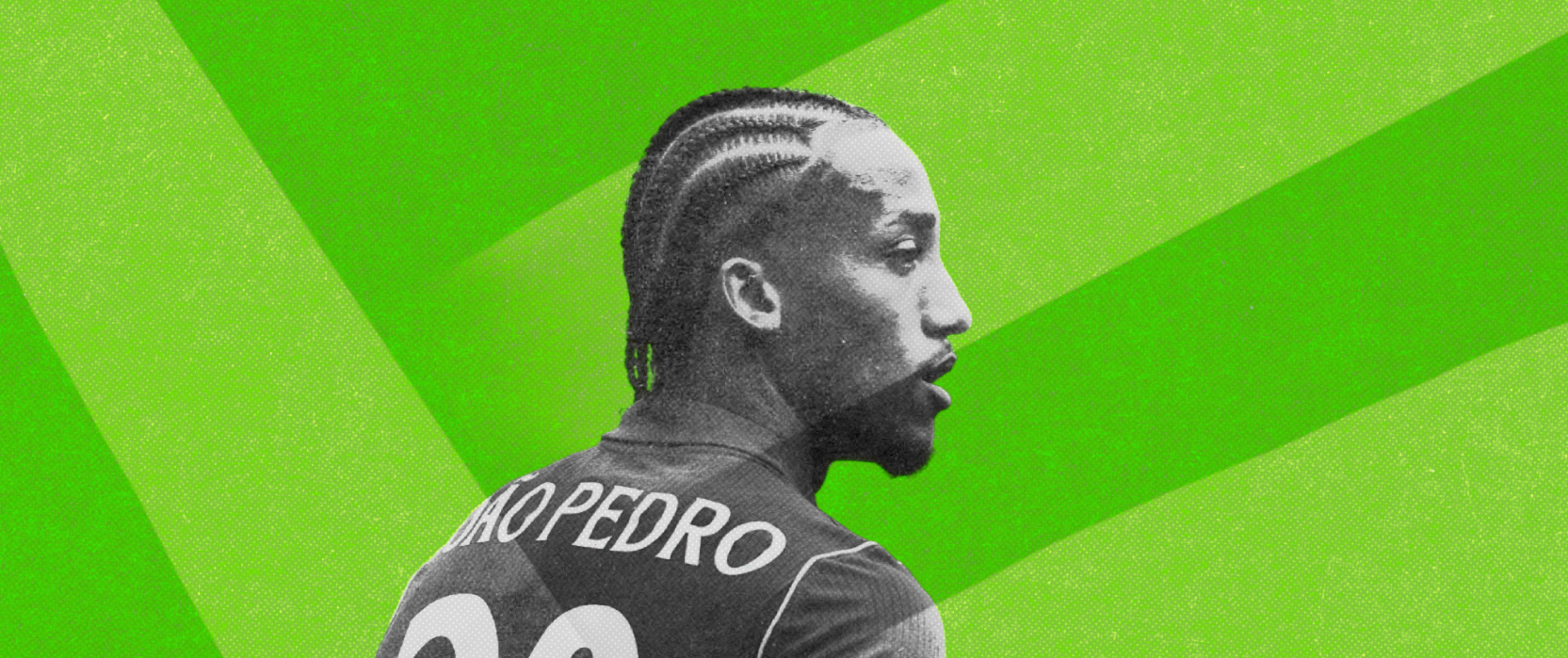
Illustrator Gabriel Foligno Photographer John Walton Publication PA Images
The Boy Who Kept Going
His mother carried him when he was a child. He now carries her name on his skin. After a season of 20 goals and a World Cup heartbreak, João Pedro is ready for what comes next.
Ribeirão Preto, São Paulo. 26 September 2001. A boy is born into a city of coffee plantations and red earth. His father is a footballer. His mother holds him close. The family has a dream.
Within a year, that dream fractures. His father, Botafogo midfielder known as Chicão, is sentenced to sixteen years in prison for being an accessory to murder. He serves eight. João Pedro grows up without his father.
His mother, Flavia, raises him alone. She works, sacrifices and, at times, goes without food so that her son can eat. She tells him that football is his path. Before it became João Pedro's dream, it was hers.
At ten, a youth tournament catches the eye of Fluminense scouts. The offer means moving 430km from home, from São Paulo to Rio de Janeiro, from everything he knows to everything he doesn't. A child leaves home with only his mother by his side.
At Fluminense, he plays almost everywhere: as a number six, a number eight, a number ten and even a winger. Tall and thin, he struggles to find consistent minutes. His mother cries on the parking ramp of the training centre, worried that her son might not make it.
At sixteen, the coaches move him to striker. He absorbs their instructions and begins to develop quickly. The goals follow, and so does the belief that a professional career is possible.
Then England calls.
Watford. Brighton. Chelsea.
The names of his mother, Flavia, and his grandmother, Dalva, are tattooed on his arms. Before every match, he kisses them, carrying the same motivation that has followed him throughout his career: to give them the best life possible.
His journey has taken him from the red earth of Ribeirão Preto to the green grass of Stamford Bridge, from a mother who sometimes went hungry so her son could eat to a Player of the Season award, and from a boy who watched his father on television to a man who carries his family's names on his skin.
This is João Pedro.
The Numbers Behind the Finisher
According to FotMob, João Pedro attempted 73 shots in the 2025/26 Premier League season, with 28 finding the target. His 14.96 expected goals (xG) resulted in 15 goals, while his expected goals on target (xGOT) stood at 15.16.
Those numbers paint the picture of a forward who is both active and selective. He generates enough volume to consistently threaten goal without simply shooting whenever an opportunity appears.
The underlying numbers are particularly interesting because his actual output almost perfectly matches what the quality of his chances would suggest. His 14.96 xG produced 15 goals, meaning he neither dramatically overperformed nor underperformed his expected output. In simple terms, he finished the chances he received at almost exactly the rate the model predicted.
His 15.16 xGOT is marginally higher than his overall xG, which accounts for the placement of his shots and the likelihood that they would result in goals once they were on target. The difference is small, but it reinforces the broader picture of a striker whose finishing is based on repeatable shot quality rather than an unsustainable hot streak.
The consistency between the three figures is perhaps the most notable part. João Pedro's production does not appear to depend on an extraordinary finishing run or an unusual amount of good fortune. Instead, his numbers suggest a forward whose output reflects both the quantity and quality of the chances he receives.
Across the full 2025/26 campaign, Chelsea's official statistics record 50 appearances, 20 goals and six assists for João Pedro in all competitions. He scored 15 Premier League goals, added three in the Champions League and two in the FA Cup.
Built for Alonso’s Football
The strongest argument for João Pedro's fit with Xabi Alonso may be found in the manager's title-winning season at Bayer Leverkusen. In 2023/24, Alonso's attack consistently created high-value opportunities for his central forwards, with Victor Boniface and Patrik Schick sharing the striker role.
According to FBref, Boniface produced 17.2 xG across 1,546 Bundesliga minutes, while Schick recorded 11.8 xG in 1,063 minutes. Both averaged exactly 1.00 xG per 90, meaning the difference between them was largely playing time rather than the quality of chances they received.
The importance of that figure is that Alonso's system was capable of generating a substantial volume of chances for two different types of striker. Boniface was the more physical, mobile presence who could carry the ball and attack space, while Schick offered a more traditional penalty-box threat. Yet both were consistently placed in positions where they could generate roughly one expected goal per 90 minutes.
João Pedro's first Premier League season already puts him in that conversation. His 14.96 xG was only slightly below Boniface's 17.2 and comfortably above Schick's 11.8, despite being produced in a different league and within a Chelsea side that was still developing its attacking identity. The comparison is not about saying the players are identical; it is about the amount of goal threat Alonso's system has historically been capable of creating for its central forwards.
At Real Madrid, that pattern became even more pronounced. Kylian Mbappé accumulated 15.42 xG in La Liga during Alonso's tenure, scoring 18 goals in 1,570 minutes before Alonso's departure. That works out to 0.88 xG per 90, almost identical to the level João Pedro generated across his entire Premier League campaign.
That makes the comparison particularly interesting. Across two very different teams, Alonso has consistently put his most important forwards in positions to generate a large volume of high-quality chances. From Boniface and Schick at Leverkusen to Mbappé at Madrid, the role has remained central even as the individual profile of the striker has changed.
João Pedro already showed that he can generate that kind of attacking volume without Alonso. The question is what happens when the system is designed to make him an even greater focal point. If Alonso's previous teams are any indication, his second season at Chelsea could bring not only more chances, but a significantly larger share of the team's attacking burden.
Left Behind, Then Let Loose
One significant disappointment overshadowed João Pedro's debut season.
On 18 May 2026, Carlo Ancelotti announced Brazil's 26-man World Cup squad. João Pedro, despite scoring 20 goals for Chelsea and winning the club's Player of the Season award hours later, was left out. Ancelotti admitted that "for the season he had in Europe, he probably deserved to be on this list" and said he felt "very sad" about the decision. Neymar was selected instead, making the decision feel like a choice between current form and reputation.
João Pedro responded quietly, writing that "Joys and frustrations are part of football" and that he would support Brazil from afar.
Brazil were then eliminated by Norway in the round of 16, while Ancelotti's decisions, including Neymar's introduction, came under heavy criticism. João Pedro could have been there, and even Ancelotti had acknowledged that he had a case.
Instead, he returned to Chelsea and channelled the disappointment into his football. He scored seven goals in five pre-season friendlies, including a hat-trick against Western Sydney and braces against AC Milan and Real Sociedad. Brazilian media described him as mordido: wounded, hungry and determined to prove a point.
As the new Premier League season begins, João Pedro returns without the fatigue that often follows a major international tournament. He also returns with the memory of being left out when many believed he had done enough to earn his place. That combination of physical freshness and a personal sense of unfinished business could make his second season at Chelsea even more significant than his first.