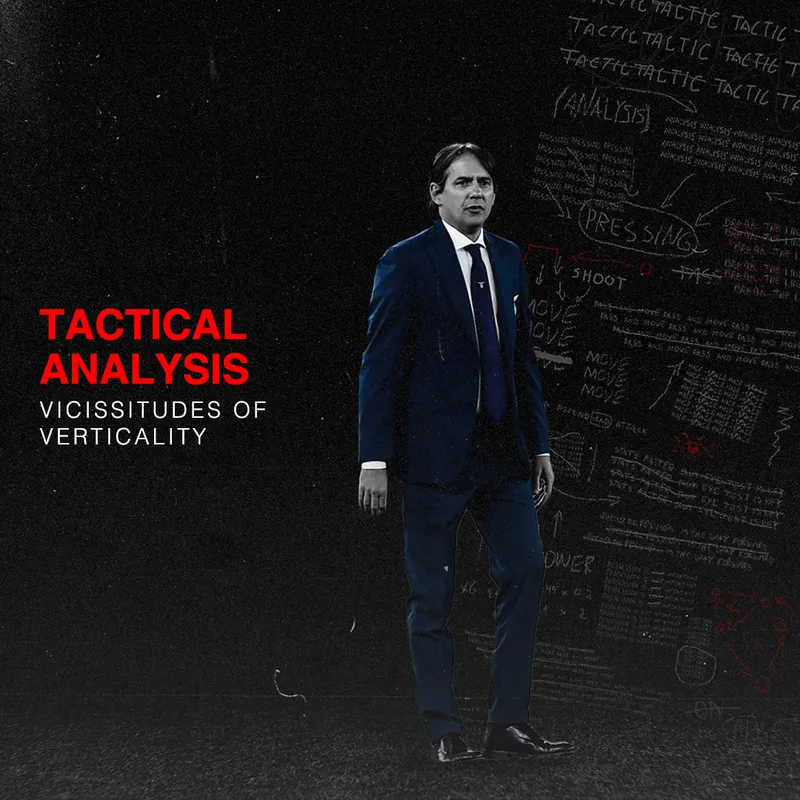
Illustrator Gabriel Foligno Photographer Mondadori Portfolio
Vicissitudes of Verticality: Lazio
Stretching the opposition vertically is typically conceptualised positively because it increases the space in between the opposition’s lines, granting additional space for the players in possession to move into to be effective at…
Stretching the opposition vertically is typically conceptualised positively because it increases the space in between the opposition’s lines, granting additional space for the players in possession to move into to be effective at eventually infiltrating in behind and generating a goalscoring opportunity.
However, the flipside of this is the potential for opposition benefit from the spatial circumstances produced, with errors or risky passes which lead to turnovers now being especially dangerous because of the lack of compactness out of possession, allowing the opposition to exploit the attacking shape through a counterattack.
In essence, while large distances between players in possession can be positive for stretching the opposition defence, it can often lack a counter, counter, whilst additionally fostering a potentially more high-risk playstyle more conducive to turnovers because of the lack of short, safe passing connections for potential progression to provide a support structure for the player receiving in space. To analyse this paradigm, this article will investigate Simone Inzaghi’s Lazio.
In short, Lazio deliberately add backwards depth which creates a conundrum as to whether to continue pushing higher onto Lazio’s deepening line or to allow them to consolidate possession in deeper regions. In this regard, they seek to bait a press in part because that creates a conundrum for the defensive line should the opposition decide to press higher: stay deeper to protect space in behind which a probing Ciro Immobile could potentially exploit.
Credits
Words
@mezzala8