Barcelona: the wilderness years (Part 2)
This piece is part of a series on Barcelona's tumultuous era between Johan Cruyff's departure in 1996 and the Blaugrana's Champions League win in 2006 featuring Josep Lluís Núñez, Joan Gaspart, Luís Figo, a host of managerial changes, successes, failures and more. Part 1 can be found here.
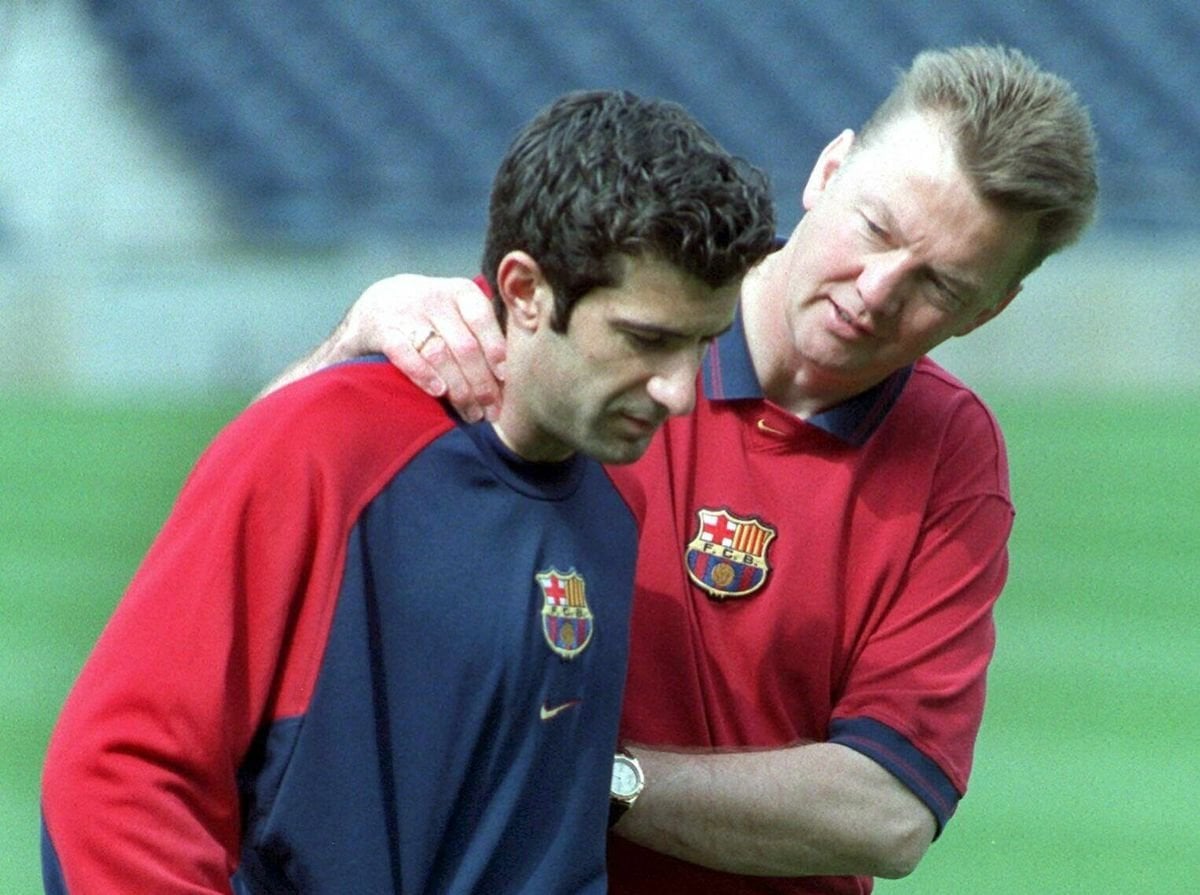
Replacing Cruyff was never going to be easy, but Barcelona’s next attempt at doing so was a man they felt was as close as you could get to a replica: Louis van Gaal of Ajax.
The Dutchman came with a glowing reputation, and the Blaugrana’s decision to go for him stemmed from three reasons:
- Van Gaal’s track record was as good as anyone’s in European football. In six years managing Ajax, his first job in senior football as a coach, he did it all: three league titles, one cup, reached two Champions League finals, winning one, won the UEFA Cup, Super Cup and Intercontinental Cup — there was nothing left for him to achieve.
- Ajax played in a similar way to what Barcelona wanted. Given their links that went back over 20 years from the days of Cruyff and Rinus Michels, fans at the Camp Nou wanted a modern take on Dutch totaalvoetbal, something the club felt Van Gaal could bring. The Barcajax connection was undeniable, and Van Gaal was the latest to represent both clubs.
- Most importantly, it had been over a decade since Barcelona revamped their selection process and training methods at La Masia. They felt Louis van Gaal — who won the European Cup with Ajax with a squad that was mostly homegrown — was the ideal man to work on that and develop them to a higher level. In the academy were emerging youngsters like Xavi, Carles Puyol and Victor Valdés while the likes of Pep Guardiola and Guillermo Amor were established in the Barcelona first-team having graduated from La Masia.
Barcelona has always been a difficult team to manage - there is arguably no club more challenging, given its history, politics, desire and ambition. During his time, Cruyff described it as the entorno — the environment and pressures surrounding the club and he found his way of dealing with it by isolating his squad from external figures. Now, with the club under pressure to get things right, adding in a fiery personality like that of Van Gaal only added to the noise.
As Ronaldo left, another Brazilian, Rivaldo joined, along with Sonny Anderson, Michael Reiziger and later in the winter, Winston Bogarde. Like his predecessor, Van Gaal, too, started brilliantly in the league, going unbeaten in the first nine with the added bonus of an away win against Real Madrid in his first Clásico. But while he brought in some attacking confidence and Rivaldo shining, there was often criticism by many. At times, they felt the football was slow and not as advertised when he first moved, but more significantly, it was his bluntness with his squad that was often highlighted, along with his difficult relationship with the media that caught the ire of the locals.
Fans and the media spoke about how the Dutchman tinkered with smaller internal matters within the team - how they travelled, what they wore on away trips, what they ate. Conversations with him hardly evoked feelings of joy. He was the opposite of Robson. Too hard on his team and not giving much to the media. He wasn’t helped by his thicker accent when speaking Spanish. A lot of players tolerated it, if not appreciated it, but some - like the heroic Hristo Stoichkov — couldn’t wait to see the back of him. Many of the players secretly spoke about him to the media, revealing secrets within the team and that gave them plenty of ammunition to go after Van Gaal.
Still, it didn’t affect the team on their domestic charge. Despite faltering in the Champions League, finishing bottom of their group, Barcelona took advantage of a relatively weak field in domestic competitions, sitting pretty on top of the table and progressing well in the cup. Jupp Heynckes, the Real Madrid boss, who put all his focus on the Champions League (they would win it that season) admitted that in Rivaldo, Figo and Guardiola, Barcelona had the three best players in the world and would be hard to beat. Despite stuttering at times, the Blaugrana secured the title with relative ease, nine points clear of Athletic Club. Van Gaal would later become the first Barcelona manager since Helenio Herrera to win the double in his debut season as his side would beat Mallorca to retain their Copa del Rey title.
If Van Gaal thought the domestic double would give him some leeway with the fans, he definitely took his grace too far. By the end of that summer’s transfer window, the Dutch coach brought in three compatriots — Phillip Cocu, Boudewijn Zenden and Patrick Kluivert, who scored the winning goal for Ajax in the Champions League final of 1995 that Van Gaal won. When Barcelona visited Valencia at the start of the La Liga campaign, they were greeted with a banner that read: “Welcome to Mestalla, Ajax”.
The matter became a problem across Catalonia. Kluivert felt it gave the Dutch players unwelcome feeling, suggesting that he and his compatriots would get the blame for all the problems at the club, while Cruyff suggested giving local players a chance once in a while wouldn’t be a drastic step. Even local politicians had their shot at the coach, to which Van Gaal responded by asking them to stick to politics. In the winter, Van Gaal added to the Dutch clan — Frank and Ronald de Boer, the Ajax twins, would join the club too. By the end of that transfer window, five members of Ajax’s 1995 Champions League winning team that were led by Van Gaal were at Barcelona (a sixth, Jari Litmanen, would join later in the summer).
That wouldn’t have been as big a problem had he not sanctioned the sale of three Masia talents: Albert Ferrer and Guillermo Amor, who had plenty of experience with the club, and the more emerging Iván de la Peña. Given that Van Gaal regularly maintained that he wanted to prioritise the academy and local talent — even explicitly stating he wanted to win a Champions League title with a primarily homegrown squad — he wasn’t doing much to live up to that promise. Van Gaal’s justification was that there were talents coming through that would be in the squad - that campaign, he would hand the midfielder Xavi his debut: some criticised Van Gaal’s misprofiling of the player, as he often played in the defensive midfield role; others criticized the coach putting so much pressure on the player by immediately comparing him to Pep Guardiola. Xavi, though, would speak of his admiration and respect for Van Gaal in later years, crediting him plenty for the opportunity to breakthrough.
Barcelona were getting ready for a party that season — they began celebrations for their centenary year in November, but the party already had some dampeners. The Camp Nou was to host the Champions League final that year and for months, those in the city believed they had the squad to compete for the title in their 100th year. By the time their celebrations began in the winter, they already had one foot out of the competition at the first huddle. In a tough group containing Bayern Munich and Manchester United — the two finalists — Barcelona only got maximum points from the weakest opponent, Danish side Brøndby. In the league, despite building an early lead, they were faltering too, and on the club’s birthday in late November, immediately after their celebrations ahead of their match against Atlético Madrid, the mood went from that of joy to anger as the first whistle blew. Chants of “fuera van Gaal, fuera van Gaal” (Van Gaal out) rang around the ground, and the white handkerchiefs were out. Barça would lose 1-0.
It didn’t help that the mood around the club was hardly that of celebration too. While the team was performing poorly, the fans were at the tipping point of their anger. At the centenary celebration game, they showed that disappointment towards Núñez. He was labelled a dictator for the control he had over the club and local media — fans constantly screamed “Núñez, Pinochet! Núñez, dictador!” at him as he sat comfortably in the directors’ box, beside the special guest that evening, the daughter of King Juan Carlos. They also lamented the fact that the club hadn’t invited Cruyff to the centenary celebrations — that the most important figure in Barcelona’s history was missing for such a significant day was akin to a crime. The fans wanted someone’s head on a spike.
Cruyff, meanwhile, was still involved in Barcelona’s politics: he supported the emerging party Elefant Blau (Blue Elephant). The group’s objective was to lobby for more supporter democracy at Barcelona, something they felt was taken away by Núñez. Since their emergence in 1997, they had been gathering signatures from Barcelona members to join them and build up support against the current regime. Vocal about the club’s issues and with big plans to enforce change, they even caught the eye of Van Gaal, who felt distracted by them. The group’s leader? Joan Laporta.
The blue elephant signified hope and change. After years of mismanagement and corruption that had plagued Barcelona for years, Laporta’s campaign had promised to bring back the glory days of the club, and the blue elephant became a symbol of that promise. Jacint Borràs, one of the members of the organisation, said: "The elephant is an animal that travels in herds, and not alone, like the Barça board. It has thick skin and is slow, but sure, with a great memory, like the Barça member, who doesn't forget the mistakes of the Núñez board. And blue because, since the current Barcelona directors get paid even to breathe, we thought they might charge us too if we used the blue and maroon colors."
As the new year came around and the De Boer brothers joined the club, Barcelona’s form drastically improved domestically. They would win games on the regular in the league, and with players like Rivaldo and Figo shining, the blaugrana eased their way to a second-successive league title. Van Gaal was now the first manager since Herrera in 1960 to win back-to-back championships in his first two seasons, but support for him was still limited. Many in the squad now found it easier to stand against him than with him, namely Rivaldo, who had plenty of support from the fans.
In the summer of 1999, Laporta had spent time across Europe talking to fans. One of the more striking conversations he had was with a group of Manchester United supporters, who flat out rejected the planned takeover bid from Rupert Murdoch and BSkyB that year. Barcelona had long been inspired by Manchester United, and Núñez had been intending to emulate their commercial model through the 1990s. The president was keen to strike renewed TV and commercial deals, as evident by the one struck with Nike for their kits, and he wanted a greater slice of the pie when it came to being broadcast worldwide. He also saw Van Gaal as his Alex Ferguson, hoping to create a long-standing dynasty with the Dutchman at the helm, believing he could stave off the skepticism surrounding his playing style and deliver trophies for the long run.
A big Núñez project was Barça 2000, a theme park around the Camp Nou area for fans and tourists to visit all year long. Núñez had regularly purchased land around the stadium in the hopes of getting the project off the ground, but it never truly took flight. Significantly, though, there were murmurs that Núñez would eventually make the club go public, something that fans, local media and politicians were strongly against, and having been a member-led club throughout its history, it would’ve been an unforgivable sin. Despite Núñez making it clear it would never happen, those connected to the club were always pessimistic of his words, and to prevent that, Laporta and Elefant Blau fought harder. The Manchester United fans Laporta spoke to at a conference at London’s Birkbeck College in the summer of 1999 had lit a flame in his passion for the club, and the campaign against Núñez only intensified.
Support for Van Gaal was inflated thanks to positive results and trophies but as the new season rolled around, that started to fade away. Performances were already in decline, and Barcelona weren’t winning as convincingly, or sometimes not winning at all. Even the players couldn’t wait to see the back of him. Rivaldo’s rivalry with the Dutchman also affected the team. The Brazilian, named as the World Player of the Year that season, stated that he wanted to be moved from the left wing to being a number 10, playing behind the forward. Van Gaal refused, citing that it affected the balance of the side. “He doesn’t want to think for the team, he wants to think for himself,” Van Gaal said in an interview many years later. “For the first two years he was not a big problem. I invested a lot of time in him, but he thinks he is bigger than the coach. He won the World Player of the Year award when he was playing on the left wing, which was where he was of most benefit for the team. But he wasn’t interested. He wanted to be a number ten. I like talented players and individual skill is vital but the team has to come first.”
Feeling the heat from the fans, and having been caught in the presidential web, with arguing and infighting constant, Van Gaal felt isolated. The media didn’t help either - they still weren’t fans of his sternness, with many calling him the anti-Cruyff — the antithesis of the man they thought they were getting. The blaugrana would finally lose their grip of the league title at the turn of the millennium, as Deportivo would finally claim the championship for the first time. At the same time, Real Madrid, having won the European Cup in 1998, did so again in 2000, as Barcelona finished that season trophyless. At the end of the season, he would leave the club, but not without one final jab. Upon his departure, he expressed his displeasure at fan and media expectation, explaining that the club’s sense of self-worth was far higher than he felt it was: “Barcelona is nowhere near as important a club as everybody here thinks it is. You have not won much. I won more in six years at Ajax than Barcelona have won in 100.”
Van Gaal’s departure would be the first in a series of changes at Barcelona. As the coach left, so did the president. Years of demonstrations against him had finally taken a toll and upon the conclusion of the previous campaign, he announced he would end his term two years earlier than planned. Standing in to replace him was Joan Gaspart, who had been by his side for most of his tenure.
The insecurity at the club hadn’t just been reserved to the top. The players, too, started considering their futures at Barcelona, with the club keen to tie them down to new deals, but unable to do so due to the uncertain short-term future. While they had a poor campaign, interest in them had still been prevalent, namely for Figo, who had been touted by Real Madrid in what would be the biggest betrayal of the club. The Portuguese had been widely loved in his time at Barcelona thus far. The players enjoyed playing with him, and the fans appreciated his anti-Madrid sentiment in his time at the club. Guardiola, one of his closest friends at the club, even penned a note for his biography in the months before that summer: “We know you’re always there. He was there when everyone else had left, every last one of them. He lifted his head and shouted when others were silent. He was being Maradona. He was loved. Venerated. Maradona did what Figo does. Figo does what Maradona did.”
It seemed unthinkable at the time that Figo would drop the blue and red of Barcelona for the white of Real Madrid, but the deal on offer and the circumstances for it to happen also seemed unthinkable. Like Barcelona, Real Madrid were hosting elections of their own. Standing to become president, Florentino Pérez, one of the richest men in Spain, had great ambitions for the club. Whilst campaigning, he ran a poll that asked the club’s supporters which player they’d like to see at the Bernabéu the most. The answer was clear: Figo. While engaging in negotiations with Barcelona would be impossible, he did notice a loophole in Figo’s contract, which Barcelona were aiming to negotiate new terms for. The release clause stood at a world-record, but manageable sum of €62 million.
Real Madrid’s elections were due for the middle of July, while Barcelona’s would be a week later. For most of the lead-up to that time, it seemed unlikely that Pérez would win the race to become president, but he struck a deal with Figo before then anyways. He offered the winger a fee of €2.5 million in a legally-binding agreement to sign for the club in case he won the election. If Pérez didn’t win the election, Figo could keep the money with no repercussions, but if Pérez won and Figo refused to join, the player would have to pay €30 million in compensation. Figo and his camp accepted the terms, believing it was extra cash in the bank for nothing, and the Portuguese star, amidst increasing rumours around Spain that he would move, reassured fans and team-mates that he was staying at the Camp Nou for the foreseeable future.
In a shocking turn of events, on July 16, Pérez ended up winning the election, taking over as new Real Madrid president. A week later, Gaspart did the same at Barcelona, and immediately had a problem with one of his biggest stars to deal with. Within days of taking on the role, he would either become the president that oversaw the biggest transfer betrayal in the club’s history, or become the president that gave Real Madrid €30 million to effectively sign their own player, which, at a time of increasing financial trouble at the club, would’ve been the fifth-highest transfer fee ever. With Figo having a year left on his Barcelona deal, Gaspart got the impression that Pérez would sign him on a free the following year using the fine Barcelona paid him for not sanctioning Figo’s transfer that summer. Helpless, Gaspart and Barcelona accepted the sale, and by the end of the month, Figo was presented with the number 10 shirt at Real Madrid, becoming the first of Pérez’s galácticos.
"I'll not forget this. Whoever is responsible for this will pay for it. We'll see how and when," Gaspart said as the sale was completed. He then turned his wrath upon Figo. "Figo gave me the impression this morning that he wanted to do two things — make more money and stay with Barcelona. He thinks money can do everything in this life." Pérez, meanwhile, was overjoyed: “Figo was born to play for Madrid,” he declared at his presentation.
The injection of cash was an uninvited but welcome boost, however, under pressure, Gaspart and the new Barcelona board seemed intent on wasting it all. Aware they had money to spend, clubs across Europe hiked up prices for players the Catalans were interested in, and those that were already at the club asked for newer contracts, including Rivaldo and Kluivert, the former of whom was made the highest-paid player in the world. Joining the club were Marc Overmars, Gerard López, Alfonso Pérez and Emmanuel Petit for a combined fee of around €85 million as Barcelona flexed their financial muscle. Not one of them made an impact in a terrible season under new coach Lorenzo Serra Ferrer. Fourth in La Liga, grouped in the Champions League and losing semi-finalists in both the Copa del Rey and UEFA Cup in another forgettable Barça campaign.
The following year was almost exactly the same. Club legend Charles Rexach started the season as the coach, plenty of players signed, Barcelona finished fourth in the league again, embarrassingly lost to third division Figueres in the cup in the first round and, to give the season some grace, reached the Champions League semi-final, but lost to Real Madrid, who would win the tournament again - their ninth overall and third in five years. By the summer, top scorer Rivaldo would leave, as did homegrown hero Guardiola - his press conference announcing his departure was attended by friends and the media, but not the club president.
Pressure was mounting on the president again: Gaspart was a broken, dejected figure and the writing was so clearly on the wall. Van Gaal was brought back that summer to save face, but the following season was the worst of Gaspart’s run and after a 3-0 loss to Sevilla in December, he stood alone in the directors’ box at the Camp Nou, giving fans the chance to voice their grievances against him. They wanted him gone, and he obliged: another election was called. In the transition, Van Gaal was sacked again in a forgettable second spell, and the fans were clear on what they wanted: Laporta, the eccentric Catalan nationalist who built a career in law, was emerging as a favourite.