Illustrator Canva
UEFA Women's Coefficients Preview: 2026/27 Season
A look at the coefficient battles for the 2026/27 UEFA women's club competition season.
The UEFA women's club competitions get underway on Wednesday as the UEFA Women's Champions League first qualifying round begins. A total of 19 sides will commence the action over the next four days, which will shape how the UEFA coefficients will go this season.
In what is the second season under the current format, the access list used for the Women's Champions League and the UEFA Women's Europa Cup have multiple key changes as the farther up (or down) the five-year coefficient rankings.
Unlike the men's coefficient, where the seasonal ranking is also key, all of the women's club coefficient battles apply for the five-year spots only.
Looking At the UEFA Coefficient Battles For the 2026/27 Season
Heading into what should be an exciting 2026/27 season, here is a preview of the UEFA coefficient battles we can expect to see on the women's side.
Battle for 24th-28th: Large Group Hope for Special Year
One of the things that makes the UEFA women's coefficient battles so fascinating is the fact there are so many countries who have a legitimate chance of shooting up or down the rankings. It adds a special intrigue to it.
This is particularly evident in the battles for top 24 and top 28. A finish in the top 24 guarantees a country multiple European places, while spots 25 to 28 assures the country in question have their domestic champion enter the second qualifying round of the UWCL.
As many as two dozen countries have a realistic opportunity of grabbing any of the coveted places from 20th to 28th. A starting coefficient of between 4.500 and 8.500 points is considered as in the running here.
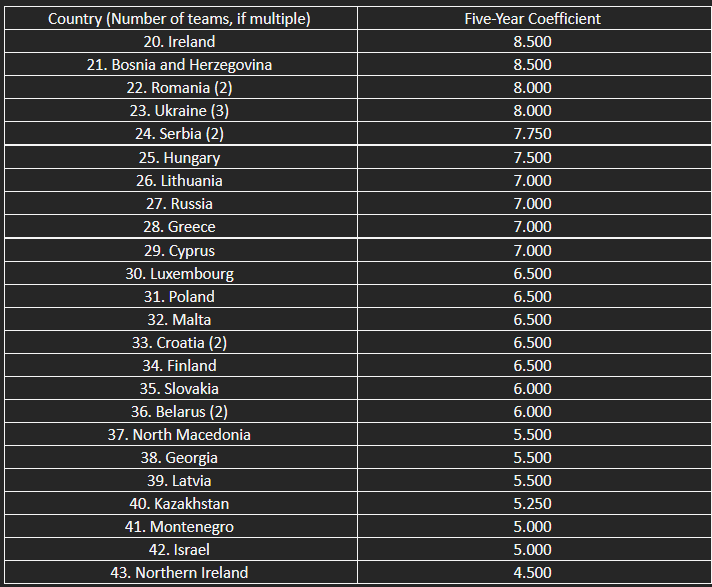
A note before diving further: Russia will not have any teams in Europe due to their continued ban. They will be assigned a 2026/27 coefficient of 1.750 at season's end, giving them a total of 8.750 points over the five-year period.
Success for these nations largely depend on how the domestic champion does in qualifying. Of course, reaching the Women's Europa Cup plays a pivotal role here, as failing to do so leaves these nations no shot at claiming a top 28 place to begin with.
To have a shot at top 24, ideally having a team in the first main round of the UWEC will be important. For the five countries listed with multiple clubs involved, they will want another side getting past the first round of UWEC qualifying. That will strengthen their chances of a top 24 spot as well.
The other thing worth noting is that for countries starting with a coefficient of 7.500 or more, they could also be in contention for a top 17 place. More on that later.
So, who have the best shot of claiming a top 24 place? Romania, Ukraine, and Serbia all have multiple teams, which gives them an edge. Anyone with a starting coefficient of 6.000 or higher will certainly fancy their chances, though finishing that high will surely involve some standout showings. The UWCL second qualifying round performances will tell us much more here as we will then be able to assess who starts where in the UWEC.
As for 28th, that will likely be determined first off by who wins their UWCL Q1 mini-tournament. After that, it is what happens in UWCL Q2 and then UWEC Q1. One thing is for certain though: we are in for a fun ride in this battle.
Battle for 13th-17th: Middle Group Push For Extra Spots
The other cluster of countries set to clash for key places in the UEFA coefficient rankings are the nations hoping for a top 13/top 17 finish. The six highest ranked nations noted in the previous section are also realistically in the running for top 17 at minimum as well.
Places eighth to 13th in the ranking allow three teams in Europe - two starting in UWCL Q2 and one entering UWEC Q1. From 14th to 17th, they are the last spots to award two UWCL Q2 places. The major difference here is that there is no UWEC place available for these countries.
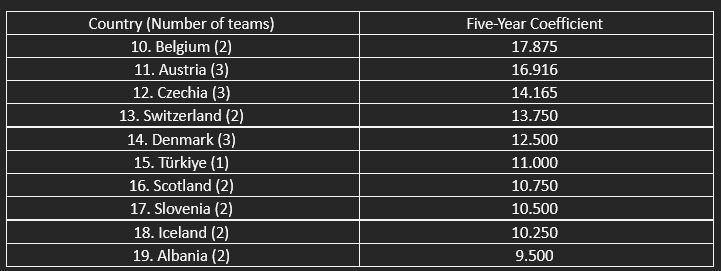
Nine countries are clear of falling out of the top 24, but have no chance to finishing higher than ninth. This leaves them the prime suspects for the top 13/top 17 battle.
In order to earn a top 13 place come season's end, the goal should be to have a side either reach the league phase of the UWCL, and/or a place in the main rounds of the UWEC. Since all but one of the countries listed here have multiple sides, a second team should be pushing for at least UWEC Q2, though a knockout round place would also be beneficial.
For top 17, the aim should be to have at least one team in the UWEC main round. The other team(s), if applicable, should strive for UWEC Q2 minimum. Again, going a step further would certainly bolster their country's hopes.
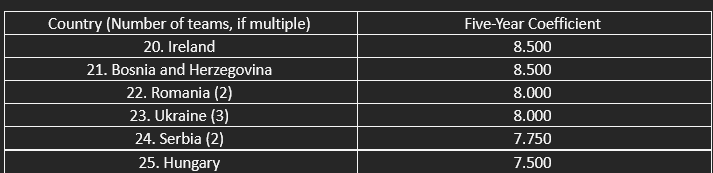
Here is a reminder of the other six countries with a chance at competing for a top 17 place. Anything higher than that is a bonus. It is unlikely for any of the group here to finish higher than 15th.
Who are the favourites for top 13? Belgium and Austria have a decent head-start, and should be among the group most likely to succeed here. Czechia and Switzerland will face stiff competition from Denmark, who could be in for another strong year.
For 17th, many will be hoping for Türkiye's downfall, seeing they have just one team. Iceland could very well pose a threat here, given their generally strong group of clubs. Beyond that, the second qualifying round will provide more insight as to what to expect here.
Battle for Sixth/Seventh: Sweden Pushing for More
On to the race for sixth as well as seventh. In essence, this is a battle that goes down to Sweden facing Portugal for sixth, and Netherlands for seventh. This could end up finishing either way for the Swedes, who had a wonderful 2025/26 campaign.
The countries in the top six share the eight automatic spots in the UWCL league phase, along with the competition's defending champion. For seventh, a third UWCL spot is also assured, though all three teams enter at the second qualifying round.

The distance for both countries immediately above and below Sweden is about 4.000 points either way. It gives the Nordic nation something to work with this term.
For this battle, a key will be having at least one automatic UWCL place, something both Portugal and Sweden currently have. In fact, they also possess the advantage of having three UWCL teams to Netherlands' two. That could prove pivotal.
Having multiple UWCL league phase places will be even more positive, with the 2.333 bonus points going a long way. A knockout round participant in the competition is also important, while all three teams from the countries in question will really need to be playing at least UWEC football by late October. Losing any sides before that makes the task that much more difficult.
If Sweden repeats the performance from last season, sixth will very likely be theirs. It will be an incredibly difficult task for Portugal or Netherlands to keep up. With that said, it is an incredibly high bar for the Nordic nation to set. Earning another 12.500 points - nearly half of their current five-year coefficient - is no straightforward task. That could work to their rivals' advantage here.
Battle for Second/Third: Top Nations Push for Key League Phase Berth
Finally, the other battle we can expect to see in the UEFA women's coefficient ranking is the one for second and third place. There, it is Spain, France, and Germany in contention.
The top two nations in the five-year rankings send two teams to the UWCL league phase, with third having just one automatic spot while their other two sides enter at the third qualifying round. Fourth (and fifth) have their lowest ranked side start in the second qualifying round.

Spain's lead over France is more than 4.500 points, while Germany sits 6.250 points behind the French. It is worth noting that France already have two sides in the UWCL proper, something the other two cannot say. This provides an opportunity for both to put the Germans under pressure early on.
Simply put, multiple UWCL league phase participants is a must. Anything less and the pressure will mount right away. If any of them fail to have all three teams make the UWCL main stages, they have to reach the latter rounds of the UWEC, ie semifinals or better. Otherwise, that is a considerable loss of points.
From there, at least two UWCL knockout round teams should be an expectation, with one getting to at least the quarterfinals. Of course, the further, the better.
Spain and Germany are likely to have multiple UWCL sides come October. This means France will have to try for their third team, Paris Saint-Germain, to get past their third qualifying round clash. It feels like the current order will remain intact at the end of the campaign, but things could change quickly here.
Credits
Words