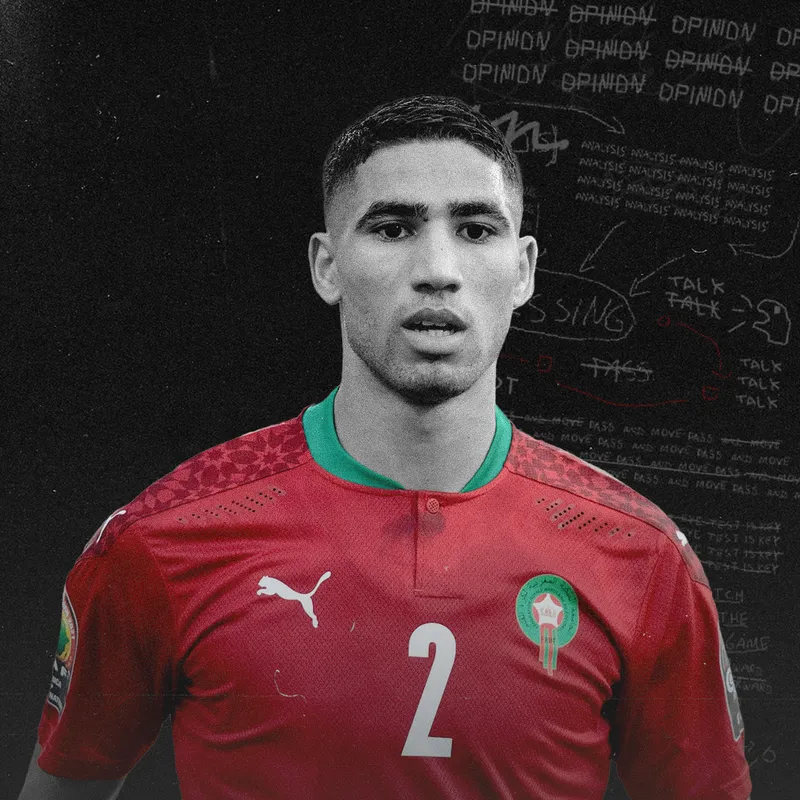
Illustrator Gabriel Foligno Photographer Visionhaus – Getty Images
Achraf Hakimi and the Architecture of Chaos: How PSG’s Right Side Broke Bayern’s System
How PSG’s right flank turned a structured press into a timing crisis—and why it decided the semi-final. There are matches decided by tactics. There are matches decided by moments. And then there are matches where one player changes the…
How PSG’s right flank turned a structured press into a timing crisis—and why it decided the semi-final.
There are matches decided by tactics. There are matches decided by moments. And then there are matches where one player changes the rules the game is being played by. In a nine-goal storm between Paris Saint-Germain and Bayern Munich, Achraf Hakimi didn’t just influence events—he forced Bayern into situations they were never structurally prepared to solve. He didn’t exploit chaos. He authored it.
The System That Created the Lane
PSG’s 4-3-3 was only a starting point. In possession, it became a 3-2-5—designed to stretch Bayern both horizontally and vertically. With Désiré Doué drifting inside and Ousmane Dembélé operating centrally, the entire right flank was left open. Hakimi wasn’t overlapping a winger. He was the width.
Behind him, Warren Zaïre-Emery dropped into cover, while Marquinhos shifted across to contain wide threats. But that coverage was always reactive—never fully secure. PSG accepted that risk for one reason: Hakimi turns space into advantage faster than most teams can even recognise it.
/@btl/nuno-mendes-the-tactical-missile-on-psgs-left-flank
The Mechanics Behind the Chaos
What made Hakimi unplayable wasn’t just pace—it was preparation. His body orientation was consistently half-open, angled toward the touchline. When Vitinha found him, he didn’t need to turn. His first step was already forward. His first touch was aggressive and space-orientated. Not to keep the ball—but to eliminate the defender.
A 3–5 yard push forced players like Dayot Upamecano into a footrace rather than a duel. And then there was decision speed. In transition, it was instant. In the final third, it slowed—just enough. That half-second delay before the decisive pass wasn’t hesitation. It was control inside chaos.
The Transition Engine
When PSG won the ball, Hakimi didn’t check his run. He ran. The trigger was simple: the first clean pass out of pressure. The moment it was played, he was already accelerating—often before the ball carrier even looked up. In the 12th minute, after a Bayern corner broke down, Hakimi sprinted 60 yards into space before the attack had even formed. Bayern’s backline didn’t drop because they wanted to. They dropped because they had no choice.
How He Manipulated Space Without Touching the Ball
Hakimi’s influence wasn’t tied to possession. At times, he was the receiver—targeted by diagonal switches and driving directly at defenders. But just as often, he became the decoy. By sprinting high and wide, he pinned Alphonso Davies deep, collapsing Bayern’s shape and opening central corridors for Dembélé and Doué. He switched constantly between:
/@btl/vitinha-the-unlikely-heartbeat-of-luis-enriques-psg
- wide overlaps to stretch,
- inside-channel underlaps to disrupt,
- one-touch combinations to bypass pressure
He didn’t just use space. He dictated where space appeared.
56 Minutes: The Decisional Collapse
The assist will define the highlight. The moment itself defined the match. As PSG recovered possession in an open phase, Hakimi didn’t take the obvious wide route. With Doué dragging Konrad Laimer inward, he attacked a narrow corridor that Bayern’s system simply didn’t account for.
That movement created a decisional crisis. Do Dayot Upamecano and Jonathan Tah step out? Do they hold? Do they track Dembélé? They hesitated. That hesitation was enough. Hakimi delivered. Khvicha Kvaratskhelia finished. Bayern didn’t lose their structure in that moment. They lost time—and at this level, that’s the same thing. Bayern didn’t lose shape. They lost time—and Hakimi took the rest.
/@btl/willian-pacho-the-ecuadorian-youngster-making-a-name-for-himself-at-psg
When the Game Broke, He Took Over
Hakimi was always dangerous. But he became decisive when the game lost control. Between the 45th and 60th minute, as the match turned into an end-to-end exchange, his speed outpaced defensive organisation itself. Rotations couldn’t keep up. Decisions arrived too late. He didn’t just play in chaos. He accelerated it until Bayern could no longer operate inside their own system.
The Trade-Off: Why Bayern Found a Way Back
That freedom came with consequences. Because Hakimi stayed high, Bayern repeatedly attacked the space behind him. Luis Díaz targeted that channel, creating overloads and forcing Marquinhos wide. From 5–2 to 5–4, Bayern’s comeback came through that exact imbalance. This wasn’t a mistake. It was the cost of how PSG chose to play.
The Strategic Pivot: From Chaos to Survival
The introduction of Fabián Ruiz shifted everything. Before Ruiz, Hakimi’s freedom came from absence—no cover, constant exposure. After Ruiz, it came from structure. Ruiz operated as a defensive cushion, dropping into the right half-space and allowing Hakimi to step forward with control rather than risk.
Then the game turned again. Hakimi pulled his hamstring. He couldn’t sprint. He couldn’t recover. But he stayed. And in the 84th minute, he still cut out a Bayern counter—not with pace, but with positioning. At that point, his role had changed completely. From runner to reader. From outlet to obstacle.
/@btl/lee-kang-in-psgs-korean-playmaker
Hakimi vs Davies: Reaction vs Control
On the opposite flank, Alphonso Davies provided the contrast. Davies used his speed to recover. Hakimi used his speed to dictate. One reacted to danger. The other created it. By the time Davies was withdrawn, Bayern had already lost their primary outlet. They weren’t defending Hakimi anymore. They were reacting to him—and that was already too late. Hakimi didn’t beat Bayern’s press—he made it arrive late.
Conclusion: A Player Who Breaks Systems
Achraf Hakimi didn’t dominate possession. He didn’t control tempo in the traditional sense. He did something far more disruptive. He didn’t just influence the game. He forced Bayern to play a version of it they couldn’t control. This wasn’t a performance. It was a shift in how the match was played.
By: Dhruv Kapoor
Credits
Words
Dhruv Kapoor