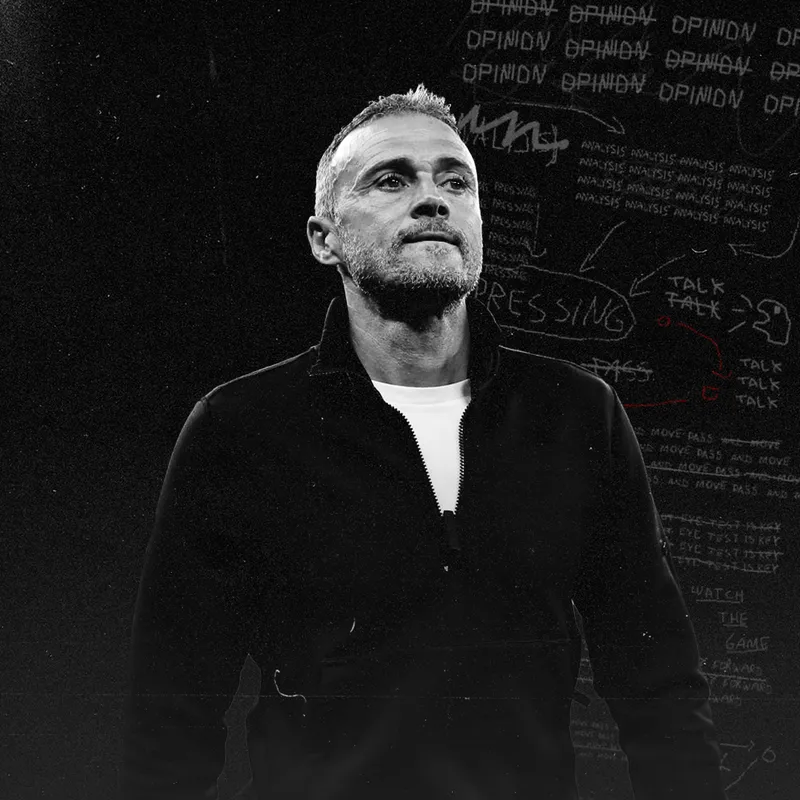
Illustrator Gabriel Foligno Photographer Emilio Andreoli – UEFA
Once Upon A Time in Budapest: Previewing the 2026 Champions League Final
There are nights in football that belong to tactics. Nights that belong to systems, statistics, diagrams and debate. And then there are nights like this. Nights that seem written long before the players arrive. Nights that feel less like…
There are nights in football that belong to tactics. Nights that belong to systems, statistics, diagrams and debate. And then there are nights like this. Nights that seem written long before the players arrive. Nights that feel less like sport and more like prophecy.
Tonight, in Budapest, two worlds will collide at the summit of Europe — one seeking to protect a crown already resting upon its head, the other reaching for a heaven it has never once touched. The holders, arrive like emperors returning from conquest. No longer the fragile aristocrats of old Parisian failure. No longer the beautiful nearly-men wandering Europe draped in perfume and regret. This version is something colder. Something evolved.
And at the centre of it all stands a man who has stared directly into football’s highest fire and refused to blink. He lifted this trophy once with Barcelona, when Lionel Messi, Neymar Jr. and Luis Suárez tore through Europe like three notes from the trumpet of judgement itself. And last year, he did it again with Paris — proving greatness, when real, leaves fingerprints across eras. But this PSG. This PSG may be his masterpiece.
Because they are not merely an attacking side. They are contradiction incarnate. Structure dissolving into instinct. Planning collapsing into improvisation. One moment they move with the precision of mathematics, the next they swarm with the madness of birds escaping a storm. They are positional until relationism seduces them away from their maps. They are organised until freedom whispers into their bloodstream, when that happens, God help whoever stands in front of them.
Ousmane Dembélé arrives first — all electricity and broken rhythm, like lightning refusing to strike the same place twice. Désiré Doué glides through spaces defenders cannot even see. Khvicha Kvaratskhelia plays as though gravity personally insulted him as a child. Behind them, Vitinha and João Neves circulate the ball like priests protecting sacred scripture, while Nuno Mendes erupts from the backline with the fury of a dam collapsing.
PSG do not attack opponents. They consume certainty. They bend matches until football itself seems briefly unrecognisable. And yet, waiting for them tomorrow stands perhaps the only team in Europe untouched by fear. A club carrying twenty years of unfinished prayer. A club haunted by Paris, 2006 — by Jens Lehmann’s red card, by Samuel Eto’o, by Juliano Belletti, by the unbearable cruelty of seeing destiny appear, only to disappear into Catalan colours before their eyes.
Since that night, Arsenal have wandered Europe like exiles searching for a home they once glimpsed but could never return to. And now, at last, they are back. Arsène Wenger was the first man to bring Arsenal to this stage. For two decades, he remained the last. Until Mikel Arteta arrived carrying patience in one hand and obsession in the other.
Three times he reached for the Premier League. Three times it slipped away. Each failure sharpening him. Hardening him. Purifying him. And now, finally crowned champions of England, he brings Arsenal to the edge of immortality itself. But this Arsenal side does not seduce Europe with romance. No. They suffocate it. They are iron disguised as elegance.
The only unbeaten side left in this Champions League season. A team so defensively complete they often appear to move as one nervous system. William Saliba and Gabriel Magalhães stand at the back not like defenders, but like ancient gates protecting a kingdom from invasion. To enter their penalty area is to trespass.
Then come the set pieces. Corners no longer feel like corners against Arsenal. Free-kicks no longer feel like free-kicks. They arrive with the inevitability of fate itself. Every delivery hangs in the air like a sentence already completed. Declan Rice attacks those moments with biblical force. Martin Ødegaard drifts between lines like a composer hearing music others cannot. Myles Lewis-Skelly plays with the terrifying innocence of youth unaware it should be intimidated.
And then… Bukayo Saka. The heartbeat. The smile beneath the pressure. The boy who disappeared injured and returned transformed, as though pain itself had initiated him into another level of existence. Since coming back, he has not merely played well — he has resurrected Arsenal’s season. Every touch from him now feels charged with consequence. Every acceleration carries the sound of belief returning to life.
Ahead of him stands Viktor Gyökeres, dragged from Sporting with the hunger of a man who still feels he has something to prove to the world, while Gabriel Jesus prowls beside him with restless Brazilian mischief flickering in every movement. And so today arrives carrying a question too enormous for tactics alone. Because this is not merely attack versus defence. It is chaos against control. Tempest against stone.
The most devastating attacking machine in Europe against the one fortress nobody has yet managed to break. One side trying to establish a dynasty. Because this is not merely attack versus defence. It is chaos against control. Tempest against stone. The most devastating attacking machine in Europe against the one fortress nobody has yet managed to break. One side trying to establish a dynasty. The other trying to touch eternity for the very first time.
In Budapest tonight, football will ask its oldest and cruelest question once again: What survives longer? The storm or the wall?
Control, Destabilisation, and the Battle for Structural Integrity
In this match, it is more useful to move away from the surface framing of PSG versus Arsenal and instead interpret the encounter as a collision between two competing definitions of control within modern positional play. Both teams are, in their own ways, highly organised, but the organisation serves fundamentally different purposes. Arsenal’s structure is designed to reduce volatility in the game state, while PSG’s structure is designed to actively generate volatility in order to create exploitable moments.
This distinction is not cosmetic; it determines how each team behaves in every phase of play and how they interpret risk. Arsenal’s model of control is built on stabilisation. Their rest-defence structures ensure that even in advanced attacking phases, there is a consistent protective layer behind the ball. This allows them to occupy higher zones without fully sacrificing balance, which in turn reduces the frequency and severity of transition exposure.
Their positional occupation is therefore not only about attacking presence, but also about limiting the opponent’s ability to counterattack effectively. In this sense, Arsenal do not seek control through dominance of possession alone, but through the reduction of chaos in both attacking and defensive transitions.
PSG, by contrast, approach control through destabilisation rather than suppression of variability. Their positional fluidity is not aimed at maintaining fixed structure, but at constantly reshaping the opponent’s reference points. Through rotations in midfield and attack, combined with dribble-oriented progression, PSG attempt to break the opponent’s structural coherence rather than simply bypass it.
Control, in their model, emerges from the ability to create superiority in moments of disorganisation. This means that instability is not a risk to be avoided, but a tool to be manufactured and exploited. The central tension of the match therefore emerges as a clash between control through order and control through induced disorder. Arsenal attempt to compress space and time in a way that reduces unpredictability, while PSG attempt to expand or distort those same parameters until defensive structures lose synchronisation.
Importantly, neither model exists in isolation from the other; each directly reacts to and reshapes the conditions the other relies upon. This makes the encounter less about fixed tactical superiority and more about which system can impose its preferred rhythm onto the game state. Ultimately, the match is unlikely to be decided through sustained possession dominance or territorial control in isolation. Instead, the decisive factor is structural survival under transition conditions.
Once the ball is lost or regained, both teams are forced into rapid reorganisation, and it is in these moments that structural integrity is most tested. The team that maintains coherence during these transitional phases—while disrupting the opponent’s ability to do the same—will likely determine the outcome of the final.
Arsenal’s Structural Identity
Arsenal’s structural identity is best understood not as a static 4-3-3, but as a continuously adjusting control system built around the principle of compression. Rather than defining themselves through fixed positional zones, Arteta’s side oscillates between asymmetrical build-up structures and stabilised rest-defence shapes depending on where and how possession is established. This allows them to maintain a consistent relationship between ball location, spacing, and defensive security, even as individual players shift roles dynamically.
The underlying idea is not to occupy more space than the opponent, but to compress the game into zones where Arsenal retain numerical and positional control. In this sense, structure is less about formation and more about regulating the distances between players across phases. Within possession, one of the most consistent features is the emergence of a 3-2 structure behind the ball, formed through rotational fullback positioning and midfield staggering.
Typically, one fullback steps into midfield to support circulation, while the opposite fullback either remains deeper or provides controlled width, depending on the phase of progression. This creates a stable platform of three defenders plus two midfielders that sits behind the attacking line, ensuring immediate access to counterpressing coverage if possession is lost.
The importance of this structure lies not in its shape alone, but in its ability to maintain central access protection while still enabling forward progression. It is a mechanism designed to ensure that attacking commitment never fully dissolves defensive integrity. At the core of this system sits Declan Rice, whose role extends beyond traditional midfield screening into full structural stabilisation. His positioning acts as the balancing reference point that connects attacking occupation with defensive security, particularly in moments where fullbacks step into advanced or inverted roles.
Alongside him, Ødegaard functions as the primary half-space connector, operating between lines to link circulation phases with advanced occupation. This dual-axis relationship allows Arsenal to sustain progression without sacrificing compactness in central zones. Meanwhile, wingers maintain width not simply for stretching the opposition line, but to preserve horizontal balance across the final third, ensuring that central congestion does not collapse spatial options.
What emerges from this structure is a team that can advance the ball without fully dismantling its own rest-defence architecture. Even in advanced attacking phases, Arsenal rarely commit all structural layers forward simultaneously, meaning there is almost always a residual protective framework behind the ball. This residual structure is crucial because it significantly reduces the frequency and severity of transition exposure, which is one of the defining risks against a team like PSG.
Arsenal’s attacking logic therefore becomes inseparable from their defensive logic; every progression carries an embedded consideration for what happens immediately after possession is lost. The consequence is a team that does not seek to overwhelm opponents through volume or chaos, but through controlled occupation that preserves structural integrity at all times.
The PSG Identity
PSG’s structural identity under Luis Enrique must be understood through a fundamentally different conceptual lens than most conventional positional teams. Their organisation is not built around the preservation of stability, but rather around the deliberate production of instability within the opponent’s structure. In this sense, PSG do not seek to maintain a fixed spatial order across phases of play; instead, they continuously reshape the spatial conditions of the game in order to force defensive units into constant recalibration.
The structure is therefore not an end state, but a mechanism for creating and exploiting disruption. What appears as organisation is, in reality, a controlled process of engineered disorder. In build-up phases, PSG often appear to form a 3-2 base structure, but this description only captures the surface layer of their behaviour. The more relevant interpretation is relational rather than positional, as players are constantly exchanging roles and reference points rather than occupying fixed zones.
Midfielders frequently drop to connect first and second lines, fullbacks advance aggressively to stretch the pitch vertically, and wingers drift inside to occupy intermediate channels between opposition lines. At the same time, the striker often vacates central zones, removing fixed reference points for central defenders. This creates a situation where the opponent cannot rely on stable markers for pressing orientation or defensive assignment.
The objective of this system is not simply to progress the ball through structured passing sequences, but to generate situations where opponents are forced into structural misalignment. PSG aim to create “free men” not through numerical superiority in static zones, but through positional distortion that emerges from continuous rotation and movement. Once the opposition is drawn toward one area of the pitch, PSG systematically shift the point of attack away from that pressure, exploiting the imbalance created by defensive overcommitment.
This cycle of attraction, displacement, and exploitation forms the core logic of their possession game. Progression is therefore not linear, but emerges from the manipulation of opponent orientation and spacing. As PSG move into the middle third and final third, their attacking behaviour becomes increasingly reliant on dribble-oriented progression rather than purely combinational play. Players such as Dembélé or Kvaratskhelia profiles function less as traditional wide attackers and more as progression engines capable of directly attacking unsettled defensive structures.
In these moments, PSG’s advantage does not come from passing superiority, but from the ability to attack disorganised reference points before defensive shape is fully re-established. The key mechanism is therefore not combination alone, but a repeated pattern of structural manipulation: attract pressure into one zone, rotate away from it, and then attack the space created by that displacement. This produces a form of controlled aggression that prioritises timing and disorganisation over sustained positional circulation.
Equally important is PSG’s behaviour immediately after losing possession, which forms a second layer of structural identity. Their counterpress is not reactive in a passive sense, but aggressively oriented toward immediate spatial compression around the ball carrier. The objective is to recover possession before the opponent can stabilise their first pass or reorganise their rest-defence structure.
This transforms transition phases into an extension of their attacking logic, where the moment of loss becomes an opportunity to reapply pressure in an even more unstable environment. In effect, PSG operate with a dual-layer system: one that destabilises opponents in possession, and another that compresses them immediately after loss. This creates a continuous cycle of structural pressure that defines their overall approach to control.
First Phase Battle: Build-up vs Pressing Structure
The opening phase of this match will be defined less by direct duels for immediate ball recovery and more by the interaction between PSG’s positional circulation and Arsenal’s selective pressing structure. Rather than a traditional high-intensity pressing contest, what emerges is a controlled negotiation of access points, where both teams attempt to influence the opponent’s first progression step.
PSG’s objective is not simply to escape pressure, but to actively shape the direction and timing of Arsenal’s pressing movements. Arsenal, meanwhile, are less concerned with immediate ball-winning and more focused on preserving structural integrity while guiding PSG into less dangerous receiving zones. This turns the first phase into a battle over orientation rather than possession itself.
Les Parisiens' build-up structure is specifically designed to manipulate pressing references rather than directly bypass them through speed or verticality. By dropping midfielders into deeper lines and circulating the ball laterally across the first phase, they create a dynamic in which Arsenal’s first pressing line is constantly forced to re-evaluate its engagement triggers. This lateral circulation is not neutral; it functions as a mechanism to stretch compactness horizontally and destabilise the coordination of the first pressing action.
As pressing distances increase, Arsenal are gradually drawn into decisions between stepping out aggressively or maintaining containment shape. It is within this hesitation that PSG seek to create their initial advantage, not through penetration, but through induced structural imbalance. Arsenal’s response to this structure is deliberately non-uniform, reflecting their broader preference for conditional rather than continuous pressing.
Instead of committing to a sustained high press, they operate with selective activation points that depend on ball location, body orientation, and surrounding support structures. Ødegaard may step forward to influence the first line of build-up, particularly when PSG attempt to establish short central connections, while Rice remains positioned deeper to secure central access and protect against vertical progression.
Such a division of responsibility ensures that pressing does not come at the expense of structural security. The primary objective is not to regain possession immediately, but to prevent PSG from receiving the ball in a forward-facing orientation between the lines. The central tension of this phase emerges from the inherent trade-off embedded in Arsenal’s pressing logic. If Arsenal commit too aggressively to pressing triggers, they risk dismantling the very compactness that protects them against PSG’s rotational build-up patterns.
This would open central corridors behind the first line, allowing PSG to access more advanced zones with reduced resistance. However, if Arsenal adopt an overly passive approach, PSG gain the time and spatial stability required to establish rhythm in circulation and progressively impose positional superiority. In that scenario, Arsenal would find themselves defending deeper and more reactively, gradually losing control over central access points.
The critical question, therefore, is not whether Arsenal can press effectively in isolation, but whether they can maintain structural compactness while selectively engaging PSG’s build-up structure. This requires a delicate balance between aggression and restraint, where pressing actions are not judged individually but as part of a wider spatial system.
Moreover, the success or failure of this phase will depend on whether Arsenal can disrupt PSG’s progression without breaking their own midfield coherence. Ultimately, the opening exchanges will function as a test of structural discipline under controlled provocation, where the first significant imbalance may shape the rhythm of the entire match.
Half-Spaces and Zone 14 Access
The half-spaces represent the true structural centre of this match, functioning as the primary interface between build-up progression and final-third penetration. Rather than being peripheral channels, they are the zones in which most elite attacking systems attempt to establish forward-facing control. In this context, both Arsenal and PSG orient large parts of their offensive logic around gaining access to these areas under favourable body orientation.
What differs, however, is not the importance assigned to the half-spaces, but the method through which each team attempts to occupy and exploit them. The match therefore becomes, in large part, a contest over who can stabilise control in these central-intermediate zones.
Arsenal’s attacking structure is heavily dependent on controlled and structured occupation of the half-spaces, particularly through the role of Ødegaard as a connective reference point between midfield circulation and advanced attacking entry. The Norwegian's positioning allows Arsenal to establish a stable relay structure, where progression into central areas is supported by coordinated positional occupation rather than isolated individual actions. This creates a layered attacking structure in which the ball is advanced into the half-spaces with predefined support angles already in place.
As a result, Arsenal’s entries into central zones are typically organised and rehearsed in their spacing, reducing the likelihood of chaotic or unsupported penetration. The emphasis is therefore on structured access rather than spontaneous occupation. PSG approach the same zones through a fundamentally different mechanism, relying less on fixed occupation and more on rotational emergence into half-space areas. Instead of maintaining consistent positional presence, PSG frequently rotate players into these zones dynamically, often disorganising defensive reference points before the actual reception occurs.
Dribble penetration plays a particularly important role in this process, as it allows PSG to bypass intermediate passing structures and directly attack destabilised defensive shapes. This means that their access to half-spaces is less about pre-established positioning and more about creating moments in which the space becomes temporarily unguarded. The result is a more fluid but less predictable method of central-zone occupation.
The key issue is not simply who enters these spaces more frequently, but who is able to receive the ball within them in a forward-facing and structurally advantageous position. Reception quality, rather than mere access, becomes the decisive variable in determining control over these zones. If PSG consistently manage to secure forward-facing receptions in the half-spaces, Arsenal’s defensive line will be forced into more reactive stepping behaviour, potentially disrupting their overall structural coherence.
This would draw defenders out of their preferred zones and create secondary spaces behind or beside the first line of pressure. Conversely, if Arsenal succeed in preventing such receptions, PSG will be pushed into wider or less centrally advantageous areas of progression, reducing the direct threat of their attacking sequences. In this way, control of the half-spaces directly translates into control of defensive behaviour, making Zone 14 access one of the most decisive battlegrounds in the entire match.
Wide Zones: Isolation vs Structural Protection
Wide zones in this match function less as isolated channels of progression and more as structured environments in which both teams attempt to manipulate defensive spacing across the entire width of the pitch. PSG’s attacking logic frequently uses the wide areas as a staging ground for controlled isolation scenarios, rather than as an end in themselves. By shifting play to one flank and consolidating numerical presence around that zone, they aim to manufacture repeated 1v1 situations for their wingers against isolated fullbacks.
However, these situations are rarely purely spontaneous; they are often preceded by deliberate positional occupation elsewhere on the pitch that serves to fix Arsenal’s defensive structure before the final activation. In this sense, the wide zones are not peripheral, but structurally central to PSG’s broader attacking model.
The underlying principle behind PSG’s use of width can be described as overload to isolate. Initial phases often involve attracting Arsenal’s midfield and defensive block toward one side of the pitch, compressing space and drawing multiple defenders into a localized engagement. Once this overload is established, PSG rapidly shift the point of attack or create direct isolation conditions for their wide players.
This transition from collective concentration to individual confrontation is a key feature of their attacking logic. The aim is not simply to win isolated duels, but to ensure that those duels occur under structurally favourable conditions, where defensive support structures are momentarily displaced or delayed.
Arsenal’s response to these wide isolation mechanisms is typically based on a combination of delayed engagement and layered defensive support. The nearest winger often tracks deeper to assist the fullback, effectively converting the situation into a temporary 2v1 defensive structure rather than a pure 1v1 duel. At the same time, midfielders are required to shift laterally in order to compress central space and reduce the possibility of inside progression following wide penetration.
This coordinated shifting ensures that Arsenal do not become purely reactive in wide zones, but instead attempt to preserve a balance between external containment and internal protection. However, this defensive coordination must operate under strict timing constraints to remain effective. The structural difficulty for Arsenal lies in the trade-off between protecting wide isolation and maintaining central compactness.
If too many players are committed to supporting wide duels, central zones become vulnerable to secondary movements and cutback opportunities. Conversely, if Arsenal prioritise central compactness, they risk leaving their fullbacks exposed in prolonged 1v1 situations against PSG’s dribble-oriented attackers.
This creates a fundamentally unsolvable tension within their defensive structure, where full coverage of both zones simultaneously is impossible. The problem is not one of tactical deficiency, but of spatial limitation under elite-level pressure. As a result, the outcome of these wide-zone interactions is less about structural resolution and more about execution under repetition.
Over the course of the match, repeated exposure to isolation scenarios will test the consistency of Arsenal’s timing, coordination, and recovery behaviour. Small deviations in engagement timing or midfield support distances can accumulate into larger structural imbalances over time.
Conversely, PSG’s effectiveness in these zones depends on their ability to repeatedly recreate favourable isolation conditions rather than relying on singular moments of success. In this sense, the wide zones become a sustained battleground of structural stress, where control is determined not in isolated incidents, but through the accumulation of repeated interactions.
The Set-Piece Joker
Set pieces represent a parallel attacking system within Arsenal’s overall structural model, rather than a marginal or supplementary phase of play. In contrast to open-play sequences, which are governed by continuous positional interaction and transitional risk, dead-ball situations offer a controlled environment in which structure can be fully pre-arranged. This allows Arsenal to temporarily bypass PSG’s positional fluidity and counterpressing mechanisms, which are otherwise difficult to escape in dynamic phases.
The importance of this dimension increases significantly in matches of this level, where open-play access to high-quality chances is often limited by mutual structural discipline. Set pieces therefore operate as a distinct layer of attacking logic within Arsenal’s broader game model. Arsenal’s set-piece organisation is characterised by highly structured movement patterns, often built around coordinated blocking schemes designed to manipulate defensive reference points inside the penalty area.
Near-post runs are frequently used not only as direct attacking threats, but also as mechanisms to disrupt defensive spacing and create secondary lanes for delivery or rebounds. At the same time, Arsenal consistently prioritise occupation of second-ball zones around the edge of the penalty area, ensuring that partially cleared situations remain under controlled pressure. This layered approach means that even if the initial delivery is not successful, the attacking structure remains active and capable of producing follow-up threats.
The key principle is not singular execution, but sustained structural occupation of dangerous zones. Against PSG, this dimension becomes particularly relevant due to the specific characteristics of their defensive organisation in set-piece situations. While PSG’s open-play structure is highly adaptive and dynamically coordinated, set-piece defending introduces a different set of constraints that can be exploited through repetition and physical occupation.
Their defensive line, while well-drilled in terms of zonal and hybrid responsibilities, can be disrupted when faced with sustained blocking actions and coordinated movement patterns across multiple reference points. In such scenarios, small timing advantages in movement or positioning can have disproportionate effects on the outcome of the phase. This makes Arsenal’s structured repetition in these situations a particularly relevant tactical lever.
In a match where open-play chances are likely to be heavily contested and structurally limited, set pieces emerge as a crucial secondary system of pressure accumulation. Unlike open play, where PSG’s rotational fluidity can continuously reshape defensive reference points, dead-ball situations freeze the structural environment and allow pre-planned attacking mechanisms to be executed with precision.
This reduces the influence of PSG’s positional instability mechanisms and shifts the emphasis toward execution, timing, and coordination. As a result, Arsenal’s set-piece threat becomes not just an additional attacking tool, but a parallel route to generating expected goals in a tightly balanced tactical environment. In matches of this profile, such alternative systems often become decisive in determining marginal outcomes.
Conclusion
I think about how we always return to this game, football, the way one returns to a voice they cannot quite forget. PSG and Arsenal will step into this final with their patterns and their plans, but what they cannot plan for is what it will do to us while we watch. Because there will be moments that feel almost like desires—unpredictable, impossible to fully hold, but impossible to turn away from.
This would. not merely a final. This is a romance written in movement. A love story told in passes and pauses, in tension and release. And like all great love stories, it did not ask to be understood. Only remembered.
Credits
Words
Tobi Peter