Barcelona: the wilderness years (Part 3)
This piece is part of a series on Barcelona's tumultuous era between Johan Cruyff's departure in 1996 and the Blaugrana's Champions League win in 2006 featuring Josep Lluís Núñez, Joan Gaspart, Luís Figo, a host of managerial changes, successes, failures and more. Part 1 can be found here, and Part 2 can be found here.
Ever so charismatic, Laporta grew up supporting Barcelona in its Cruyff heyday. He was a young teenager when Cruyff joined and watched him spur the blaugrana on to their first league title in 11 years in 1974, and was charmed by how he adopted Catalan culture so quickly. Wanting to be a footballer himself, Laporta would copy Cruyff’s hairstyles, moves on the pitch, flicks and overall energy, but after realising he had no career in the game, he decided to switch to studying medicine.
It wasn’t long before he dropped out of that at university, moving on to corporate law, making a stellar career for himself there, whilst continuing his fervent passion for the football club he loved most. By the 1990s, having experienced the first European Cup win in 1992, he was outraged at the way Cruyff was betrayed by Núñez and Gaspart, leading to him creating Elefant Blau to oust them out of power. The elections of 2000 came too soon for him, so he joined marketing executive Lluís Bassat in his charge. After Bassat fell short that year to Gaspart, Laporta flew solo, and had a star cast to support him.
Laporta’s charm and eagerness was hard to ignore and he was making waves across the city. He had local businessman and friend Sandro Rosell, once of Nike, as his senior advisor, marketing and media expert Marc Ingla to back him and financial expert Ferran Soriano all part of his cast. Most importantly, though, he was in close contact with Cruyff. Standing in the election against him again was Bassat, and initial polls showed he was the favoured choice given his experience, wisdom and longer history with the club. At a time of turbulence when the club needed a safe pair of hands, Bassat just made more sense. But that changed for the Laporta campaign after Ingla, who had several links in the US, contacted a Catalan friend in Washington on how to run an effective campaign. They worked on strategy and communication, got advice on how to win and how to change the short-term future for the club and got their act together ahead of the spring of 2003.
As polls approached in May, Laporta dropped a huge bomb to swing the election in his favour. Reports emerged that he had met with the agent of Manchester United outcast David Beckham in France. Then, Laporta requested a press conference, where he revealed, amidst links of Beckham moving to Real Madrid, that his club had arranged a deal with the English side for Beckham’s transfer should Laporta win the election. All of a sudden, everyone wanted Laporta — whether or not he had agreed a deal was unknown, but the fact that he was able to start his spell with a coup this big was akin to Figo being Pérez’s first transfer at Real Madrid. Come election day, Laporta overwhelmed Bassat, winning 52.7 percent of the votes over Bassat’s 31.80 percent. “Long live Catalonia, everyone,” the new president declared in his first speech. Ingla, meanwhile, recognised the modernity of the new leaders: “It was both conscious and well-discussed in our campaign sessions that we had to depict freshness and change. I think we won because of that...it was all a different story.”
Laporta’s cabinet included the same members as above. Rosell was his deputy, Soriano and Ingla saw marketing and finances, where they had a huge task, given they walked into a club with debts reaching €150 million, while former winger Txiki Begiristain joined as sporting director with Cruyff advising him. The goals were simple. Firstly: get Barcelona playing in a way they were meant to, with speed, verticality, a positive passing game and a style deployed across all age groups. They analysed the work of the Masia, recognised the talent it had brought in (in previous years, the likes of Xavi, Puyol, Valdes, Thiago Motta and Andrés Iniesta had all made their debuts) and said that funding was more important than ever. “Very good business,” Soriano said, when he found out it cost an estimated €2 million per player that was promoted to the first-team in the last decade.
Secondly, they analysed the squad. It didn’t take an expert to realise that in previous years, they had spent far more than they were earning, and a lot of it was wasted, especially since the windfall they received from the Figo sale. Too much deadwood, too many underperforming players, and too many players on high contracts. They had to streamline the squad, and the first summer in charge would be a busy one. Laporta made it clear to the staff and team that they would have to accept a few years of mediocrity, away from the title race and probably away from Champions League football that would bring in essential funds. They needed deals on the cheap too and formed essential links with agents, namely Jorge Mendes, who was influential in bringing in his client, the Mexican defender Rafa Márquez, from Monaco in a cut-price €8 million fee.
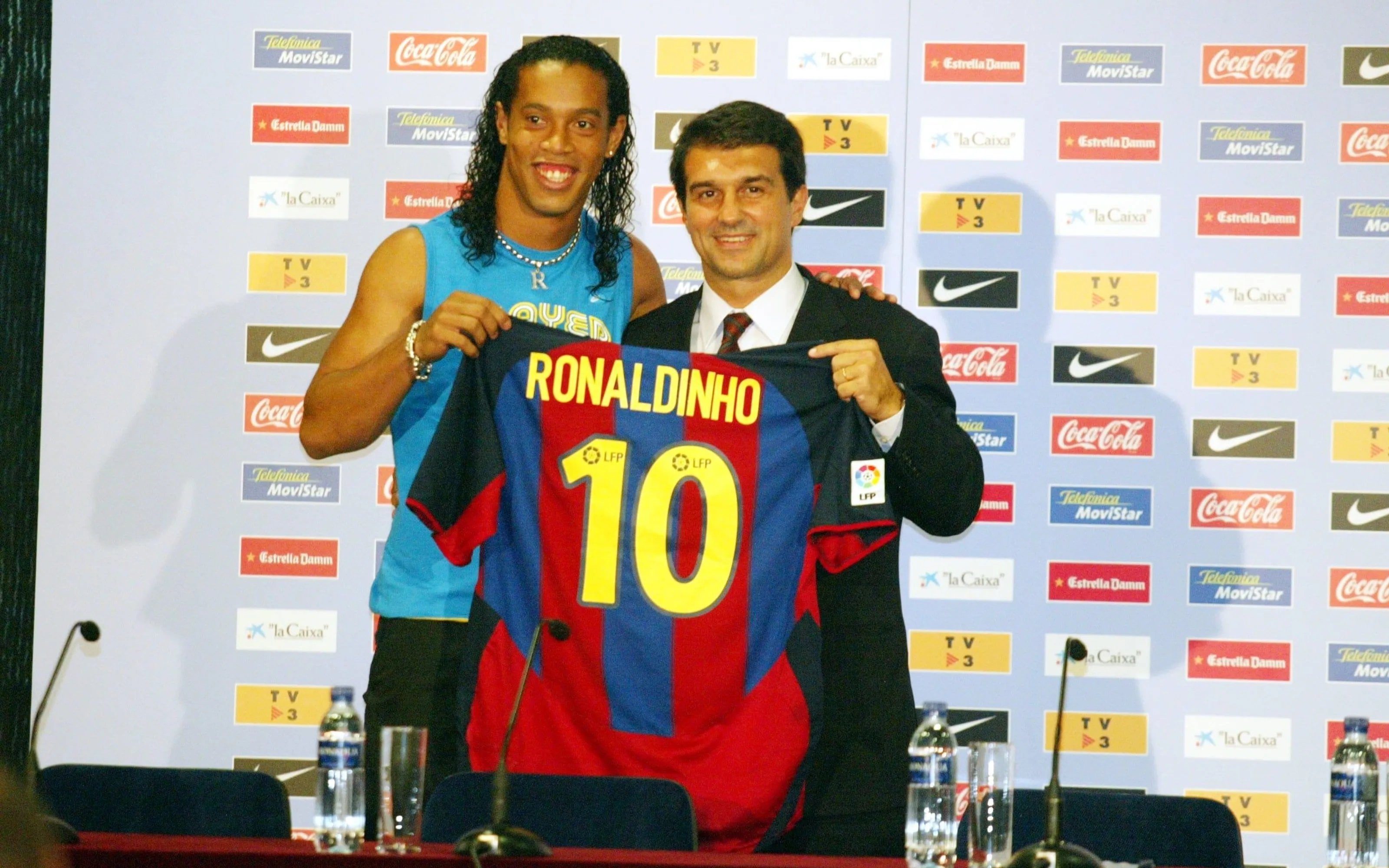
The more significant transfer they were working on, though, was that of enigmatic Brazilian Ronaldinho. Paris Saint-Germain’s World Cup-winning midfielder was ready for a big move away from France, and with Manchester United and Real Madrid also keeping tabs on him, the competition was high. United were looking for someone to fill up the gap left by Beckham, who went to Real Madrid (which in itself left Laporta looking for a big signing, having promised the Englishmen before), while Real Madrid backed out early - one member of Pérez’s cabinet said that he was “too ugly” to play for the club. Manchester United believed they were in the lead for him though, and their executives had spoken to the player to be closer than ever. Barcelona’s trump card came from Rosell, who knew Ronaldinho well from his time at Nike and in the end, he managed to beat Manchester United’s offer, and agreed a significant €27.5 million transfer — a huge coup for the Laporta administration.
Most importantly, though, Barcelona needed a new head coach. Radomir Antić ended the previous season in the job but Laporta wanted a fresh start, or, to be specific, someone more Cruyffian. Guus Hiddink and Ronald Koeman were both considered but both were too costly, leaving them with the third man on the list, and Cruyff’s biggest recommendation: Frank Rijkaard, Cruyff’s trusted ally when managing Ajax. His limited experience where he briefly and rather unimpressively led the Dutch national team and then Sparta Rotterdam, where he was relegated, hardly painted a pretty picture, but Cruyff was confident, and by default, Laporta was.
Barcelona fans could be excused for thinking that the faith was misplaced: by the halfway point of the season, they’d won only seven of the 19 league games, but showed some signs of form in the cups. A 5-1 loss to Málaga away just before Christmas led to chants of “segunda, segunda,” and with Barcelona close to the relegation zone, fear of the drop was creeping amongst the most pessimistic of fans. Performances were slow and largely forgettable. Ronaldinho shone, though, and was clearly established as the face of the side. But while things weren’t so good on the pitch, off it, the board were making big changes. Ingla, Soriano and Rosell were impressed by the improving popularity of Manchester United as a brand in the past decade, and felt Barcelona could take inspiration from it, so they implemented changes across the club and city to enforce that.
The first thing was to sign a series of sponsorships that would, firstly, bring in more money, and secondly, take the FC Barcelona brand across the world, namely in Asia, where they felt there was a huge untapped selection of football fans that didn’t quite get to experience Barça. Soriano, in particular, felt Real Madrid had taken up a large selection of the foreign fans given their series of European Cup successes in the previous six years, and it was up to those at the club to change that, with the previous board having neglected that. Locally, they added more VIP seats in the directors’ box, and improved the Camp Nou experience for visiting tourists — the local council was asked to change the route of the local bus tours to include the stadium so visitors got at least a hint of the club. Perhaps most significant was the banning of Boixos Nois, the violent ultras group. Removing them from the stadium would, in the club’s opinion, uphold Barcelona values and make the stadium more family-friendly.
Back on the pitch, after intense meetings on how to fix the squad, the board’s solution on limited funds was the loan signing of 30-year-old Edgar Davids, a once-great midfielder. Once again, it was Cruyff’s recommendation, and the tag of FC Netherlands wasn’t going away. “I really like this guy. I’ve signed a real man,” Laporta said. Others didn’t quite feel the same way. Many amongst the board were keen to sack Rijkaard, with Rosell hoping to bring in World Cup-winning coach Luiz Felipe Scolari, but Cruyff backed his compatriot, and by default, Laporta did too. Davids would provide a jolt of energy to the side, with his style perfectly matching the team’s. Straggling in mid-table when he arrived, he would power a run of nine successive wins, and 13 in 15, putting the team in an unlikely title charge. They would fall five points short of Valencia in the end, but the improvement and more importantly, return to the Champions League, was essential.
Rijkaard was backed further in the summer — key figures left, high earners off the books, and eight players joined, including Samuel Eto’o, Deco, Juliano Belletti, Henrik Larsson and Sylvinho. Rijkaard now felt his team was more settled. Eto’o in attack, Puyol in defense, Xavi and Deco in midfield with Marquez now further forward and Ronaldinho still the catalyst. There were also hopes for Lionel Messi, who had fleeting moments with the first team and was now ready to get more of a shot.
As ever, though, you can’t expect much stability at Barcelona at boardroom level. This time, it was Rosell who felt Barcelona were relying on Cruyffian ideals that were outdated, and irrelevant to modern day football. More importantly, he was disappointed about the lack of clarity on who had the final say on transfer decisions, and that he wanted the club to make more use of his contact list in getting deals over the line. Rosell also had a strong relationship with Real Madrid’s Pérez. His opinion at the time was that the new Barcelona regime wasn’t maintaining that positively, and that the rivalry would get out of hand. All of it seemed quite unreasonable, as though one was backing a different horse from the one others had their money on. It was kept quiet, though, as Barcelona started the season fantastically.
Despite the cup and Champions League not going as planned, Barcelona were clearly the best team in Spain. Real Madrid struggled for much of the galácticos era, especially domestically, and the blaugrana were just hungrier than the rest. A 3-0 Clásico win at the Camp Nou in the winter gave fans renewed optimism that the league title could return for the first time since the Van Gaal era. The team was united, regularly hanging out together, becoming friends and it showed on the pitch. Many of the players that joined in the summer had previously won little — the idea of collecting a bunch of nearly-champions seemed to drive them forward at a club where winning was consistent. By the end, they were four clear of Real Madrid, and the title returned to Catalonia. Eto’o hit 29 that campaign, Ronaldinho was inspiring, and by far the best player in Europe — he would later win the World Player of the Year title that year.
To add to their joy, Laporta had a huge problem solve itself: Rosell would resign from his role, citing a lack of transparency at the club and it wouldn’t hinder the club at all. “I’m a loyal club socio and someone who takes responsibility for his actions but, friends and cules, there are problems which do not have simple solutions,” Rosell said in his final statement. “For months my situation has been very uncomfortable and has saddened me. The project which that group of proud, ambitious young men explained during the last election campaign has been consistently diminished during the management of the last two years at Barcelona. Either I didn’t originally understand the idea with which Joan Laporta sought the presidency or things have been changing towards a style of management which lacks independence, transparency or democracy in its direction. For these reasons I must step down and for those reasons I must also avoid giving more details of our differences in public.”
The players were still hungry for more in the following months. Mark van Bommel signed on to bring in more experience while there were no significant departures: a winning formula didn’t have to be changed. Fourteen straight wins along the start of the following league season was the best run of Rijkaard’s career. One of those wins was against Real Madrid in Madrid, as a Ronaldinho inspired 3-0 success led to him getting a deserved ovation from the home fans, a rare occurrence for any player visiting the Bernabéu, let alone a Barcelona one.
Off the pitch, Soriano’s business in China and Japan, as well as a renewed partnership with Nike for the club’s kits flipped the club’s financial situation — they were now amongst the highest earners in Europe, even more than Manchester United. They would also get a shirt sponsor for the first time for the following season, rejecting lucrative offers from major companies to sign with Unicef, who they would donate money to, rather than earning money from staying true to their més que un club motto. "The pillars of Barcelona are Cruyff, La Masia, Catalonia, Unicef,” Laporta later said.
In Europe, Barcelona were dominant too, topping their group, and in the last 16, they got revenge on Chelsea, who knocked them out the previous season. It was a young Messi who announced his arrival on the biggest stage in a game at Stamford Bridge, giving Ashley Cole, arguably the world’s best full-back, a torrid time. Benfica and Milan would fall too, and while the attack was thriving, it was the back-line that stuck together to get Barcelona to the final, where Arsenal awaited in Paris.
Before that, the league title was sealed — two consecutive championships was a feather in Rijkaard’s cap — but anxiety was high ahead of the Champions League’s ultimate showdown. It had been 14 years since their last win in this competition, the club, only three years into Laporta’s tenure, was still nervous from ghosts of the past decade. They weren’t helped at the Stade de France by Sol Campbell’s first-half goal to open the scoring, despite Arsenal having their goalkeeper sent off. The Gunners were watertight at the back, resisting Barcelona attacks, and keeping Ronaldinho quiet. It wasn’t until the substitution of Larsson on the pitch that things started to change: the Swede was prolific, finding spaces his Brazilian team-mate was blocked from. Late in the second-half, he set up Eto’o for the equaliser before finding Belletti to squeeze in his winner - all three signed together in 2005, now they’d won Barcelona their second Champions League.
The league and Champions League double, same as 1992, lifted Catalonia, giving the region its biggest hangover ever in the middle of May. Not many gave Laporta a chance of this in 2003 — they’d only seen decline after decline after Cruyff’s sacking as manager in 1996. Now, they were the best team in the world with the best player and forward in the world, as well as one of the richest clubs in the world.
There were risks aplenty, arguments and infighting, some glorious football and some absolute low-points, betrayal, drama and three presidents, making the decade between 1996 and 2006 the most tumultuous in Barcelona’s history but the Champions League win inspired the club. They would add three more European titles in the nine years after, in a team now led by Xavi, Iniesta and Messi, who would go on to become the greatest footballer ever, largely led by Guardiola. There’s a fair argument that Laporta is one of the most important figures in Barcelona’s history, and no matter what he does or whatever is said against him, he will always be the president that took the club out of its wilderness years and into a bold new trophy-laden era.
References:
- Lowe, S. (2014), ‘Fear and Loathing in La Liga: Barcelona vs Real Madrid’, Yellow Jersey Press
- Burns, J. (1999), ‘Barça: A People's Passion’, Bloomsbury Publishing
- Haugstad, T. (2022), ‘The Laporta Revolution,’ Thore Haugstad, found here: https://www.thorehaugstad.com/profiles/the-laporta-revolution
- Reyes, M. (1997), ‘La construcció d'un president’, El Temps, found here: https://www.eltemps.cat/article/5735/la-construccio-dun-president
- Finestres, J. (1998), ‘El Complot de l'Elefant Blau’, El Temps, found here: https://www.eltemps.cat/documents/el-temps_1998_01_0709_0020_0024.pdf
- Meijer, M. (2014), ‘Louis van Gaal’, Ebury Press
- Wilson, J. (2018), ‘The Barcelona Legacy: Guardiola, Mourinho and the Fight For Football's Soul,’ Blink Publishing
- Kuper, S. (2021), ‘Barça: The rise and fall of the club that built modern football,’ Short Books
- Hunter, G. (2012), ‘Barça: The Making of the greatest team in the world,’ BackPage Press Limited