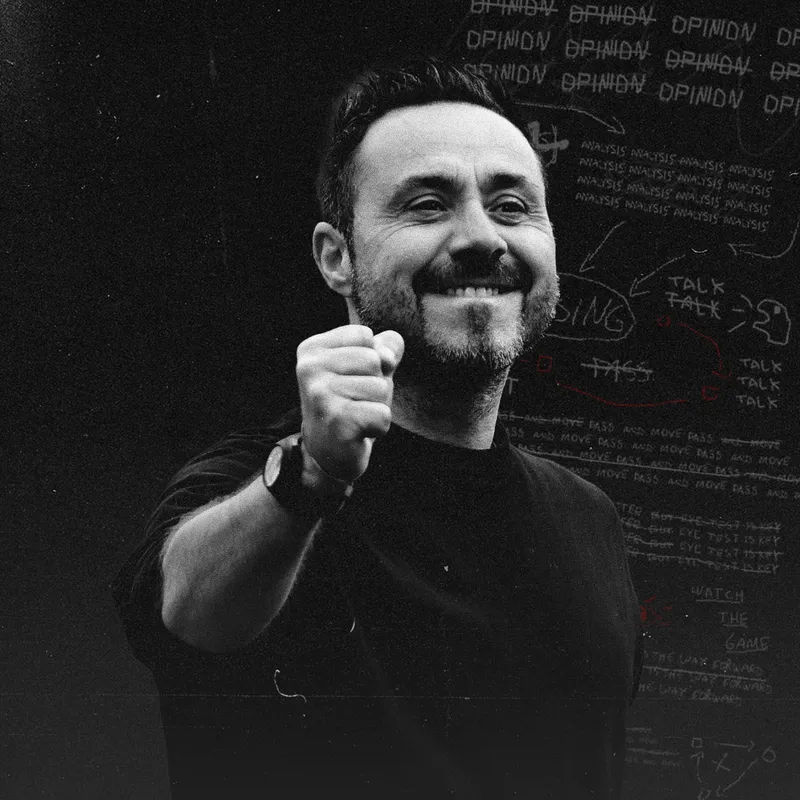
Illustrator Gabriel Foligno Photographer Mike Hewitt Publication Getty Images
Roberto De Zerbi: An Italian Source of Pride Abroad
When Tottenham—in dire straits and sitting third-to-last in the Premier League—called upon Roberto De Zerbi, the immediate reaction in both Italy and England was that this was a mad move only a genius would make. Spurs’ first two matches…
When Tottenham—in dire straits and sitting third-to-last in the Premier League—called upon Roberto De Zerbi, the immediate reaction in both Italy and England was that this was a mad move only a genius would make.
Spurs’ first two matches didn't go well—a loss to Sunderland and a draw against De Zerbi’s former club, Brighton—but the results that ultimately secured safety were two away wins: one against a Wolves side already relegated, and, more importantly, one in Birmingham against Aston Villa, managed by Unai Emery—a coach De Zerbi greatly respects, despite their differing footballing philosophies.
De Zerbi’s managerial career began at Darfo Boario, but his first major commitment to a club—and one to which he remains deeply attached—was with Foggia. He gained widespread admiration and recognition from the likes of Damian Pedrosa during his time at Sassuolo, where he narrowly missed out on Conference League qualification, losing out to Roma on goal difference.
He then moved to Shakhtar Donetsk, where he made an excellent start, but—due to the well-known circumstances—he terminated his contract and signed with a Premier League club for the first time on September 18, 2022, after Chelsea paid to lure Graham Potter away from the Seagulls. At Brighton, he dazzled the Premier League with his highly distinctive style of football and led the club to historic Europa League qualification—a first in their history.
Mathys Tel: Tottenham’s French Forward
The following year, likely struggling to balance domestic and European commitments with a limited squad, the team finished 11th; they were eliminated from the Europa League by his friend Daniele De Rossi’s side, and at the end of the season, he mutually agreed to terminate his contract with the club. On June 24, his move to Olympique Marseille was officially confirmed, following a hugely disappointing season for the French club that saw them miss out on European competition entirely.
Naturally, De Zerbi excels in his role here as well, developing players whom the club is set to sell during this transfer window—such as Mason Greenwood—or has already sold, like Robinio Vaz. Although he described this as the most inconsistent team he has ever managed—full of ups and downs—he finished second in his first year. The following season, he resigned after a shocking Champions League exit (featuring a goal scored by the Benfica goalkeeper) and a third-place standing in Ligue 1; the team ultimately finished fifth under Habib Beye.
Before explaining the style of football Roberto De Zerbi plays, I want to start with a quote from Lewis Dunk, Brighton’s captain under De Zerbi: "Since De Zerbi arrived, I see football in a completely different way; when I learn something new, I ask myself, 'Why didn't I know this before?'"
Another statement that really struck me came when he was a guest on a Twitch show hosted by his friends Lele Adani, Antonio Cassano, Nicola Ventola, and Bobo Vieri; he said: "If I have the ball, do I have a better chance of winning the match? If I have ten arrows and the opponent has three, sure, they could still win—but mathematically, who has the better odds? Of course, possession goes hand in hand with shots on goal."
Tottenham Hotspur’s Season of Conundrums: From High Hopes to Harsh Realities
Indeed, De Zerbi’s football relies heavily on possession, structured build-up play, and immediate ball recovery upon losing possession. Building play from the back is a fundamental element for the coach from Brescia; he aims to draw the opposing team's press before using short passing sequences to advance into the final third.
A remark he made a few years ago really stuck with me: "To me, launching the ball and competing for the header to win the second ball is a gamble; if I have to gamble, I’d rather do it by training the team to play out from the back—because that involves actual coaching work."
His build-up play is not rigid; it depends heavily on the specific situation. We might see the center-backs split wide with a midfielder dropping deep, a full-back tucking inside while the other pushes high to provide width, or both full-backs pushing high while the attacking midfielder drops back. It is a fluid, non-formulaic approach aimed at always maintaining a numerical advantage during the build-up phase.
Naturally, the goalkeeper plays a crucial role; both at Brighton and Marseille, he rotated his goalkeepers far more frequently than almost any other European team, basing his choice largely on the type of match he anticipated. His teams employ a ferocious pressing game, aiming to win the ball back immediately in the opponent's half; when they fail to do so, they steer the play toward areas they deem less dangerous for the opposition's attack.
Dominic Solanke to Tottenham: The Rebirth of One of England’s Finest Wonderkids
The Italian coach’s primary system is the 4-2-3-1, yet—much like Pep Guardiola and Luis Enrique—De Zerbi is a manager for whom formations matter very little; as previously mentioned, he demands specific actions during both possession and ball recovery, making it highly unlikely for a player to remain static in their position. However, he is not a dogmatic manager —a fact demonstrated notably during the final stretch of his time at Marseille.
Despite openly disliking the setup, he switched to a back-three formation because he believed a specific player (Facundo Medina) would perform better in that context. Thus, while his core concepts remain—and, as he has frequently stated, are non-negotiable—he is capable of fielding diverse lineups and systems.
I was fortunate enough to meet him in person when he visited Rome for a training camp with Marseille; although I could only speak with him for a few seconds, it was clear that Spurs were in dire need of a strong leader with bold ideas—backed by a club willing to listen to him completely.
As he has proven in numerous other settings, handing the keys of a club to Roberto De Zerbi guarantees results, style, ideas, identity, and courage. This underscores the fact that great coaches must possess strong values and concepts, which in turn requires being a strong individual—something Roberto De Zerbi undoubtedly is.
Credits
Words
Matteo Zamprioli