
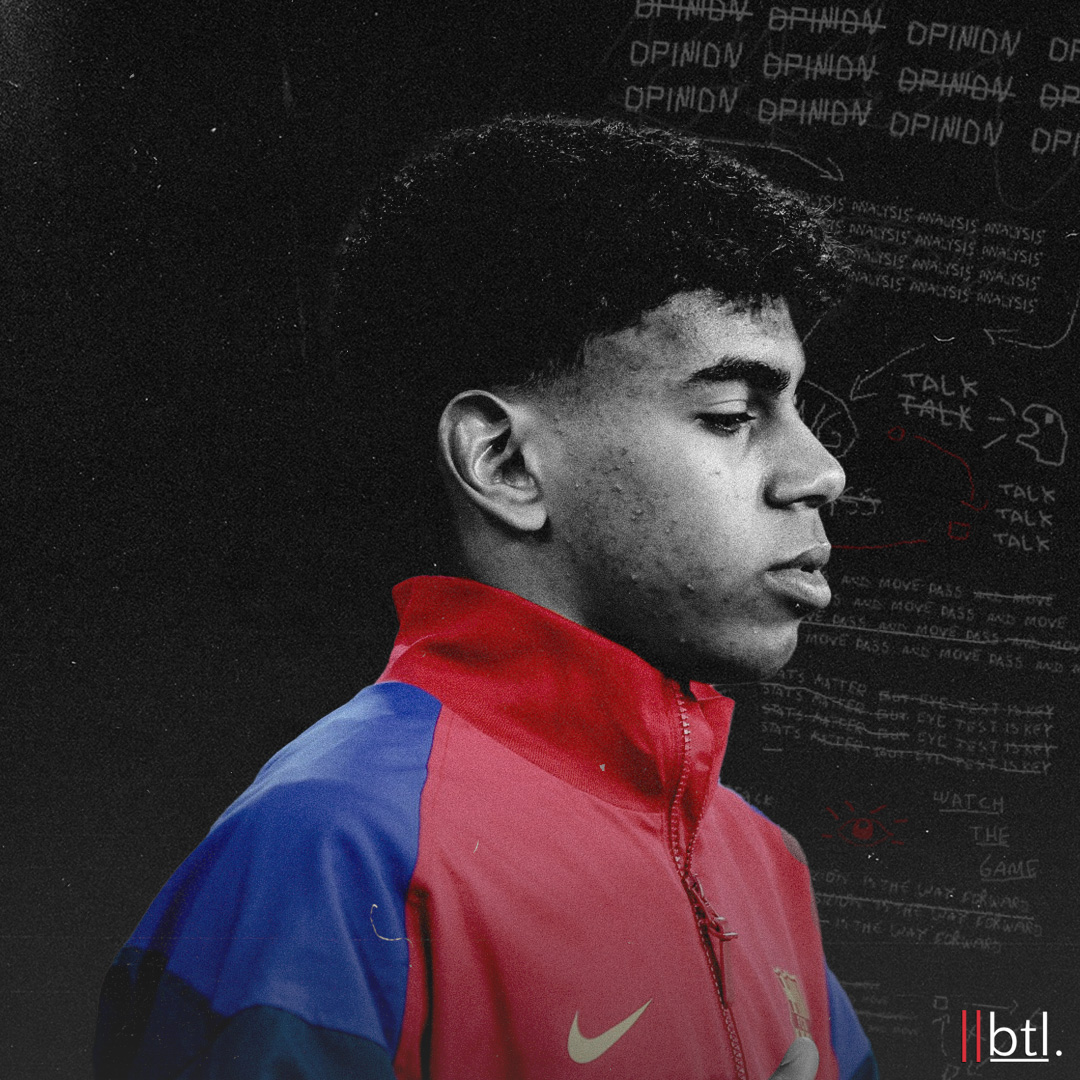
The Boy Who Skipped the Development Curve
There is a concept in ancient Stoic philosophy called Amor Fati. Love of fate. The idea that a person of true character does not merely tolerate what the world throws at them. They do not grit their teeth and endure it. They embrace it. They walk toward the fire and find it warm. Marcus Aurelius wrote about it. Friedrich Nietzsche built an entire philosophy around it. And for centuries, it remained the exclusive property of emperors and philosophers and men who had survived things that would have destroyed anyone else.
Then Lamine Yamal received the ball twenty-five yards from goal in the semifinal of Euro 2024, with the weight of an entire nation on his back, on the eve of his seventeenth birthday, against the best defensive structure France had built in a generation, and bent the ball into the far corner with the outside of his left foot as if the occasion had personally asked him to do something beautiful and he had simply obliged.
The stadium did not react immediately. There was a silence first. The particular silence of forty thousand people encountering something their eyes have shown them and their brains have not yet accepted. And in that silence, before the noise arrived like a wave breaking, you could see it clearly if you were watching closely enough.
He was not celebrating. Not yet. He was watching the ball. Watching it curl. Watching it go where he had already decided it would go. His face was not the face of someone who had just done something extraordinary. It was the face of someone confirming something they already knew. That face. That specific expression. That is where this story begins.
Joan Garcia is the transformational signing Barcelona desperately needed
Because the number of eighteen-year-olds in the history of football who have worn that face in that moment, in a tournament semifinal, against France, with Spain level and the game in the balance, can be counted on one hand. Not because the talent is so rare, though it is. But because the mind is. The talent is visible.
You can measure it, analyse it, place it in a database and compare it to every wide attacker in Europe. But the mind that produces that face in that moment — calm, confirming, almost indifferent to the scale of what has just happened — that is not in any database. That is something older and stranger and considerably more frightening than statistics.
Lamine Yamal, at eighteen, is not the next Messi. He is the first player of his kind in a very long time to arrive with both halves fully formed at once: the technique that makes analysts reach for their notebooks and the mentality that makes philosophers reach for theirs.
The Architecture of the Unbreakable
To understand what psychological invincibility actually means in a football player, it helps to understand what it is not. It is not confidence, which is fragile and dependent on form and circumstance. It is not arrogance, which is a performance, a mask worn to convince others and occasionally the self. It is not fearlessness, because fearlessness implies the absence of something that should be present.
What Yamal has is something closer to what psychologists call equanimity under pressure. The state where the weight of a moment does not alter the quality of a decision. Where the magnitude of the stage does not change the speed of thought or the precision of execution. Where the brain, which in most people floods with cortisol at the exact moment clarity is most needed, simply continues to operate as it does in training. As it does on a quiet afternoon when nobody is watching and nothing is at stake.
This is extraordinarily rare. Studies on performance under pressure, particularly the research of sports psychologist Sian Beilock on the phenomenon of choking, show that the overwhelming majority of athletes perform worse when the stakes are highest. Not because they lack ability. Because the brain, under extreme pressure, starts to monitor its own processes too closely. Thinking about the technique interrupts the technique. Awareness of the moment disrupts the performance of the moment. The very size of the occasion becomes the obstacle.
Yamal appears immune to this. Not partially immune. Not mostly immune. He appears to be, at eighteen, operating in high-stakes environments with the same cognitive fluidity he brings to a league match that means nothing beyond three points. The France goal was not the exception. It was the proof. The data of an entire season backs it up.
Across La Liga and the Champions League in 2024-25, Yamal produces 0.68 assists per 90, an expected assisted goals figure of 0.44, 2.85 key passes per 90, and a goal-creating action rate of 1.1 per 90. These are not the numbers of a player who finds his level only in comfortable circumstances. They are sustained, consistent, cross-competition numbers produced against the full range of defensive preparation that elite European football can offer.
More Than a Club, More Than a Game: FC Barcelona, Kurdistan, and the Hope League
Every team in La Liga has months of footage on him. Every Champions League opponent has spent the week before their match building a specific plan for his specific tendencies. And he produces those numbers anyway. Not despite the attention. Almost because of it.
There is a concept in performance psychology called pressure inoculation. The idea that repeated exposure to high-stakes environments, when managed correctly, builds a kind of immunity to the psychological noise those environments generate. The pressure becomes familiar. The familiar becomes manageable.
Most players acquire this immunity gradually, over years of experience, of failure and recovery, of learning what the big occasion feels like from the inside. Yamal arrived with it already installed. Which raises a question that nobody in football has fully answered yet: what do you do with a player who is already pressure-inoculated at eighteen?
The Boy Who Arrived Already Finished
The goal against France was not a fluke, and it was not the only evidence. It was a summation. Earlier that season for Barcelona, he scored against Atlético Madrid with a first-time finish inside the penalty area that required him to control a difficult ball, assess the goalkeeper’s position, and place the shot, all in less than a second, under pressure from two defenders closing from different angles.
Most professional footballers, good ones, simply do not have the processing speed to run those three assessments simultaneously and arrive at the correct answer. Yamal ran them and made them look like a single, unhurried thought. Then there was the goal against Valencia, where he received on the right side, took two touches to engineer the angle that the situation required, and curled the shot into the top corner with the outside of his left foot.
Not the inside, where the natural curve assists you. The outside. As if the more difficult option was simply the more accurate one and accuracy was all that mattered. These are not the goals of a prospect feeling his way into the highest level. They are the goals of a player who has already established, at eighteen, a complete and settled relationship with the ball. Who knows what his body will do before it does it. Who has closed the gap between intention and execution so thoroughly that the two things feel like one.
Watch Yamal receive the ball and you will notice something that takes a moment to identify because it sits so far outside the normal vocabulary of wide attacking play. His body is open. Not angled toward goal, not leaning into the direction he intends to travel, not giving the defender any of the small physical signals that the human brain processes unconsciously to anticipate movement. His shoulders are square. His posture is almost relaxed. He looks, genuinely, like a person who has nowhere particular to be.
It is a lie. One of the most devastatingly precise lies in European football. That open body position does two things at once. First, it gives Yamal a panoramic view of the pitch that most wide attackers simply do not have at the moment of reception. While a conventionally-positioned winger can see the space immediately ahead and one or two nearby options, Yamal, in his open stance, can see the full width, the defensive shape, the runs developing thirty yards away, and the second and third options that exist beyond the first.
Marc Casado: The Latest La Masia Gem Making a Name for Himself at Barcelona
This is why his key passes average 2.85 per 90, which places him among the highest of any wide attacker in Europe this season. He is not finding the first option. He is seeing the fourth option before most players have processed the first. Second, and more importantly, that open body makes his direction of travel completely unreadable until it is too late to respond.
When Messi received the ball, his body angle usually telegraphed at least the general direction of his intent. Defenders had a starting point. A probability to defend against. With Yamal open-bodied, there is no starting point. He can go inside or outside. He can play the through ball or turn and recycle. The decision is made in a fraction of a second by a brain that has already seen the whole picture, and the defender, who has been watching a body that promised nothing, has no head start on the reaction.
His miscontrols across the season sit at around 1.0 per 90, consistent with Dembélé and Saka, unremarkable on the surface. But the number does not capture what happens in the moment before the miscontrol does not occur. Yamal’s first touch does not simply control the ball.
It moves the ball into the precise position that makes his next action hardest to defend. It is not a touch to safety. It is a touch to advantage. The ball arrives and in the same movement that brings it under control, he has already created a geometry that did not exist a second ago.
At eighteen. Against defenders who have studied him for months. Against teams whose entire defensive structure for the week has been built around this exact problem. He produces those numbers anyway.
The Company He Keeps. And Leads.
Messi is one benchmark. But to understand the true scale of what Yamal represents, you have to place him against the best wide attackers alive right now. Not teenagers. Not prospects. The finished, elite, world-class attackers who have won things and terrorised defences for years and earned every piece of their reputation.
Start with Vinícius Jr., the reigning Ballon d’Or winner and the player Real Madrid built their entire attacking architecture around. Vinícius is a phenomenon in the truest sense. A player whose pace and directness in behind make him genuinely unmanageable on his best nights.
The Brazilian forward’s progressive carries average 6.5 per 90. His carries into the final third sit at 4.75. His dribble success rate hovers around 57.5%. He runs at defenders the way a storm runs at a coastline, with the absolute conviction that the coastline will give first. But in chance creation, in the art of making things happen for teammates rather than himself, Vinícius falls behind Yamal in ways that are hard to overlook.
Vinícius’ assists average 0.28 per 90. His xAG sits at 0.28. His key passes run at 1.9 per 90. His GCA at 0.9. These are the numbers of a brilliant goalscorer and runner who wins games with his finishing and his movement. They are not the numbers of a player who controls the creative output of an attack. Yamal, at eighteen, is both things simultaneously.
Ousmane Dembélé at PSG has been one of the most dangerous wide attackers in European football this season and his profile is worth describing carefully because it represents something genuinely different to what Yamal does. Dembélé dribbles as if the rules of geometry were invented specifically for his inconvenience. His body feints are violent and sudden.
Yamal’s changes of direction arrive without warning, a sharp cut inside followed immediately by a cut outside followed by something else entirely, each touch landing fractionally differently than the last, each one forcing the defender to make a new decision before they have finished processing the previous one.
His GCA of 1.3 per 90 is the highest in this comparison. His key passes at 3.05 per 90 edge Yamal’s. His progressive carries at 6.5 per 90 reflect his extraordinary willingness to take defenders on anywhere on the pitch. He loses the ball more often than Yamal, with a dispossession rate of 1.15 per 90, but the damage he does when he keeps it justifies the risk entirely.
Raphinha: Challenging the Stereotypes of Brazilian Wingers at Barcelona
Dembélé is 27 years old, at peak physical maturity, in a PSG side constructed specifically around his strengths, in a league that provides more space and less defensive intensity than La Liga. The fact that Yamal at eighteen is within touching distance of him across most metrics, and ahead of him in assists per 90, is not a compliment designed to flatter. It is simply what the numbers say.
Khvicha Kvaratskhelia plays football with a specific kind of arrogance that belongs to players who have decided, at a fundamental level, that being stopped is not a realistic outcome. The Georgian winger invites contact. He dribbles directly at defenders, in their own half, in tight channels, in situations where the sensible option is clearly to play it simple, and then makes them regret the engagement.
The PSG forward’s progressive carries at 4.75 per 90 and key passes at 2.15 reflect a player who is slightly more conservative in volume than Dembélé or Vinícius but whose GCA of 1.0 and xAG of 0.33 confirm genuine elite-level creative output. His assists of 0.18 per 90 suggest that his teammates do not always convert the chances he creates, which is a distinction worth noting: the quality of the creation and the quality of the statistical reward are not always the same thing.
Bradley Barcola is the most physically dominant wide attacker in this comparison, a player whose defining quality is pace deployed with intelligence rather than simply aggression. Alongside Dembélé and Kvaratskhelia at PSG, he has developed a specific and lethal role: the runner who attacks the space behind the defensive line in the precise moment before it closes.
Barcola’s carries into the penalty area average 2.25 per 90. His progressive carries sit at 5.5. His GCA of 1.1 and assists of 0.38 reflect a player who converts his physical advantages into actual outcomes, which is rarer than it sounds.
Michael Olise at Bayern Munich might be the most quietly devastating player in this entire group. His assists of 0.58 per 90 are the second highest here, behind only Yamal. His xAG of 0.53 is the highest of anyone in the comparison, including Yamal. His GCA of 1.3 matches Dembélé for the top position.
Olise’s key passes of 2.6 per 90 reflect a player who creates with genuine, sustained consistency. Olise is proof that the elite wide attacker in modern football is increasingly a hybrid creature, part carrier, part creator, part finisher, and he embodies that hybrid more completely than almost anyone in Europe right now.
Then there is Kenan Yıldız, the youngest player here besides Yamal, and the one whose profile is most useful as a point of contrast rather than comparison. Yıldız has a left foot that belongs to a different era, the kind of technique that makes the ball look grateful to be touched by it. His sense of the game suggests an intelligence that will only deepen with time.
But his numbers, assists at 0.15, xAG at 0.18, key passes at 1.9, GCA at 0.9, progressive carries at 4.25, are those of a gifted young player still developing his relationship with elite-level football. He is a genuine prospect. He is also operating in a different statistical universe to Yamal, which is not a criticism of Yıldız. It is simply the clearest possible illustration of how extraordinary Yamal’s output actually is.
Look at this entire group and understand what they represent. These are not ordinary footballers. These are the elite wide attackers of the current generation of European football. Vinícius has a Ballon d’Or. Dembélé has a Champions League. Kvaratskhelia dismantled Serie A for two years before PSG came calling. Saka has been one of the Premier League’s most consistent attackers for three consecutive seasons. All of them have earned their place in this conversation over years of high-level performance.
Yamal leads the group in assists per 90. He matches the best for GCA. He is among the top for key passes and SCA. His carries into the final third at 4.25 per 90 place him in the upper half of the comparison. His ball security is among the cleanest in the group.
He is eighteen years old. This is not potential. This is not projection. This is current, active, this-season output against defences that have months of footage and specific tactical preparation designed to neutralise exactly what he does. And he produces those numbers anyway.
From the Ashes of Annihilation: Hansi Flick and the Rebirth of Barcelona’s Footballing Soul
What Eighteen Actually Means
Consider the attack Yamal leads and the company he keeps inside it. Robert Lewandowski, who is 37 years old and one of the greatest pure goal scorers the game has ever produced, has spent two decades winning things in virtually every major stadium in European football.
His career is the kind that gets written about in the past tense even while it is still happening. Raphinha, at 28, has completely reinvented himself at Barcelona and is in the form of his life, a Brazilian international who has become one of the most complete and dangerous wide attackers in La Liga this season.
Around them: Pedri, the Spanish midfielder who bends time. Fermín López, one of the most dynamic young midfielders in Europe. Dani Olmo, a Spanish international with the technical range to play anywhere across the attacking line. Pau Cubarsí, nineteen years old and already one of the most composed and authoritative defenders on the continent.
Alejandro Balde, the left back who attacks like a winger and defends like he genuinely enjoys the confrontation. João Cancelo, a full back producing the creative output of an attacking midfielder.
This is not a team built around an eighteen-year-old. This is one of the deepest, most technically gifted squads in European football, assembled across years, full of players who have earned every piece of their reputation through sustained performance at the highest level.
And yet. When Barcelona need someone to make something happen, when the game is tight and the opposition is organised and the moment demands a player who will not feel the weight of it, the ball finds Yamal. Not because the system demands it. Because the situation does. Because there is something in him that the moment recognises and trusts above everyone else in that squad, including the 37-year-old legend and the Brazilian in the form of his life.
Messi at eighteen was already extraordinary, already producing flashes that made Barcelona fans suspend their disbelief. But his estimated numbers at that age, around 0.30 assists per 90, 0.28 xAG, 2.25 SCA, were those of a spectacular teenager finding his footing at the highest level. The development curve from that teenager to the player who would eventually win ten Ballon d’Ors was long and steep and it required everything. It required Pep Guardiola. It required a specific system. It required years.
Yamal is already at the destination. The curve that took Lionel Messi years appears, in Yamal’s case, to have been compressed into a timeline that does not match any existing model. And unlike Messi, whose genius was always partly in the physical, in the low centre of gravity and the feet that moved faster than defenders could follow, Yamal’s genius is substantially cognitive. It is in how he sees and reads and processes and decides. Cognitive gifts, unlike physical ones, do not diminish with age. They compound.
The Standard Messi Set and Why It Still Stands.
None of this diminishes Messi. Let that be absolutely clear, because this piece will be misread if it is not. What Messi did across fifteen years of sustained, unparalleled brilliance exists in a category that no number of extraordinary eighteen-year-olds can threaten. Messi was not just great in his output. He was great in his consistency, in his ability to produce at that level season after season, year after year, against teams that made stopping him their life’s work and still failed.
That is a career. Not a season. Not a set of statistics produced over eight months. The standard Messi set is not one that anyone is going to casually surpass. It requires not just the talent, which Yamal clearly possesses, but the sustained will, the physical resilience, the psychological endurance across decades of the highest conceivable pressure.
But here is the thing. Messi at his peak was unstoppable. His feet moved at a frequency the human eye genuinely struggled to track. He ran with the ball almost glued to the ground, his centre of gravity so low that defenders who committed to tackles found themselves grabbing at air.
You could foul him, and he would absorb the contact and keep moving as if the foul had been a mild suggestion he had chosen to decline. He was a physical phenomenon as much as a technical one. And eventually, with enough study, defenders developed partial answers. Not solutions. Never solutions. But frameworks. Distances to keep. Angles to force him toward. Triggers to watch for.
Messi’s game said: try to stop me. Yamal’s game says something different. It says: try to read me. And that is a problem with no framework yet. Because the reading requires knowing what his body is going to do before it does it, and his body refuses to tell you.
The open stance that hides his intention. The deceleration that arrives exactly when defenders expect acceleration. The first touch that creates the problem instead of solving it. There is no trigger to watch for. There is no angle to force him toward. There is no partial answer because the question keeps changing.
When you fold Yamal into Messi’s story as a successor or an heir, you are doing both players a disservice. You are suggesting that greatness only comes in one shape, that the game only produces one kind of genius, that the highest compliment a new player can receive is resemblance to an old one.
Messi was unique. The word means one of a kind. There cannot, by definition, be a next one. Yamal is unique in his own right. Different mechanisms. Different genius. Equally, perhaps more frighteningly, unrepeatable.
Robert Lewandowski: Reunited With Flick and Back to his Best
The First Yamal
On the evening of 9 July 2024, in the Allianz Arena in Munich, a boy who was hours away from his seventeenth birthday stood over the ball in the semifinal of a European Championship and bent it into the far corner. The occasion was enormous.
The pressure was total. France were in front of him. An entire country was behind him. And he produced the curl, the arc, the silence before the noise, with the same face he wears when he does it in a Tuesday night league match that means nothing beyond three points. That face. Not celebration. Not relief. Not disbelief. Confirmation.
He is eighteen now. He has not changed. If anything, the occasions have grown and the face has remained exactly the same, which is perhaps the most unsettling thing about him. Pressure, for most people, accumulates. It builds. It bends. It eventually breaks something. For Yamal it appears to do none of these things. It arrives, he acknowledges it briefly, and then he plays football.
The Stoics believed that a person reveals their true character not in comfort but in the moments that demand everything. Marcus Aurelius wrote his most honest thoughts in the middle of a plague and a war, not in the palace. Nietzsche said that what does not kill you makes you stronger, which is only true of people built a specific way, people who metabolise difficulty rather than accumulate it. Yamal appears to be built that specific way. He metabolises the moment. He does not carry it.
Alejandro Baldé – Do Barcelona Have Jordi Alba’s Replacement at Home?
He is leading one of the most technically gifted squads in European football at eighteen years old. He is producing creative numbers that match or exceed every elite wide attacker on the continent. He is doing it inside a competition, La Liga and the Champions League, where every opponent has spent weeks building a specific cage designed to contain him, and he is walking out of the cage each time as if the cage was always the wrong shape for him anyway.
There is a specific kind of player the game produces once in a very long while. Not the generational talent, because that phrase has been cheapened by repetition. But the player who makes you feel that something genuinely new is happening in front of you. Not better. Not faster. Not a refinement of an existing blueprint. Something that requires new language, new frameworks, new ways of seeing to fully hold.
Yamal is that player. And the thing that makes him most extraordinary is not the technique or the vision or the dribbling, though all three are already elite. It is the mind behind all of it. The mind that produced that face in Munich. The mind that has not flinched once, not in a league match, not in a Champions League knockout, not in a tournament semifinal on the eve of his birthday, since the moment he arrived.
Ask yourself what he becomes when the body catches up fully with everything the mind already is. Ask yourself what the finished version of a player who arrived already half-finished looks like. Then look at that face one more time. The one from Munich. The one that was not celebrating. The one that was simply confirming. He already knew. That is the part that should frighten you. He is not the next Messi. He never was. He is the first Yamal, and the game is still learning what that sentence means.
By: Shawal Hossain / @itadorinotyuji
Featured Image: @GabFoligno / NurPhoto